
Catalogue Search | MBRL


Are you sure you want to remove the book from the shelf?

{{itemTitle}}
6,010
result(s) for
"ART / Conceptual."
Sort by:

Almost nothing
This book proposes a new reading of contemporary art between 1958 and 2009 by sketching out a trajectory of ‘precarious’ art practices. Such practices risk being dismissed as ‘almost nothing’ because they look like trash about to be thrown out, because they present objects and events that are so commonplace as to be confused with our ordinary surroundings, or because they are fleeting gestures that vanish into the fabric of everyday life. What is the status of such fragile, nearly invisible, artworks? In what ways do they engage with the precarious modes of existence that have emerged and evolved in the socio-economic context of an increasingly globalised capitalism?Works discussed in this study range from Allan Kaprow’s assemblages and happenings, Fluxus event scores and Hélio Oiticica’s wearable Parangolé capes in the 1960s, to Thomas Hirschhorn’s sprawling environments and participatory projects, Francis Alÿs’s filmed performances and Gabriel Orozco’s objects and photographs in the 1990s. Significant similarities among these different practices will be drawn out, while crucial shifts will be outlined in the evolution of this trajectory from the early 1960s to the turn of the twenty-first century.This book will give students and amateurs of contemporary art and culture new insights into the radical specificities of these practices, by situating them within an original set of historical and critical issues. In particular, this study addresses essential questions such as the art object’s ‘dematerialisation’, relations between art and everyday life, including the three fields of work, labour and action first outlined by Hannah Arendt in 1958.
eBook

Automotive Prosthetic
In the twenty-first century, we are continually confronted with the existential side of technology—the relationships between identity and the mechanizations that have become extensions of the self. Focusing on one of humanity’s most ubiquitous machines, Automotive Prosthetic: Technological Mediation and the Car in Conceptual Art combines critical theory and new media theory to form the first philosophical analysis of the car within works of conceptual art. These works are broadly defined to encompass a wide range of creative expressions, particularly in car-based conceptual art by both older, established artists and younger, emerging artists, including Ed Ruscha, Martha Rosler, Richard Prince, Sylvie Fleury, Yael Bartana, Jeremy Deller, and Jonathan Schipper. At its core, the book offers an alternative formation of conceptual art understood according to technology, the body moving through space, and what art historian, curator, and artist Jack Burnham calls “relations.\" This thought-provoking study illuminates the ways in which the automobile becomes a naturalized extension of the human body, incarnating new forms of “car art\" and spurring a technological reframing of conceptual art. Steeped in a sophisticated take on the image and semiotics of the car, the chapters probe the politics of materialism as well as high/low debates about taste, culture, and art. The result is a highly innovative approach to contemporary intersections of art and technology.
eBook

Transition in Post-Soviet Art
The artistic tradition that emerged as a form of cultural resistance in the 1970s changed during the transition from socialism to capitalism. This volume presents the evolution of the Moscow-based conceptual artist group called Collective Actions, proposing it as a case-study for understanding the transformations that took place in Eastern European art after the fall of the Berlin Wall. Esanu introduces Moscow Conceptualism by performing a close examination of the Collective Actions group's ten-volume publication Journeys Outside the City and of the Dictionary of Moscow Conceptualism. He analyzes above all the evolution of Collective Actions through ten consecutive phases, discussing changes that occur in each new volume of the Journeys. Compares the part of the Journeys produced in the Soviet period with those volumes assembled after the dissolution of the USSR. The concept of transition and the activities of Soros Centers for Contemporary Art are also analyzed.
eBook

No innocent bystanders : performance art and audience
The changing role of the spectator in contemporary performance art
At a moment when performance art and performance generally are at the center of the international art world, Frazer Ward offers us insightful readings of major performance pieces by the likes of Acconci, Burden, Abramović, and Hsieh, and confronts the twisting and troubled relationship that performance art has had with the spectator and the public sphere. Ward contends that the ethical challenges with which performance art confronts its viewers speak to the reimagining of the audience, in terms that suggest the collapse of notions like “public” and “community.”
A thoughtful, even urgent discussion of the relationship between art and the audience that will appeal to a broad range of art historians, artists, and others interested in constructions of the public sphere.
eBook

Not Only a Matter of Electricity–Rethinking Materiality with Victor Grippo’s Energía de una papa (1972)
In order to consider the materiality of Victor Grippo’s artwork Energía de una papa (1972) more comprehensively than has thus far been the case, the specific characteristics of this case study are initially discussed against the background of the relationship between materiality and conceptual art. In a further step, the artwork’s agency is questioned, and it is regarded in the context of positions within new materialism. This is done by utilizing certain aspects of Karen Barad’s concept of “agential realism” in an examination of Grippo’s artwork. Our thesis is that while the Baradian approach is able to explain materiality within the functioning of the case study, the complex embedding of materiality and symbolic factors for the context of the art require an even broader perspective. Finally, the different layers of materiality—the material presence and the immaterial, less tangible aspects—are considered together in order to show their indispensable entanglement in generating the artwork’s meaning. It is not just the potato as food-as-art-material or the voltameter as a ready-made that must be our focus, but all the organic, non-human materials and the non-tangible elements involved in the artistic work, as well as the human being who sets the process in motion.
Journal Article

Theory of the Art Object
Meaning in the visual arts centers on how the physical work makes its content or presence visible. The art object is fundamental. Indeed, the different object forms of each visual medium allows our experience of space-time, and our relations to other people, to be aesthetically embodied in unique ways. Through these embodiments, visual art compensates for what is otherwise existentially lost, and becomes part of what makes life worth living. The present book shows this by discussing a range of visual art forms, namely pictorial representation, abstraction, sculpture and assemblage works, land art, architecture, photography, and varieties of digital art.
eBook

Conceptual Photo Books: Photo-Imago as a Trace of the Geist Miško Šuvaković, Dubravka Đurić
In the essay, we will deal with the models of the photo book of artists in conceptual art 1966–80. A short sketch of the international history of photo books in conceptual art will be presented, ranging from the examples of American, British, Croatian, and Serbian authors, etc. We will point out to the two levels of discussion: (1) the essential morphological properties of the book, artistic books and photo book in conceptual art – the transformation of static photographic image into a series of sequences and a series of sequences into mental representation; and (2) typology of characteristic models of photo books in conceptual art (book-project, artist's book as a first-person speech, tautological articulation of a series of photographs, analytical reflection between image and text, documentary book etc.). We will also discuss photo books in conceptual art in relation to models: phototautology, photodocuments, photoperformance, photoselfreflectivity, photoarchive, photo-remediation, photosemiology, photoshifter, photoconceptual text, phototravellers, photo-construction-of-the-every-day-life, phototranscultural narration, photoexistence, photopolitization and photo-simulation. Article received: April 23, 2022; Article accepted: June 21, 2022; Published online: September 15, 2022; Original scholarly paper
Journal Article
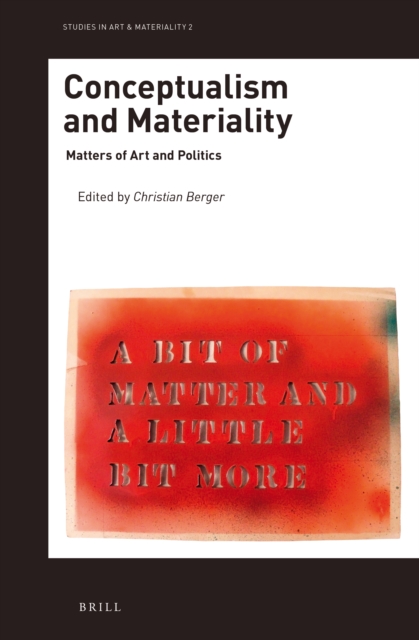
Conceptualism and Materiality
Conceptualism and Materiality. Matters of Art and Politics underscores the significance of materials and materiality within Conceptual art and conceptualism more broadly. It challenges the notion of conceptualism as an idea-centered, anti-materialist enterprise, and highlights the political implications thereof.
eBook

On, In, and Within a Place
Abstract This article examines six modes of operation on, in, and within a place in Israeli conceptual art and landscape architecture. These modes—action-in-place; intervention; place-making; representation; readymade; and second-nature—maintain landscape architecture's conception of a genius loci, the spirit of the place. They also attend to place as a new and critical means of operation in the 1970s emerging field of conceptual art. This article explores diverse attitudes and motivations for operating with/in place, as it became a fundamental issue in the international arena in the 1970s, in relation to Israeli cultural, political, social, and environmental concerns. In the context of the period's sociopolitical turmoil and ideological controversy, the article's two focal points—the six-mode perspective and the disciplines’ attitude toward place—complement each other and attend to the manifold aspects of place (ha-Makom) in Israel, while highlighting its intricacy.
Journal Article

French Phenomenology of Art and Metaphysics
This article examines the relationship between French phenomenology of art and metaphysics. More specifically, it highlights four points. Firstly, French phenomenological aesthetics is characterized by a certain ignorance of the renewal of artistic questioning initiated by Anglo-Saxon aesthetics. Secondly, French phenomenology of art is a metaphysics of art, which considers that works of art contain an ontological (cosmophanic or theophanic) revelation. Thirdly, French phenomenology of art is part of the “theological turn of French phenomenology”. Authors tend towards theology or “cosmotheology”. Fourthly, French phenomenology of art, which is a metaphysics of the sensible, possesses the theoretical means to think philosophically about conceptual art.
Journal Article