
Catalogue Search | MBRL


Are you sure you want to remove the book from the shelf?

{{itemTitle}}
3,051
result(s) for
"ART / Forgeries"
Sort by:

A real van gogh
Vincent van Gogh’s paintings and drawings are fabulously expensive. Millions of people admire his work, but are those masterpieces all genuine? To this day, the international art world struggles to separate the real Van Goghs from the fake ones, and the key question addressed in this book is what may happen to art experts when they publicly voice their opinions on a particular Van Gogh (or not). The story starts with art expert J.B. de la Faille who discovered to his own bewilderment that he had included dozens of fake Van Goghs in his 1928 catalogue raisonné. He wanted to set the record straight, but met with strong resistance from art dealers, collectors, critics, politicians and others, marking the beginning of a fierce clash of interests that had seized the art world for many decades of the twentieth century.
eBook

Italian Forgers
Italian Forgers takes an
unorthodox approach to the fascinating topic of art forgery,
focusing not on art forgery per se, but on the major forgery
scandals that shifted the Italian art market in response to
constant, and often intense, demand for Italian objects.
By focusing on power dynamics that both precipitated forgery
scandals and forged Italian cultural identities, this book connects
the debates and discussions about three well-known Italian
forgers-Giovanni Bastianini, Icilio Joni, and Alceo Dossena-to
anchor and investigate the mechanics of the Italian art market from
unification through the fascist era.
Carol Helstosky examines foreign accounts of transactions and
Italian writings about the art market. The actions and words of
Italian dealers illustrate how the Italian art and antiquities
market was an undeniably modern industry, on par with tourism in
terms of its contribution to the Italian economy and to
understandings of Italian identity. These accounts also reveal how
dealers, artists, go-betweens, guides, and restorers worked to not
only meet the intense demand for Italian products but also to
develop highly sophisticated business practices to maintain
financial stability and respond to shifts in demand consciously
(but not always conscientiously).
Italian Forgers weaves a compelling narrative about the
history of Italian identity, forgery, and the value of the past. As
a result, Helstosky brings historical perspective to the study of
art forgery and art fraud. She reveals how historical circumstances
and structural imbalances of cultural power shaped the market for
art and antiquities and amplified incidents of art deception and
forgery scandals.
eBook

Scientific Investigation of Copies, Fakes and Forgeries
The faking and forgery of works of art and antiquities is probably now more extensive than ever before. The frauds are aided by new technologies, from ink jet printers to epoxy resins, and driven by the astronomic prices realised on the global market. This book aims to provide a comprehensive survey of the subject over a wide range of materials, emphasising how the fakes and forgeries are produced and how they may be detected by technical and scientific examination. The subject is exemplified by numerous case studies, some turning out not to be as conclusive as is sometimes believed. The book is aimed at those likely to have a serious interest in these investigations, be they curator, collector, conservator or scientist. Paul Craddock has recently retired from the Department of Conservation, Documentation and Science at the British Museum, where he was a materials scientist.
eBook

When Art isn't Real
How an initially valueless object becomes worth hundreds
of millions. And vice versa. The art world is a
multi-billion-dollar industry which captures world headlines on a
regular basis, for both good and bad reasons. This book deals with
one of the most-discussed areas of controversy: high-profile
objects that have experts arguing about their veracity. Some may
have been looted, others may be fakes, some may be heavily restored
or misattributed. Often, in these cases, analytical science is
called on to settle a dispute. The authors of this book have
decades of experience in this field, working on a range of objects
dating from prehistory to the twentieth century. They present seven
of the most famous cases from the Getty Kouros to the Turin Shroud
- some of which are still contested, and examine how a few words
from a connoisseur or scientist can make a virtually valueless
object worth hundreds of millions. And vice versa.
eBook

Criminal Liability for Forgery of Print in Polish Legislation
This paper aims to outline relevant legal problems of domestic legislation in aspects such as evidence difficulties, the so-called legalisation of forgery, and choosing the legal qualification of forgery of print. The doctrine for many years has postulated (and still does) the increase of protection of works of art from crimes such as forgery would increase the safety and fair trade on the art market. However, legislators tend to omit this problem. So, the other possible acts are: the Polish Criminal Code, Act of 23 of July 2003 on the Protection and Guardianship of Monuments, and Act of 16 of April 1993 on Fair Trade. Each of these acts are analysed in the context of its evidential requirements to find the most useful one. The choice of a legal action depends on whether the work of art (print) is considered a monument as in the definition included in the Act on the Protection and Guardianship of Monuments. We then compared our results with cases prosecuted in Poland.
Journal Article
Whiteley on Trial
It was a cause célèbre: the biggest case of alleged art fraud to come before the Australian criminal justice system, a 4.5 million sting drawing in one of the country's most gifted and ultimately tragic artists, Brett Whiteley, a heroin addict who died alone in 1992. It started with suspicions raised about artworks being produced in the style of Whiteley in a Melbourne art restorer's studio. Secret photographs were taken as the paintings took form. A jury finds two men guilty of faking Whiteleys, but a year later the appeal bench sensationally acquits them. The paintings are returned to their owners, leaving the legitimacy of the artworks in limbo. Whiteley on Trial investigates this remarkable case and exposes the avarice of the art world, the disdain for connoisseurship and the fragility of authenticity.
eBook
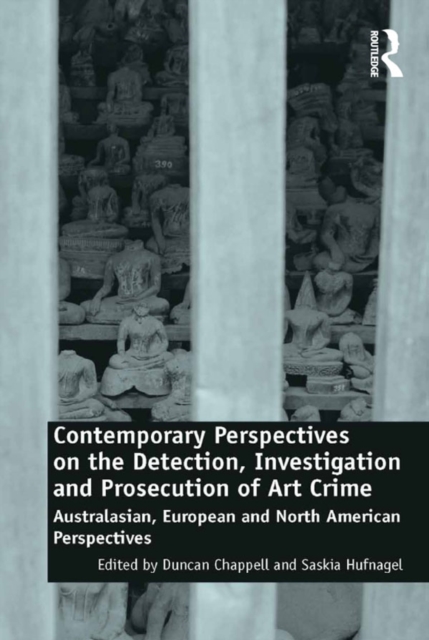
Contemporary Perspectives on the Detection, Investigation and Prosecution of Art Crime
In the world of law enforcement art and antiquity crime has in the past usually assumed a place of low interest and priority. That situation has now slowly begun to change on both the local and international level as criminals, encouraged in part by the record sums now being paid for art treasures, are now seeking to exploit the art market more systematically by means of theft, fraud and looting. In this collection academics and practitioners from Australasia, Europe and North America combine to examine the challenges presented to the criminal justice system by these developments. Best practice methods of detecting, investigating, prosecuting and preventing such crimes are explored. This book will be of interest and use to academics and practitioners alike in the areas of law, crime and justice.
eBook

Art forgery
Art Forgery charts the changing status of art forgery from the time of its appearance in the Renaissance, when it was initially hailed as a true artistic feat, to its condemnation in modern times. Lenain describes the genealogy of faking and the anxious, sometimes neurotic, reactions that these clever frauds trigger.
eBook

Art and Race: The Strange Case of Eddie Burrup
Elizabeth Durack, a white Australian artist, produced an extended series of paintings in Aboriginal style that she promoted as being done by Eddie Burrup, a fictitious persona she devised. Upon admitting the subterfuge, she was strongly criticized, but she never apologized, justifying her action through her extensive contact with Aboriginal people and their art. This article examines the reaction against Durack in light of postcolonial perspectives on the forgery of Indigenous artworks, and relates the discussion to the larger context of the phenomenon of “passing” as a person of color.
Journal Article

The expert versus the object : judging fakes and false attributions in the visual arts
The authenticity of visual art has always commanded the attention of experts, dealers, collectors, and the art-minded public. Is it \"real\" or \"original\" is a way of asking what am I buying? What do I own? What am I looking at? And today more sophisticated questions are being asked: How is authenticity determined and what weight does this determination have in court? This book of essays proposes to answer those questions. Three lines of inquiry are basic to determining authenticity: a connoisseur’s evaluation, historical documentation or provenance, and scientific testing. A connoisseur is an expert who evaluates the \"rightness\" of a work based on much careful scrutiny of many works by an artist and familiarity with that artist’s usual manner of working with materials. In determining provenance, a researcher traces the physical object from the artist through a chain of ownership to the present owner--simple enough in concept, though it assumes that the documentation is not faked or inaccurate. The goal is to ensure that the object is the same one that left the artist’s hand. Scientific testing, although sometimes useful, is often longer on promise than result. Dating paint or wood samples, for instance, can show that a painting was made in Rembrandt’s lifetime, but it cannot prove that it is by Rembrandt’s hand. If expert opinion is divided, and large sums of money are involved, a dispute over authenticity may end up in a court of law, where evaluation of expert opinion evidence can be problematic. The essays in this book clarify the nature of the methods outlined above and explain, based on case law, the present status of authentication issues in court. Contributors include experts from Christie’s, London; Sotheby’s, New York; and the former director of the Frick Collection; as well as leading art historians and art dealers; an art conservator; a forensic graphologist; a philanthropist and collector; and a specialist in French art law. Their collective knowledge on issues of authenticity will be invaluable for anyone interested in the world of visual art.
eBook