
Catalogue Search | MBRL


Are you sure you want to remove the book from the shelf?

{{itemTitle}}
13
result(s) for
"Abbott v. Burke"
Sort by:

Under the Law: Expanding access to preK and the legacy of Abbott v. Burke
In the 1998 Abbott v. Burke decision, New Jersey’s highest court because the first in the nation to require access to high-quality preK education for three- and four-year olds as part of their constitutional right to K-12 public education. Robert Kim describes the legal landscape in New Jersey leading up to the decision and discusses the legacy of Abbott in New Jersey and its possible national influence.
Journal Article

Interest Groups, the Courts, and Educational Equality: A Policy Regimes Approach to Vergara v. California
In Vergara v. California (2014), a trial-level court ruled that California laws governing teacher tenure and dismissal were unconstitutional. This study analyzes Vergara in light of the shifting use of the courts to promote equal educational opportunities and the changing power bases of educational interest groups, including educational advocacy groups and teacher unions. This study particularly uses policy regimes theory to analyze the relationship between political interests, ideas, and institutions and highlights how the case represents an inversion of how educational interest groups have traditionally used the courts as vehicles for effecting education reform. Grounded in this analysis, this study explores legal and policy implications for both courts and reformers acting in this new context.
Journal Article

The Tangible Impact of School Finance Litigation
The purpose of this study was to address the extent to which adequacy litigation functions as a means for improving student achievement, particularly among low-income and minority students. The study extended theory established in prior studies, and took into account the idea that change takes several years to realize and that sufficient time to fully implement the court's decision and embark on a mission of reform may not have been possible with the two-year turnaround time provided for in past studies. Longitudinal NAEP data were examined to answer the research questions and contribute to current theory that deals with adequacy, school finance litigation, and student achievement. A primary finding from the study was that the filing of an adequacy lawsuit can contribute to student achievement outcomes for students overall and that litigation that results in a plaintiff victory can affect achievement among minority student populations, particularly in fourth grade. Furthermore, there is evidence to suggest that school finance litigation can contribute to overall reform efforts in education. However, with the many influences on student achievement, students living in poverty do not appear to benefit from adequacy litigation.
Journal Article
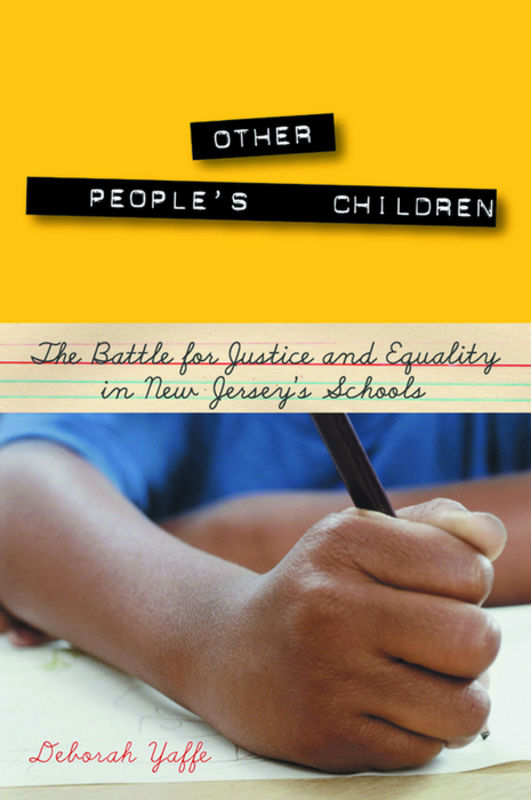
Other People's Children
Winner of the 2008 NJ Studies Academic Alliance author's award for an outstanding non-fiction work about New Jersey In 1981, when Raymond Abbott was a twelve-year-old sixth-grader in Camden, New Jersey, poor city school districts like his spent 25 percent less per student than the state’s wealthy suburbs did. That year, Abbott became the lead plaintiff in a landmark class-action lawsuit demanding that the state provide equal funding for rich and poor schools. Over the next twenty-five years, as the non-profit law firm representing the plaintiffs won ruling after ruling from the New Jersey Supreme Court, Abbott dropped out of school, fought a cocaine addiction, and spent time in prison before turning his life around. Raymond Abbott’s is just one of the many human stories that have too often been forgotten in the policy battles New Jersey has waged for two generations over equal funding for rich and poor schools. Other People’s Children, the first book to tell the story of this decades-long school funding battle, interweaves the public story—an account of legal and political wrangling over laws and money—with the private stories of the inner-city children who were named plaintiffs in the state’s two school funding lawsuits, Robinson v. Cahill and Abbott v. Burke. Although these cases have shaped New Jersey’s fiscal and political landscape since the 1970s, most recently in legislative arguments over tax reform, the debate has often been too abstract and technical for most citizens to understand. Written in an accessible style and based on dozens of interviews with lawyers, politicians, and the plaintiffs themselves, Other People’s Children crystallizes the arguments and clarifies the issues for general readers. Beyond its implications for New Jersey, this book is an important contribution to the conversations taking place in all states about the nation’s responsibility for its poor, and the role of public schools in providing equal opportunities and promising upward mobility for hard-working citizens, regardless of race or class.
eBook
The Unaddressed Costs of Changing Student Demographics
This article discusses the impact of changing student demographics on financing education and on our national wellbeing. We begin by examining the research of current student demographics and their relationship to learning and education costs. We then calculate a 1% cost factor from the average per-pupil expenditure based on the 2011 Digest of Education Statistics for various demographic groups in the U.S. This article provides a quantitative starting point for additional research, policy, and instructional discussions into what the actual education costs may be and how this may affect funding legislation at the local, state, and federal levels.
Journal Article
The Spirit of Serrano Past, Present, and Future
A decades-long school funding revolution continues in the United States. The litigation sparked by the Supreme Court of California's 1971 decision in \"Serrano v. Priest\" continues to reshape the legal, political, and educational landscape in the United States, affecting the lives of children, parents, educators, and taxpayers throughout the nation. \"Serrano\"-inspired lawsuits have transformed school funding policies nationwide, resulting in billions of dollars in new funding and a notable redistribution of resources among school districts. \"Serrano\"-inspired litigation has changed public schools in many states to a degree second only to the transformation that followed \"Brown v. Board of Education.\" To understand school funding litigation in the present and to better anticipate future developments, a review of the past, present, and likely future of school funding litigation is invaluable. This article briefly reviews and discusses the past, present, and likely future of \"Serrano\"-inspired school funding litigation. (Contains 85 footnotes.)
Journal Article

Other people's schools: The challenge of building new schools in New Jersey's urban districts: 2000—2010
This dissertation captures the 10-year contemporary history of implementing the facilities element of New Jersey’s historic Abbott V decision. New Jersey’s Legislature and Governor took this Supreme Court decision and created legislation responding to multiple constituencies and lobbyists while shaping a school construction program to be deposited within a government agency for implementation. While not the largest in nominal dollar value, New Jersey’s program was possibly the widest in geographic scope and most detailed in ambition in the United States. Aspects of program implementation are described and linked to their sources in the political sphere and their implications for the school facilities. New Jersey’s program built 63 new school buildings within 31 of New Jersey’s lowest-wealth school districts across the state in a fully centralized, highly controlled, and prescriptive manner. There is a political aspect of any public works program, and New Jersey’s played against a background of six Governors, beginning with Republican Christine Whitman and ending with Republican Chris Christie over the 10-year period July 2000 to July 2010. This program was a tool of Governors to be accelerated or dampened as needed through Executive Orders or more subtle controls. There is importance to this study as New Jersey is once again a national leader among the 50 states in addressing its most difficult school facility issues on a statewide basis. New Jersey’s program is a prototype and its experience, successes, and failures provide insight to other states that undoubtedly will be confronting these same problems as their school buildings age.
Dissertation
School Finance Reform in New Jersey: a Piecemeal Response to a Systemic Problem
Analyzes impact of court-mandated school-finance reform in New Jersey. Finds, for example, that while the state's poorest urban districts have benefited from the reform efforts, systematic inequities inherent in the state's system of school funding have not been addressed. (Contains 21 references.) (PKP)
Journal Article

Quality Counts 2005: No Small Change--Targeting Money toward Student Performance
\"Quality Counts 2005\" focuses on the burgeoning efforts to link funding to educational outcomes. This special issue of \"Education Week\" includes the following articles: (1) Financial Evolution (Lynn Olson); (2) Making Every Dollar Count (Robert C. Johnston); (3) Weighty Decisions (Jeff Archer); (4) Salary Adjustments (Melissa McCabe); (5) Financial Freedom (Caroline Hendrie); (6) The Bottom Line (David J. Hoff); (7) Uncertain Costs (Erik W. Robelen); (8) A Level Playing Field (Catherine Gewertz); (9) Targeted Spending (Jennifer Park); (10) Elusive Answers (David J. Hoff); and (10) State of the States (Ronald A. Skinner). Individual articles contain references, tables, and figures.
Journal Article