
Catalogue Search | MBRL


Are you sure you want to remove the book from the shelf?

{{itemTitle}}
610
result(s) for
"Abolitionists -- United States"
Sort by:


Moral Commerce
How can the simple choice of a men's suit be a moral statement and a political act? When the suit is made of free-labor wool rather than slave-grown cotton. InMoral Commerce, Julie L. Holcomb traces the genealogy of the boycott of slave labor from its seventeenth-century Quaker origins through its late nineteenth-century decline. In their failures and in their successes, in their resilience and their persistence, antislavery consumers help us understand the possibilities and the limitations of moral commerce.
Quaker antislavery rhetoric began with protests against the slave trade before expanding to include boycotts of the use and products of slave labor. For more than one hundred years, British and American abolitionists highlighted consumers' complicity in sustaining slavery. The boycott of slave labor was the first consumer movement to transcend the boundaries of nation, gender, and race in an effort by reformers to change the conditions of production. The movement attracted a broad cross-section of abolitionists: conservative and radical, Quaker and non-Quaker, male and female, white and black.
The men and women who boycotted slave labor created diverse, biracial networks that worked to reorganize the transatlantic economy on an ethical basis. Even when they acted locally, supporters embraced a global vision, mobilizing the boycott as a powerful force that could transform the marketplace. For supporters of the boycott, the abolition of slavery was a step toward a broader goal of a just and humane economy. The boycott failed to overcome the power structures that kept slave labor in place; nonetheless, the movement's historic successes and failures have important implications for modern consumers.
eBook


John Woolman's Path to the Peaceable Kingdom
The abolitionist John Woolman (1720-72) has been described as a \"Quaker saint,\" an isolated mystic, singular even among a singular people. But as historian Geoffrey Plank recounts, this tailor, hog producer, shopkeeper, schoolteacher, and prominent Quaker minister was very much enmeshed in his local community in colonial New Jersey and was alert as well to events throughout the British Empire. Responding to the situation as he saw it, Woolman developed a comprehensive critique of his fellow Quakers and of the imperial economy, became one of the most emphatic opponents of slaveholding, and helped develop a new form of protest by striving never to spend money in ways that might encourage slavery or other forms of iniquity. Drawing on the diaries of contemporaries, personal correspondence, the minutes of Quaker meetings, business and probate records, pamphlets, and other sources,John Woolman's Path to the Peaceable Kingdomshows that Woolman and his neighbors were far more engaged with the problems of inequality, trade, and warfare than anyone would know just from reading the Quaker's own writings. Although he is famous as an abolitionist, the end of slavery was only part of Woolman's project. Refusing to believe that the pursuit of self-interest could safely guide economic life, Woolman aimed for a miraculous global transformation: a universal disavowal of greed.
eBook


We Are the Revolutionists
AChoiceMagazine Outstanding Academic TitleWidely remembered as a time of heated debate over the westward expansion of slavery, the 1850s in the United States was also a period of mass immigration. As the sectional conflict escalated, discontented Europeans came in record numbers, further dividing the young republic over issues of race, nationality, and citizenship. The arrival of German-speaking \"Forty-Eighters,\" refugees of the failed European revolutions of 1848-49, fueled apprehensions about the nation's future. Reaching America did not end the foreign revolutionaries' pursuit of freedom; it merely transplanted it.
InWe Are the Revolutionists, Mischa Honeck offers a fresh appraisal of these exiled democrats by probing their relationship to another group of beleaguered agitators: America's abolitionists. Honeck details how individuals from both camps joined forces in the long, dangerous battle to overthrow slavery. In Texas and in cities like Milwaukee, Cincinnati, and Boston this cooperation helped them find new sources of belonging in an Atlantic world unsettled by massive migration and revolutionary unrest.
Employing previously untapped sources to write the experience of radical German émigrés into the abolitionist struggle, Honeck elucidates how these interethnic encounters affected conversations over slavery and emancipation in the United States and abroad. Forty-Eighters and abolitionists, Honeck argues, made creative use not only of their partnerships but also of their disagreements to redefine notions of freedom, equality, and humanity in a transatlantic age of racial construction and nation making.
eBook

Harriet Tubman : a life in American history
\"Harriet Tubman: A Life in American History is an indispensable resource for high school and college students about the life and times of anti-slavery activist Harriet Tubman, who exemplifies how slaves took the initiative to free themselves and others\"-- Provided by publisher.
Book

The Tie That Bound Us
John Brown was fiercely committed to the militant abolitionist cause, a crusade that culminated in Brown's raid on the Federal armory at Harpers Ferry in 1859 and his subsequent execution. Less well known is his devotion to his family, and they to him. Two of Brown's sons were killed at Harpers Ferry, but the commitment of his wife and daughters often goes unacknowledged. InThe Tie That Bound Us, Bonnie Laughlin-Schultz reveals for the first time the depth of the Brown women's involvement in his cause and their crucial roles in preserving and transforming his legacy after his death.
As detailed by Laughlin-Schultz, Brown's second wife Mary Ann Day Brown and his daughters Ruth Brown Thompson, Annie Brown Adams, Sarah Brown, and Ellen Brown Fablinger were in many ways the most ordinary of women, contending with chronic poverty and lives that were quite typical for poor, rural nineteenth-century women. However, they also lived extraordinary lives, crossing paths with such figures as Frederick Douglass and Lydia Maria Child and embracing an abolitionist moral code that sanctioned antislavery violence in place of the more typical female world of petitioning and pamphleteering.
In the aftermath of John Brown's raid at Harpers Ferry, the women of his family experienced a particular kind of celebrity among abolitionists and the American public. In their roles as what daughter Annie called \"relics\" of Brown's raid, they tested the limits of American memory of the Civil War, especially the war's most radical aim: securing racial equality. Because of their longevity (Annie, the last of Brown's daughters, died in 1926) and their position as symbols of the most radical form of abolitionist agitation, the story of the Brown women illuminates the changing nature of how Americans remembered Brown's raid, radical antislavery, and the causes and consequences of the Civil War.
eBook

How to analyze the works of Frederick Douglass
This book introduces readers to critical theory and its application to the speeches and writings of Frederick Douglass.
BOOK
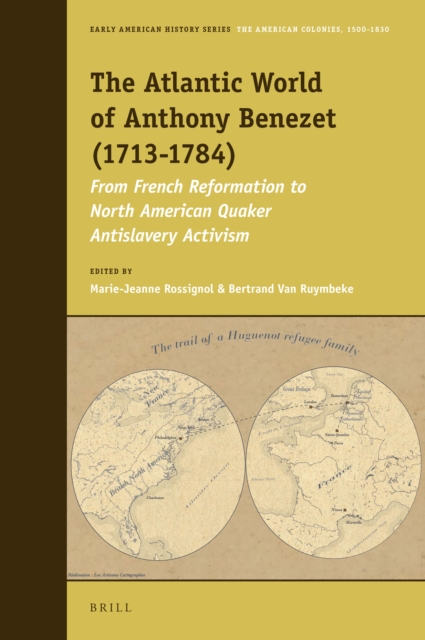
The Atlantic World of Anthony Benezet (1713-1784)
In The Atlantic World of Anthony Benezet (1713-1784): From French Reformation to North American Quaker Antislavery Activism, Marie-Jeanne Rossignol and Bertrand Van Ruymbeke offer the first scholarly volume examining Anthony Benezet, inspirator of 18th-century antislavery activism, as an Atlantic figure.
eBook