
Catalogue Search | MBRL


Are you sure you want to remove the book from the shelf?

{{itemTitle}}
12
result(s) for
"Academic spin-outs."
Sort by:


The exchange university
\"The Exchange University addresses crucial questions facing today's university, including the commercialization of research and teaching; intensifying government-university relationships; marketization and commodification; and policy and functional responses within the academy. The book will interest practitioners, students, and academics in educational studies, policy studies, and higher education.\"--BOOK JACKET.
eBook

University technology transfer
\"Research universities commonly have an office of technology transfer. University technology transfer involves the identification, protection, and marketing of university research output in order to transfer opportunities from the university into the commercial sphere. Businesses then invest in the development of products and services derived from the transferred knowledge. The author is an expert on technology transfer who writes about it in the setting of the United Kingdom and United States. This book is intended principally for university administrators who want to understand how such transfer works.\" Contents: Question time -- Coming out -- How it works -- Why it is difficult -- Structures -- Going to market -- Mind the gap -- Innovation community -- Give and take -- Currencies and metrics -- Impact -- Whatever next.
eBook
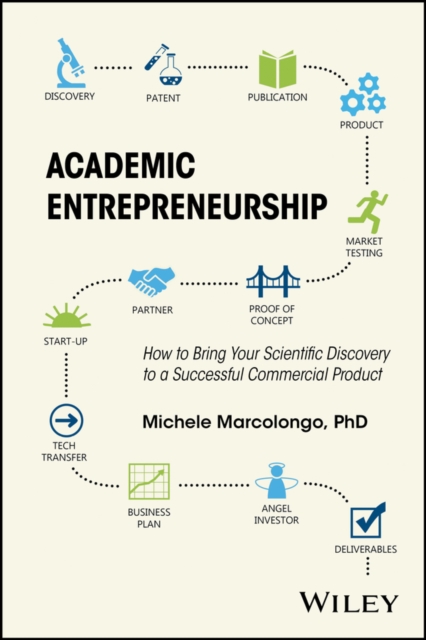
Academic entrepreneurship : how to bring your scientific discovery to a successful commercial product
The pathway to bringing laboratory discoveries to market is poorly understood and generally new to many academics.This book serves as an easy-to-read roadmap for translating technology to a product launch - guiding university faculty and graduate students on launching a start-up company.
eBook

Spin-outs
Universities increasingly encourage spin-out companies from their own departments, and interest from entrepreneurs and the commercial sphere is only set to develop further in coming years. With this in mind, Professor Graham Richards - an academic and businessman who has had many years of involvement with spin-out companies - has written this book as a guide and an inspiration for those who are thinking about commercialising intellectual property and creating a spin-out company. In an informative and enjoyable style he describes his personal experiences of the processes involved in launching a spin-out; from the key decisions that have to be made through to those inevitable mistakes to be learnt from. The University of Oxford has an outstanding record in forming spin-out companies, and has become one of the leading UK universities in this activity. Within the University, the Department of Chemistry has played a central role, with -ú80 million being contributed to university funds by spin-out companies that have emerged from the department. 'Spin-Outs' provides an insight into how this has been achieved, and carefully signposts the route for taking an academic's intellectual property from the lab, to a start-up company and then on to flotation on the stock market. As a former head of Chemistry at Oxford, Professor Graham Richards is uniquely placed to describe this process. The author gives a real-life focus to his account by using illustrative examples of the businesses in which he was personally involved, drawing extensively on the case study of Oxford Molecular Ltd to show how this company was spun-out in practice. The book provides invaluable information for universities about what can be achieved and how. It also provides guidance to the entrepreneur with thoughts of creating a high-tech company: the pitfalls, the problems and what is needed, as well as an indication of the potential benefits to all concerned.
eBook

Exchange University (The)
Intro -- Contents -- List of Illustrations -- List of Abbreviations -- Preface -- Introduction: The Exchange University -- 1 The Academic Capitalist Knowledge/Learning Regime -- 2 Academic Culture and the Research-Intensive University: The Impact of Commercialism and Scientism -- 3 The New Production of Researchers -- 4 Public Policy in Ontario Higher Education: From Frost to Harris -- 5 How Fares Equity in an Era of Academic Capitalism? The Role of Contingent Faculty -- 6 Reclaiming Our Centre: Toward a Robust Defence of Academic Autonomy -- 7 \"Gender at Work\" in Teacher Education: History, Society, and Global Reform -- 8 The Political Economy of Legal Scholarship: A Case Study of the University of British Columbia Law School -- 9 Keeping the Commons in Academic Culture: Protecting the Knowledge Commons from the Enclosure of the Knowledge Economy -- Conclusion -- List of Contributors -- Index -- A -- B -- C -- D -- E -- F -- G -- H -- I -- J -- K -- L -- M -- N -- O -- P -- Q -- R -- S -- T -- U -- V -- W -- Y -- Z.
Book


University Technology Commercialization
This volume addresses the challenges that can arise when individuals from technical, business, and legal environments must converge on the goal of commercialization. Specifically, it brings together studies from organizational behavior, marketing, economic, and sociological perspectives on commercialization of university technologies
Book
Entrepreneurial orientation in Academia
Entrepreneurial firms and new venture creation are important drivers for economic growth.Hence, emphasis is put on the question how to adequately stimulate and s- port new business creation.The corresponding discussion has not excluded academic organisations such as universities - quite the contrary.
eBook