
Catalogue Search | MBRL


Are you sure you want to remove the book from the shelf?

{{itemTitle}}
33
result(s) for
"Adams, Abigail, 1744-1818 Correspondence."
Sort by:

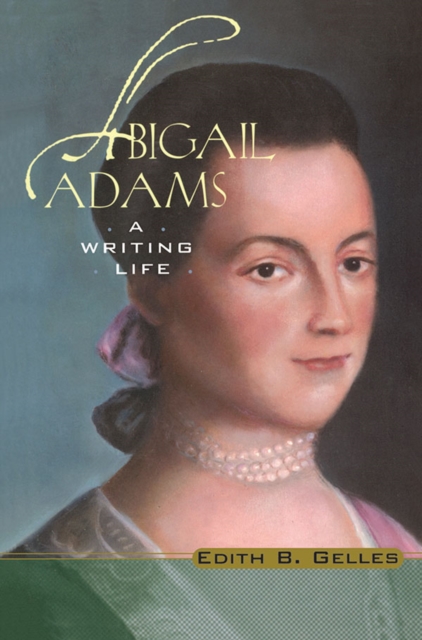
Abigail Adams
In this book, Edith B. Gelles asserts that Abigail Adams' vivid, insightful letters are \"the best account that exists from the pre to the post-Revolutionary period in America of a woman's life and world.\" Adams' spontaneous, witty letters serve dual purposes for the modern reader: it provides an intriguing first hand account of pivotal historical events and it shows how these events from the Boston Tea Party to the War of 1812 entered the private sphere. Included in the book is a chronology, notes and reference section and a selected bibliography. This book will be a must for all scholars of American literature, history and politics seeking to understand this literary figure.
Edith B. Gelles is a Senior Scholar at the Institute for Research on Women and Gender at Stanford University and the author of Portia: The World of Abigail Adams, winner of the American Historical Association's Herbert Feis Award.
eBook

The Adams-Jefferson letters : the complete correspondence between Thomas Jefferson and Abigail and John Adams
An intellectual dialogue of the highest plane achieved in America, the correspondence between John Adams and Thomas Jefferson spanned half a century and embraced government, philosophy, religion, quotidiana, and family griefs and joys.
eBook

Remembering the Ladies
This article examines how elite, white women in England and New England participated in the construction of masculinity during the long eighteenth century. In their correspondence, elite women frequently expressed their ideas about what an ideal man should be. In letters to their female friends and family members, they offered examples of men whom they thought either embodied their high ideals or who served as counterexamples. In writing to their sons and younger male relatives, these letter writers were often very direct in offering their opinions and guidance on how to be good men and good patriarchs. None of the authors examined in this article overtly challenged the patriarchal social order in which they lived. Rather, these privileged women championed values like attention to the home and Christian morality that enabled their elite, male kin to become successful providers, heads of households, and leaders in their communities. This was no less true in the new United States after 1783 than in England in the 1740s, suggesting a long-lived pattern of elite women's role in ensuring the continuity of patriarchal societies, even if some aspects of the ideal man did change over time.
Journal Article

Carrying Home the Enemy
Through an analysis of letters exchanged between spouses in the peak years of smallpox during the American Revolutionary War, this article identifies what it calls the domestic smallpox narrative, wherein vulnerability and immunity are gendered and relational. The narrative traced through numerous letters written during the Revolution reflects a concern for smallpox’s power to endanger marital and family relationships. Because a husband in service to the Revolution gained exposure and subsequent immunity to smallpox, it was feared that he could “carry home” the disease, either intentionally or accidentally, infecting and potentially killing his wife. Families could experience a kind of inadvertent or deliberate biological warfare in their homes that had the potential to revolutionize domestic life and intimate relationships between spouses. As a result of the war, men were more likely to be protected than women from smallpox just as men were empowered in the new Republic while women were not. This was particularly significant in the rebel nation that refused to bestow political rights on women.
Journal Article

Private Letters and Public Diplomacy: The Adams Network and the Quasi-War, 1797–1798
Drawing primarily on the unpublished Adams Family Papers, this essay reconstructs the correspondence-based political and diplomatic information networks that John Adams employed in 1797 and 1798. It show that Adams had two networks, an official one built around the cabinet and an unofficial one dominated by family members and friends, which had distinct approaches to gathering information and different assumptions about how to interpret it. The members of the private network collectively created shared standards for determining what constituted reliable information and sound political principles. Though Adams employed both networks, he had greater confidence in the private one. In early 1797, when Adams had to decide how to respond to the French government's rejection of U.S. emissary Charles Cotesworth Pinckney, it was the private network that persuaded him to send a new mission to France. Adams then sought to create a new mission that was composed of individuals who were part of the private network or closely connected to it. In both cases, however, Adams incorporated advice from the official network as well. The essay reinterprets Adams's diplomacy, showing that it was more consistent and less shaped by his cabinet's advice than has been thought. It also illustrates how political decision-making in the early republic drew on multiple interacting correspondence networks, suggesting the need for further study of the epistolary habits of political leaders.
Journal Article

Abigail and John Adams
During the many years that they were separated by the perils of the American Revolution, John and Abigail Adams exchanged hundreds of letters. Writing to each other of public events and private feelings, loyalty and love, revolution and parenting, they wove a tapestry of correspondence that has become a cherished part of American history and literature. With Abigail and John Adams, historian G. J. Barker-Benfield mines those familiar letters to a new purpose: teasing out the ways in which they reflected—and helped transform—a language of sensibility, inherited from Britain but, amid the revolutionary fervor, becoming Americanized. Sensibility—a heightened moral consciousness of feeling, rooted in the theories of such thinkers as Descartes, Locke, and Adam Smith and including a “moral sense” akin to the physical senses—threads throughout these letters. As Barker-Benfield makes clear, sensibility was the fertile, humanizing ground on which the Adamses not only founded their marriage, but also the “abhorrence of injustice and inhumanity” they and their contemporaries hoped to plant at the heart of the new nation. Bringing together their correspondence with a wealth of fascinating detail about life and thought, courtship and sex, gender and parenting, and class and politics in the revolutionary generation and beyond, Abigail and John Adams draws a lively, convincing portrait of a marriage endangered by separation, yet surviving by the same ideas and idealism that drove the revolution itself. A feast of ideas that never neglects the real lives of the man and woman at its center, Abigail and John Adams takes readers into the heart of an unforgettable union in order to illuminate the first days of our nation—and explore our earliest understandings of what it might mean to be an American.
eBook

Abigail Adams, Gender Politics, and \The History of Emily Montague\: A Postscript
Abigail Adams never ceases to amaze. At times obligingly candid, often consciously opaque, Adams at her best is the mistress of eighteenth-century literary allusions. Here, Crane explores Adam's literary escapades and traces the derivation of the sentence that had such an effect on Adams and Livingston. The sentence comes from The History of Emily Montague, written by English author Frances Brooke. Moreover, Gender politics aside, Adams might have found The History of Emily Montague a pleasurable escapist fantasy. The novel was a travelogue about a foreign country that had recently been conquered by the English, a barely populated wilderness filled with marvelous natural Wonders that Adams could only imagine.
Journal Article
Portia and Marcia: Female Political Identity and the Historical Imagination, 1770-1800
Presenting a case study of two major 18th-century figures illustrates how one might go about incorporating history more meaningfully into the story of women's political self-definition. Reappraising the pen names of Abigail Adams and Mercy Otis Warren shows how two of the most politically articulate women of the era struggled to maintain a female republican identity rooted in history.
Journal Article

Disciplining Jefferson: The Man within the Breast and the Rhetorical Norms of Producing Order
This essay analyzes Thomas Jefferson's letter to Maria Cosway of October 12, 1786, remembered today as the dialogue between Jefferson's head and heart By offering a close reading of the rhetorical styles of the players in Jefferson's letter, and by reading the dialogue alongside Adam Smith's The Theory of Moral Sentiments, this essay argues that Jefferson's goal was to discipline his irrational, misbehaving heart. Jefferson's letter is interesting as a rhetorical artifact in itself, and deserves a close reading; yet this essay also argues that Jefferson's letter consideration because it offers a detailed discussion of his political psychology and also, I argue, a window into his fantasies about how public affairs would be managed in the United States.
Journal Article