
Catalogue Search | MBRL


Are you sure you want to remove the book from the shelf?

{{itemTitle}}
2,107
result(s) for
"Adams, Samuel"
Sort by:

Why don't you get a horse, Sam Adams?
A brief biography of Samuel Adams, describing his activities in stirring up the British and how he was finally persuaded to learn to ride a horse.
Book

Samuel Adams
The story of one of the most important -- and most elusive -- figures of the American Revolution, Samuel Adams traces the life of the \"Man of the Revolution,\" as he was called by Thomas Jefferson, from his childhood as a fifth-generation New Englander to his pivotal role in the Boston Tea Party and war that followed to a life spent in public service.
eBook

The revolutionary : Samuel Adams
\"Thomas Jefferson asserted that if there was any leader of the Revolution, \"Samuel Adams was the man.\" With high-minded ideals and bare-knuckle tactics, Adams led what could be called the greatest campaign of civil resistance in American history. Stacy Schiff returns Adams to his seat of glory, introducing us to the shrewd and eloquent man who supplied the moral backbone of the American Revolution. He employed every tool available to rally a town, a colony, and eventually a band of colonies behind him, creating the cause that created a country. For his efforts he became the most wanted man in America: When Paul Revere rode to Lexington in 1775, it was to warn Samuel Adams that he was about to be arrested for treason. In The Revolutionary: Samuel Adams, Schiff brings her masterful skills to Adams's improbable life, illuminating his transformation from aimless son of a well-off family to tireless, beguiling radical who mobilized the colonies\"-- Provided by publisher.
Book

Samuel Hopkins Adams (1871–1958): Journalist and Muckraker
In consideration of this sum it will swallow huge quantities of alcohol, an appalling amount of opiates and narcotics, a wide assortment of varied drugs ranging from powerful and dangerous heart depressants to insidious liver stimulants; and, in excess of all other ingredients, undiluted fraud.2(p1) In 1911, the Supreme Court ruled that the prohibition of falsifications referred only to the ingredients of patent medicines, not claims as to their efficacy.
Journal Article

Enough! : 20 protesters who changed America
\"From Samuel Adams to the students from Parkland, march through history with the heroic revolutionary protesters who changed America. These heroic protesters were not afraid to stand up for what they believed in. They are among the twenty change-makers in this book who used peaceful protests and brave actions to rewrite American history\"--Jacket.
BOOK
Samuel Adams
Samuel Adams: The Life of an American Revolutionary vividly tells the story of a titan of America's greatest generation. Friend and foe alike considered Adams one of the greatest members of the generation that achieved American independence and crafted constitutions that made the ideal of republican government a living reality in the new nation. Adams's role as a major political author and organizer are explored as is his central role in momentous events including the Boston Massacre and the Boston Tea Party. The work demonstrates why Thomas Jefferson described Adams as the helmsman of the American Revolution. Adams's career during the war and his involvement in crafting and defending republican constitutions are assessed as are his views on virtue, religion, education, women, and slavery. Following Adams through the 1790s, one sees that he wanted the revolutionary generation to bequeath a land of liberty and equality to the nation's posterity. The personal side of this revolutionary who was renowned for his lack of concern for material things is not neglected. The symbiotic relationship of Samuel and his wife Elizabeth is analyzed. The work demonstrates that Adams's life provides a veritable guide to responsible citizenship and public service in a republic.
eBook

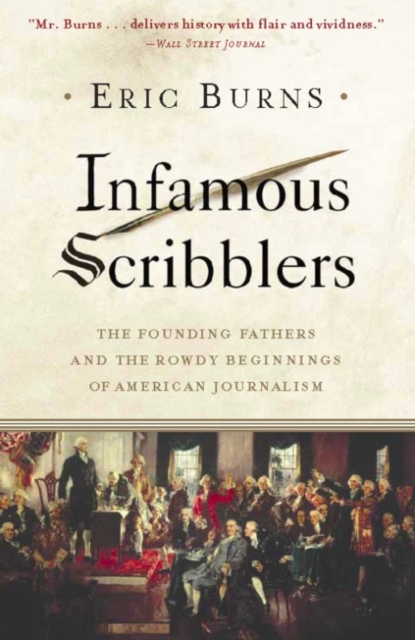
Infamous scribblers : the founding fathers and the rowdy beginnings of American journalism
Infamous Scribblersis a perceptive and witty exploration of the most volatile period in the history of the American press. News correspondent and renonwned media historian Eric Burns tells of Ben Franklin, Alexander Hamilton and Sam Adams-the leading journalists among the Founding Fathers; of George Washington and John Adams, the leading disdainers of journalists; and Thomas Jefferson, the leading manipulator of journalists. These men and the writers who abused and praised them in print (there was, at the time, no job description of \"journalist\") included the incendiary James Franklin, Ben's brother and one of the first muckrakers; the high minded Thomas Paine; the hatchet man James Callender, and a rebellious crowd of propagandists, pamphleteers, and publishers. It was Washington who gave this book its title. He once wrote of his dismay at being \"buffited in the public prints by a set of infamous scribblers.\" The journalism of the era was often partisan, fabricated, overheated, scandalous, sensationalistic and sometimes stirring, brilliant, and indispensable. Despite its flaws-even because of some of them-the participants hashed out publicly the issues that would lead America to declare its independence and, after the war, to determine what sort of nation it would be.
eBook
