
Catalogue Search | MBRL


Are you sure you want to remove the book from the shelf?

{{itemTitle}}
1,107
result(s) for
"Addicts Psychology."
Sort by:

The biology of desire : why addiction is not a disease
\"Neuroscientist Lewis (Memoirs of an Addicted Brain) presents a strong argument against the disease model of addiction, which is currently predominant in medicine and popular culture alike, and bolsters it with informative and engaging narratives of addicts' lives ... Even when presenting more technical information, Lewis shows a keen ability to put a human face on the most groundbreaking research into addiction. Likewise, he manages to make complex findings and theories both comprehensible and interesting...This book, written with hopeful sincerity, will intrigue both those who accept its thesis and those who do not.\"-- Publishers Weekly.
Book
Addictive States of Mind
'Perversion is taken to mean different things within psychoanalytic discourse. In this book the authors view perversions, not in terms of specific behaviours, but as a type of blueprint for object relations. While perversions may involve a quest for excitement through sex, drugs or gambling, for example, the focus here is on the underlying incapacity - or indeed at times refusal - to relate to the other as separate from the self and not as a narcissistic appendage. It is the anxieties aroused by intimacy and relatedness that drive the pursuit of ecstasy and excitement. Psychoanalytic thinking can help multidisciplinary teams to stand back and respond to the addictive state of mind in humane and containing ways that are not collusive. This book thus provides rich food for thought not only for the individual practitioner but also for those responsible for shaping services for addicted individuals.' - Alessandra Lemma, from the Preface.
eBook

Drugs and the future : brain science, addiction, and society
This book presents 13 reviews collected to present the new advances in all areas of addiction research, including knowledge gained from mapping the human genome, the improved understanding of brain pathways and functions that are stimulated by addictive drugs, experimental and clinical psychology approaches to addiction and treatment, as well as both ethical considerations and social policy. The book also includes chapters on the history of addictive substances and some personal narratives of addiction. Introduced by Sir David King, Science Advisory to the UK Government and head of the Office of Science and Technology, and Nora Volkow, director of the National Institute on Drug Abuse in the USA, the book uniquely covers the full range of disciplines which can provide insight into the future of addiction, from genetics to the humanities. Written for a scientific audience, it is also applicable to non-specialists as well. * Provides an unique overview of what we know about addiction, and how scientific knowledge can and should be applied in the societal, ethical, and political context * Applies the state-of-the-art research in fields such as Genomics, Neuroscience, Pharmacology, Social Policy and Ethics to addiction research * Includes a preface by Sir David King, Science Advisory to the UK Government and head of the Office of Science and Technology, and in introduction by Nora Volkow, director of the National Institute on Drug Abuse in the USA
eBook

Drug Dreams
This book is aimed at providing a systematic and comprehensive discussion on drug dreams by considering the various perspectives involved (such as therapy in drug addiction, the neurobiology of drug craving, affective neuroscience, dream research) and, ideally, at suggesting future clinical applications for therapists (counsellors, psychoytherapists, clinicians) in charge of treating drug-addicted patients, as well as providing input for dream researchers. The book draws from the author's clinical and research experience on drug dreams among heroin-addicted patients, as well as from the scientific literature in this field. The book is composed of three parts: the phenomenology of drug dreams, their clinical and therapeutic aspects, and their implications for the dream research and theory.
eBook

The recovering heart : emotional sobriety for women
\" You are finally sober and drug-free. Your old, destructive lifestyle is fading into the past and now you are a woman in recovery. What an amazing gift you've given yourself. So why aren't you happier? As sobriety takes hold and your head starts to clear, a wide range of emotions can begin to emerge-feelings that until now you've \"medicated\" with chemicals. Yet to stay sober, and to grow and flourish as a person, you must engage in healing and take responsibility for these emotions that have been neglected since you first starting using. Beverly Conyers, a prominent voice in recovery, uses personal stories and informed insight to guide you in achieving emotional sobriety by addressing behaviors and feelings unique to the female experience. Learn how to develop the inner resiliency to face and process difficult, buried emotions-such as shame, grief, fear, and anger-while freeing the positive feelings of self- worth, independence, and integrity. Discover how to heal your \"damaged self\" by improving your communication skills, expanding your capacity for intimacy and trust, and reawakening a spiritual life. It is through your own personal journey of healing your wounded heart that you can free yourself to a life of self-acceptance, and lay the foundation for a rewarding and relapse-free second stage of recovery. \"-- Provided by publisher.
Book

Internet Addiction
This essential book questions the psychological construct of Internet Addiction by contextualizing it within the digital technological era. It proposes critical psychology that investigates user subjectivity as a function of capitalism and imperialism, arguing against punitive models of digital excesses and critiquing the political economy of the Internet affecting all users.
Friedman explores the limitations of individual-centered remediations exemplified in the psychology of Internet Addiction. Furthermore, Friedman outlines the self-creative actions of social media users and the data processing that exploits them to urge psychologists to politicize rather than pathologize the effects of excessive net use. The book develops a notion of capitalist imperialism of the social web and studies this using the radical methods of philosopher Gilles Deleuze, and psychoanalyst Félix Guattari.
By synthesizing perspectives on digital life from sociology, economics, digital media theory, and technology studies for psychologists, this book will be of interest to academics and students in these areas, as well as psychologists and counselors interested in addressing Internet Addiction as a collective, societal ill.
eBook
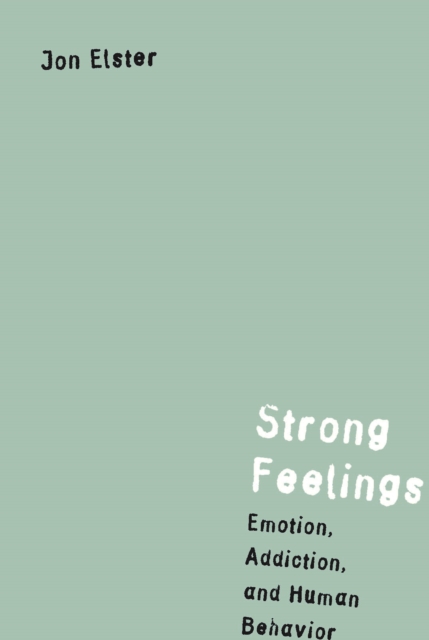
Strong feelings: emotion, addiction, and human behavior
Emotion and addiction lie on a continuum between simple visceral drives such as hunger, thirst, and sexual desire at one end and calm, rational decision making at the other. Although emotion and addiction involve visceral motivation, they are also closely linked to cognition and culture. They thus provide the ideal vehicle for Jon Elster's study of the interrelation between three explanatory approaches to behavior: neurobiology, culture, and choice.The book is organized around parallel analyses of emotion and addiction in order to bring out similarities as well as differences. Elster's study sheds fresh light on the generation of human behavior, ultimately revealing how cognition, choice, and rationality are undermined by the physical processes that underlie strong emotions and cravings. This book will be of particular interest to those studying the variety of human motivations who are dissatisfied with the prevailing reductionisms.*Not for sale in Belgium, France, or Switzerland.
eBook