
Catalogue Search | MBRL


Are you sure you want to remove the book from the shelf?

{{itemTitle}}
3,289
result(s) for
"Advanced Mathematics"
Sort by:

Multiparameter eigenvalue problems : Sturm-Liouville theory
\"With special attention to the Sturm-Liouville theory, this book discusses the full multiparameter theory as applied to second-order linear equations. It considers the spectral theory of these multiparameter problems in detail for both the regular and singular cases. The text covers eignencurves, the essential spectrum, eigenfunctions, oscillation theorems, the distribution of eigencurves, the limit point, limit circle theory, and more. This text is the culmination of more than two decades of research by F.V. Atkinson, one of the masters in the field, and his successors, who continued his work after he passed away in 2002\"-- Provided by publisher.
Book

A Primer on Mapping Class Groups (PMS-49)
The study of the mapping class group Mod(S) is a classical topic that is experiencing a renaissance. It lies at the juncture of geometry, topology, and group theory. This book explains as many important theorems, examples, and techniques as possible, quickly and directly, while at the same time giving full details and keeping the text nearly self-contained. The book is suitable for graduate students.
eBook

A functional start to computing with Python / Ted Herman
\"Open source and easy to use, Python offers the availability of exciting libraries of software, application programming interfaces, and even connections to web services. This textbook uses Python as a working environment to teach the basics of computing for students with no prior programming experience. Unlike similar texts, it organizes topics based on a functional first approach to teaching programming. The book includes case studies of practical problems as well as homework and interactive tools online, such as flashcards\"-- Provided by publisher.
Book

Computational Aspects of Modular Forms and Galois Representations
Modular forms are tremendously important in various areas of mathematics, from number theory and algebraic geometry to combinatorics and lattices. Their Fourier coefficients, with Ramanujan's tau-function as a typical example, have deep arithmetic significance. Prior to this book, the fastest known algorithms for computing these Fourier coefficients took exponential time, except in some special cases. The case of elliptic curves (Schoof's algorithm) was at the birth of elliptic curve cryptography around 1985. This book gives an algorithm for computing coefficients of modular forms of level one in polynomial time. For example, Ramanujan's tau of a prime number p can be computed in time bounded by a fixed power of the logarithm of p. Such fast computation of Fourier coefficients is itself based on the main result of the book: the computation, in polynomial time, of Galois representations over finite fields attached to modular forms by the Langlands program. Because these Galois representations typically have a nonsolvable image, this result is a major step forward from explicit class field theory, and it could be described as the start of the explicit Langlands program.
The computation of the Galois representations uses their realization, following Shimura and Deligne, in the torsion subgroup of Jacobian varieties of modular curves. The main challenge is then to perform the necessary computations in time polynomial in the dimension of these highly nonlinear algebraic varieties. Exact computations involving systems of polynomial equations in many variables take exponential time. This is avoided by numerical approximations with a precision that suffices to derive exact results from them. Bounds for the required precision--in other words, bounds for the height of the rational numbers that describe the Galois representation to be computed--are obtained from Arakelov theory. Two types of approximations are treated: one using complex uniformization and another one using geometry over finite fields.
The book begins with a concise and concrete introduction that makes its accessible to readers without an extensive background in arithmetic geometry. And the book includes a chapter that describes actual computations.
eBook

A concise introduction to data structures using Java
\"Designed for a CS2 data structures course, this text provides a thorough but concise overview of data structures as well as a gradual introduction to Java. It uses a concise style and includes pseudocode and exercises throughout so that students learn how to write code, rather than just read it. The book covers all of the main areas taught in CS2 courses, including arrays, lists, stacks, queues, recursion, maps, and trees\"-- Provided by publisher.
Book
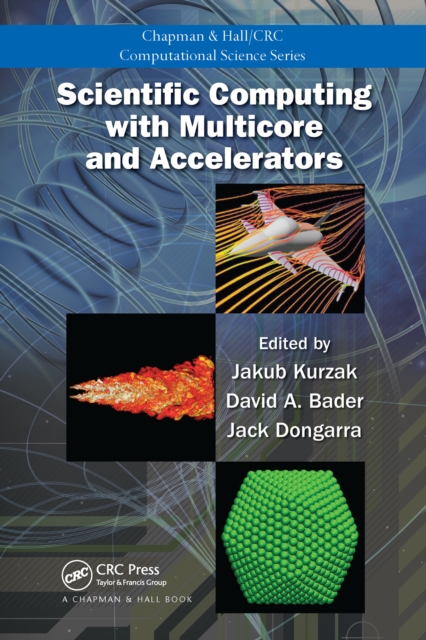
Scientific Computing with Multicore and Accelerators
By offering insight into the process of constructing and effectively using the technology, this volume provides a thorough and practical introduction to the area of hybrid computing. It discusses introductory concepts and simple examples of parallel computing, logical and performance debugging for parallel computing, and advanced topics and issues related to the use and building of many applications. The book focuses on the latest microarchitectures, including the STI Cell BE, and covers applications in high-performance multimedia and gaming, solid mechanics, fluid dynamics, molecular modeling, computational biology, drug design, and biomedicine.
eBook

Practical algorithms for 3D computer graphics
\"Practical Algorithms for 3D Computer Graphics, Second Edition covers the fundamental algorithms that are the core of all 3D computer graphics software packages. Using Core OpenGL and OpenGL ES, the book enables you to create a complete suite of programs for 3D computer animation, modeling, and image synthesis.Since the publication of the first edition, implementation aspects have changed significantly, including advances in graphics technology that are enhancing immersive experiences with virtual reality. Reflecting these considerable developments, this second edition presents up-to-date algorithms for each stage in the creative process. It takes you from the construction of polygonal models of real and imaginary objects to rigid body animation and hierarchical character animation to the rendering pipeline for the synthesis of realistic images.New to the Second EditionNew chapter on the modern approach to real-time 3D programming using OpenGLNew chapter that introduces 3D graphics for mobile devices New chapter on OpenFX, a comprehensive open source 3D tools suite for modeling and animationDiscussions of new topics, such as particle modeling, marching cubes, and techniques for rendering hair and furMore web-only content, including source code for the algorithms, video transformations, comprehensive examples, and documentation for OpenFXThe book is suitable for newcomers to graphics research and 3D computer games as well as more experienced software developers who wish to write plug-in modules for any 3D application program or shader code for a commercial games engine\"-- Provided by publisher.
Book

Using conceptual analyses to resolve the tension between advanced and secondary mathematics: the cases of equivalence and inverse
Advanced mathematics is seen as an integral component of secondary teacher preparation, and thus most secondary teacher preparation programs require their students to complete an array of advanced mathematics courses. In recent years, though, researchers have questioned the utility of proposed connections between advanced and secondary mathematics. It is simply not clear in many cases—to researchers, teacher educators, and teachers themselves—exactly how advanced mathematics content is related to secondary content. In this paper, we propose using a
conceptual analysis
—a form of theory in which one explicitly describes ways of reasoning about a particular mathematical idea—to address this issue. Specifically, we use conceptual analyses for the foundational notions of equivalence and inverse to illustrate how the ways of reasoning needed to support productive engagement with tasks in advanced mathematics can mirror and reinforce those that are similarly productive in school mathematics. To do so, we propose conceptual analyses for the key concepts of equivalence and inverse and show how researchers can use these conceptual analyses to identify connections to school mathematics in advanced mathematical tasks that might otherwise be obscured and overlooked. We conclude by suggesting ways in which conceptual analyses might be productively used by both teacher educators and future teachers.
Journal Article
“But this is not mathematics!”—mathematicians and secondary teachers explore the affordances of tertiary mathematics for teaching secondary probability
Tertiary mathematics has a central place in teacher education, yet in recent years there is growing evidence that realizing its potential affordances in secondary mathematics teaching is far from trivial. Research suggests that utilizing tertiary mathematics in secondary teaching requires interweaving it with knowledge for teaching secondary mathematics. Little is known about the underlying processes, which are often tacit and highly personal. In this article we analyze affordances of tertiary mathematics for teaching secondary probability. A group of mathematicians and experienced secondary teachers jointly inquired into the mathematics that could be addressed in school when discussing a popular probability game – the River Crossing game (henceforth “the game”). This context was chosen as an extreme case, in the sense that the mathematics underlying the game is so nuanced and complex that applying tertiary knowledge to mathematize and understand it is generally not feasible for secondary teachers. Thus, it is not clear how tertiary mathematics can inform teachers about using the game in class. Our analysis shows how the conflicting perspectives of teachers and mathematicians on what mathematics students may learn by playing the game initially hindered utilization of tertiary mathematics. Nevertheless, rapprochement was achieved, highlighting four different trajectories for interweaving knowledge of tertiary mathematics with knowledge for teaching secondary mathematics towards using the game in ingenious ways that respect both mathematical and pedagogical concerns. Our findings suggest that tertiary mathematics may have affordances for secondary mathematics teaching even in situations where teachers lack tertiary-level understanding of the underlying subject-matter.
Journal Article

Statistical Analysis of Advanced Mathematics Teaching Quality Evaluation Based on Quantile Regression Model
To understand the quantile regression model, research on a statistical analysis of advanced mathematics teaching quality evaluation was proposed. In the research, based on the test bank and questionnaires, statistical analysis was applied to examine the quality of the test bank and investigate the factors affecting the teaching quality, to understand the students’ scores, find the main factors affecting the teaching quality and use them to analyze the students’ learning status and learning quality. This will help teachers understand and grasp the students’ learning process and improve their teaching ability. And it can provide a theoretical basis for qualitative and quantitative analysis to further improve the high quality.
Journal Article