
Catalogue Search | MBRL


Are you sure you want to remove the book from the shelf?

{{itemTitle}}
831
result(s) for
"Advertising India."
Sort by:


Printed Advertisement 1947-1970
This work explains the politics of the patterns of the advertisements printed in the newspapers published in Bengal between 1947 and 1970, and the sociology of the encounter of the Bengali middleclass with these. Many of the cited advertisements were meant for the entire country but regional particularities were pronounced during the period under review, and the bhadralok consciously maintained a unique constructed identity that dates back to the colonial epoch. Therefore, their encounter wit.
eBook


'Ad'apting to Markets
This book looks at what goes into localization of advertisements in Indian languages. 'Ad'apting to Markets discusses the process of localization of advertisements (ads) in different Indian languages and its socio-cultural implications. While doing so, it provides insights into the ideologies and cultural values of contemporary societies as they have a powerful influence not only on consumers' product choices but also on their motivations and lifestyles. The book brings out the manner in which the local market is approached in regional languages to woo consumers and increase sales, the various ways in which localization is achieved, and the visual as well as linguistic 'translation' that 'localized' ads involve.
eBook


'Ad'apting to Markets
An analysis of what goes into localization of advertisements in different Indian languages.
Book

Towards an early history (1955-1975) of marketing research in India
Purpose
The purpose of this paper is to attempt to trace the origins and early history of the development of the market research practice in India. It covers the period 1955-1975.
Design/methodology/approach
A search of key terms in databases such as Google Scholar and ABI-INFORM indicated there was limited data in the public domain on the subject and that the information gleaned was not adequate to trace the birth of the market research practice in India. As there was very little recorded history, the researchers decided to initiate a recording of the history using the available literature, on the reminiscences of the authors and, to a limited extent, contemporaries of the pioneers in the field.
Findings
The origins of market research in India can be traced to its supporting role in gauging the efficacy of advertising. Examination of the history of advertising leads to the conclusion that marketing research arrived in India in the decade of the 1950s, initiated by Burmah-Shell’s needs for market research. S. H. Benson (London) Ltd was selected to undertake the pioneering market research that led to the birth of Indian Market Research Service, headed by Krishnaier Parameswaran. Marketing research in India presented numerous challenges (that were overcome) because the operating environment was very different than in advanced countries.
Research limitations/implications
Because of the paucity of information in the literature, this investigation as per the authors’ knowledge represents the first attempt to record the birth and early history of marketing research in India. The recording of history is limited by the fact that many of the early pioneers and collaborators are no longer alive and because of the difficulty in retrieving archival mostly proprietary information.
Originality/value
In determining the future of a practice, it is important to know the history of the practice. It helps determine whether history proceeds in a random manner or whether it proceeds following some discernable patterns. In an area that has been ahistorical, this research identifies the origins of the practice. It is hoped that other researchers build upon this construction of the early history of marketing research in India based on their experiences and knowledge of the pioneering companies and practitioners and using sound historiographical tenets.
Journal Article

Transnational India: Diaspora and Migration in the Anthropology of South Asia
This chapter contains sections titled:
Multiple Migrations
Discrepant Geographies and Divergent Trajectories
Nationalism in Exile
Transnational Publics
Conclusion: Flows and Encounters
References
Book Chapter

Assessing Message Deployment During Public Health Emergencies Through Social Media: Empirical Test of Optimizing Content for Effective Dissemination
During an infodemic, timely, reliable, and accessible information is crucial to combat the proliferation of health misinformation. While message testing can provide vital information to make data-informed decisions, traditional methods tend to be time- and resource-intensive. Recognizing this need, we developed the rapid message testing at scale (RMTS) approach to allow communicators to repurpose existing social media advertising tools and understand the full spectrum of audience engagement.
We had two main objectives: (1) to demonstrate the use of the RMTS approach for message testing, especially when resources and time are limited, and (2) to propose and test the efficacy of an outcome variable that measures engagement along a continuum of viewing experience.
We developed 12 versions of a single video created for a vaccine confidence project in India. We manipulated video length, aspect ratio, and use of subtitles. The videos were tested across 4 demographic groups (women or men, younger or older). We assessed user engagement along a continuum of viewing experience: obtaining attention, sustaining attention, conveying the message, and inspiring action. These were measured by the percentage of video watched and clicks on the call-to-action link.
The video advertisements were placed on Facebook for over 4 consecutive days at the cost of US $450 and garnered a total of 3.34 million impressions. Overall, we found that the best-performing video was the shorter version in portrait aspect ratio and without subtitles. There was a significant but small association between the length of the video and users' level of engagement at key points along the continuum of viewing experience (N=1,032,888; χ
=48,261.97; P<.001; V=.22). We found that for the longer video, those with subtitles held viewers longer after 25% video watch time than those without subtitles (n=15,597; χ
=7.33; P=.007; V=.02). While we found some significant associations between the aspect ratio, the use of subtitles, and the number of users watching the video and clicking on the call-to-action link, the effect size for those were extremely small.
This test served as a proof of concept for the RMTS approach. We obtained rapid feedback on formal message attributes from a very large sample. The results of this test reinforce the need for platform-specific tailoring of communications. While our data showed a general preference for a short video in portrait orientation and without subtitles among our target audiences on Facebook, that may not necessarily be the case in other social media platforms such as YouTube or TikTok, where users go primarily to watch videos. RMTS testing highlights nuances that communication professionals can address instead of being limited to a \"one size fits all\" approach.
Journal Article
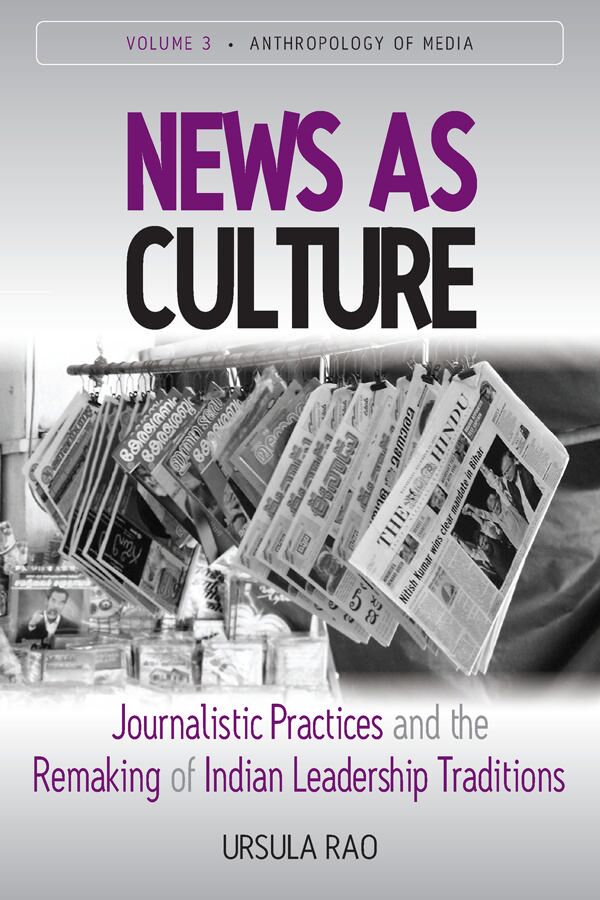
News as culture
At the turn of the millennium, Indian journalism has undergone significant changes. The rapid commercialization of the press, together with an increase in literacy and political consciousness, has led to swift growth in the newspaper market but also changed the way news makers mediate politics. Positioned at a historical junction where India is clearly feeling the effects of market liberalization, this study demonstrates how journalists and informants interactively create new forms of political action and consciousness. The book explores English and Hindi newsmaking and investigates the creation of news relations during the production process and how they affect political images and leadership traditions. It moves beyond the news-room to outline the role of journalists in urban society, the social lives of news texts and the way citizens bring their ideas and desires to bear on the news discourse.
This important volume contributes to an emerging debate about the impact of the media on Indian society. Furthermore, it convincingly demonstrates the inseparable link between media related practices and dynamic cultural repertoires.
eBook