
Catalogue Search | MBRL


Are you sure you want to remove the book from the shelf?

{{itemTitle}}
31
result(s) for
"Aelius Aristides"
Sort by:

Grammarians and Emperors
Abstract
The Greek γραµµατικός combined several functions: as editor and expounder of texts, linguist, librarian, lecturer, courtier and sometimes as ambassador for his monarch or city. In due course Latin-speaking grammatici applied philological skills developed at Alexandria to their own literature, and served as librarians in the great libraries of the imperial period. The present paper studies some Greek γραµµατικοί active in Rome, particularly Alexander of Cotiaeon, appointed by Antoninus Pius as tutor to the princes Marcus and Lucius, and also the teacher of Aelius Aristides. As Aristides' tribute to him shows, Alexander was not only a notable critic and influential teacher, but acted as a benefactor (εὐεργέτης) of his native city, in this respect comparable to the sophists who were his contemporaries.
Journal Article

Narratives of healing: a new approach to the past?
In the long history of interaction between medicine and the arts and humanities, the Hieroi Logoi have been responsible for Aelius Aristides getting a bad press. At least since the tenth century AD, his obsessive interest in his bodily experiences has led to a series of derogatory labels, and he has been retrospectively diagnosed with whatever happened to be fashionable at the time.
Journal Article
The Dreams and Visions of Aelius Aristides
An analysis of the religious experiences of the Greco-Roman sophist, Aelius Aristides. As a member of the cult of Asclepius, Aristides recorded his nocturnal dreams, waking visions and spiritual healings in a diary entitled the Sacred Tales. A study of this diary sheds light on the spiritual environment of the Roman world in the first and second century CE.
eBook

Traum - Mantik - Allegorie
The highly metaphorical language that is used in the dream narratives of the Hieroi Logoi written by the Mysian orator Aelius Aristides has hitherto hardly been assessed in a manner adequate to its depth. In her interpretation of this text that turns out to be heavily loaded with religious meaning, the author of the present monograph deploys an allegorical approach that emerges from her analyses of relevant oneirocritical texts and literature.
eBook
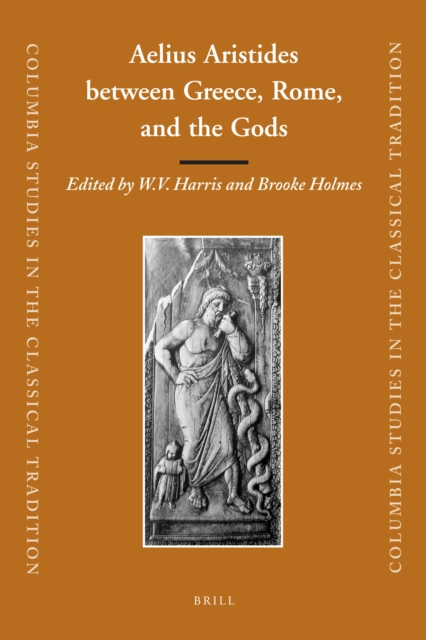
Aelius Aristides between Greece, Rome, and the Gods
This volume, containing fourteen papers given at a conference held at Columbia in 2007, is the most concerted attempt in recent times to understand the famous and enigmatic orator and to set him in his cultural, religious and political context.
eBook

Traum - Mantik - Allegorie
DieMillennium-Studien wollen Grenzen überschreiten, Grenzen zwischen den Epochen und regionalen Räumen wie auch Grenzen zwischen den Disziplinen. Millennium ist international, transdisziplinär und epochenübergreifend ausgerichtet. Das Herausgebergremium und der Beirat repräsentieren ein breites Spektrum von Fächern: Kunst- und literaturwissenschaftliche Beiträge kommen ebenso zu ihrem Rechtwie historische, theologische und philosophische, Beiträge zu den lateinischen und griechischen Kulturen ebenso wie zu den orientalischen.
eBook

Death, Rebirth, and Pilgrimage Experience in Aelius Aristides’ Hieroi Logoi
The close conceptual links between symbolic death, rebirth, and pilgrimage are widely known to modern sociologists and anthropologists and can be observed in several modern pilgrimage traditions. This study argues that the same connections can already be detected in Aristides’ Hieroi Logoi, “the earliest detailed first-person account of pilgrimage that survives from antiquity”. In terms of methodology, this article follows recent scholarly work on ancient lived religion perspectives and religiously motivated mobility that favours a broader understanding of the notion of pilgrimage in the Greek-speaking world. Rutherford, in particular, has produced a plethora of pioneering studies on all aspects of ‘sacred tourism’ experience in various media including documentary papyri, inscriptions, and graffiti. This chapter builds further on Rutherford’s work and focuses on Aristides’ accounts of his visits to smaller, less-well known healing centres. The main aim is to demonstrate how Aristides’ pilgrimage experience to the healing temple of Asclepius at Poimanenos or Poimanenon (a town of ancient Mysia near Cyzicus) is wholly recast and presented in terms of travelling to the sacred site of Eleusis, one of the most important cultural and religious centres of the Roman Empire in the Antonine Era. Thus, Aristides’ pilgrimage experience to Poimanenos is successfully reframed as a mystic initiation that marks the death of the previous ill self and the birth of the new, enlightened, and healthy self.
Journal Article

Communicating disease, care and healing. The role of medical inscriptions and patient reports in temple medicine from classical antiquity to the roman imperial age
The use of the term \"irrational\", when interpreting ancient and contemporary medical systems, is generally based on a bipolar, perhaps two-party, ideological systematization. This is a perspective behind which there is a reifying ideology that defines medical knowledge based on divination and symbolic practices as \"irrational\". Moreover, they are seen as systematized \"beliefs\". However, this approach neglects the extent to which rituals permeate all practices, including those of contemporary biomedicine. Even in the case of ancient medicine, concepts of the natural and the spiritual are not, therefore, connoted as a clear watershed between the rational and the irrational in the reductive sense described above. On the contrary, they are conjugated in a manner that coexists within the same medical system. Starting from this interpretative foundation, it is possible to trace practices of rational medicine in the temples of Asclepius, in accordance with the late testimonies of Hippocratic medicine. Consequently, this paper focuses on demonstrating the continuity between temple medicine and \"rational medicine\" through the communication strategy of the iamata (sanationes) as well as the reports of special patients, such as Aelius Aristides. In addition, the article highlights the political role of writing as a way to regulate the healing not only of the body but also of the civic body. This approach is perfectly consistent with the ancient wisdom and philosophical tradition of overlapping state and body, politics and medicine, lawgivers and physicians.
Journal Article
Society, Medicine and Religion in the Sacred Tales of Aelius Aristides
Aelius Aristides' 'Sacred Tales' offer a unique opportunity to examine how an educated man of the Second Century CE came to terms with illness. This monograph offers a textual analysis of the 'Sacred Tales' in the context of the so-called Second Sophistic; medicine and the medical use of dream interpretation; and religion.
eBook

With All Due Respect to Plato
This article offers a fresh analysis of the tone and argumentative strategies of Orations 2–4 of Aelius Aristides. It suggests that they are a more hostile and destructive exercise than is normally allowed for and that the recent critical consensus that they represent essentially an effort to reconcile philosophy and oratory needs substantial revision; these Orations testify instead to the continuing awkwardness of Plato and philosophy as components of the Greek cultural heritage in the Imperial period, as well as to the ambition of Aristides’ own strategies of self-presentation.
Journal Article