
Catalogue Search | MBRL


Are you sure you want to remove the book from the shelf?

{{itemTitle}}
6,807
result(s) for
"Aerospace engineers."
Sort by:

Shooting for the stars with a rocket scientist
\"In every neighborhood across the country, there's a young dreamer who looks up at the stars and wants to know more. This volume provides an essential outlet for exploration, discovery, and engagement with the cosmos for budding space scientists. Packed with activities that can easily be done at home, as well as vivid, full-color photography and graphics, this book is the missing link between a curious mind and a career as a rocket scientist\"-- Provided by publisher.
Book
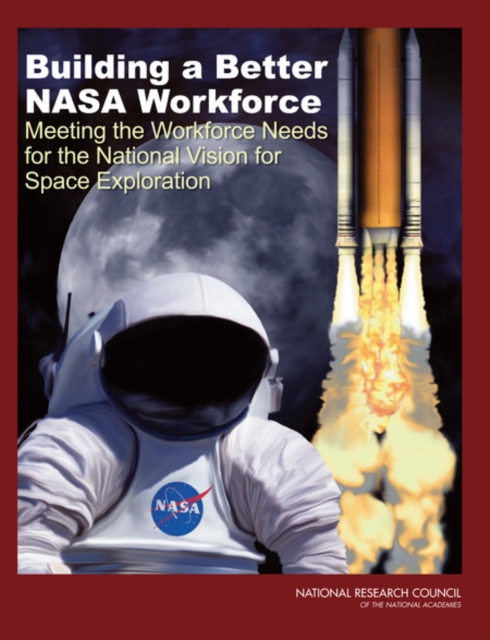
Building a Better NASA Workforce
The Vision for Space Exploration (VSE) announced by President George W. Bush in 2004 sets NASA and the nation on a bold path to return to the Moon and one day put a human on Mars. The long-term endeavor represented by the VSE is, however, subject to the constraints imposed by annual funding. Given that the VSE may take tens of years to implement, a significant issue is whether NASA and the United States will have the workforce needed to achieve that vision. The issues range from short-term concerns about the current workforce's skills for overseeing the development of new spacecraft and launch vehicles for the VSE to long-term issues regarding the training, recruiting, and retaining of scientists and engineers in-house as well as in industry and academia.
Asked to explore science and technology (S&T) workforce needs to achieve the nation's long-term space exploration, the Committee on Meeting the Workforce Needs for the National Vision for Space Exploration concluded that in the short term, NASA does not possess the requisite in-house personnel with the experience in human spaceflight systems development needed to implement the VSE. But the committee acknowledges that NASA is cognizant of this fact and has taken steps to correct it, primarily by seeking to recruit highly skilled personnel from outside NASA, including persons from industry and retirees.
For the long term, NASA has to ask if it is attracting and developing the talent it will need to execute a mission to return to the Moon, and the agency must identify what it needs to do to attract and develop a world-class workforce to explore other worlds. A major challenge for NASA is reorienting its human spaceflight workforce from the operation of current vehicles to the development of new vehicles at least throughout the next decade, as well as starting operations with new rockets and new spacecraft.
The committee emphasizes further that when evaluating its future workforce requirements, NASA has to consider not only programs for students, but also training opportunities for its current employees. NASA's training programs at the agency's various field centers, which are focused on NASA's civil service talent, require support to prevent the agency's internal skill base from withering. Furthermore, NASA faces the risk that, if it fails to nurture its own internal workforce, skilled personnel will be attracted to other government agencies and industry. Building a Better NASA Workforce: Meeting the Workforce Needs for the National Vision for Space Exploration explains the findings and recommendations of the committee.
eBook


Red cosmos
Long before the space race captured the world’s attention, K. E. Tsiolkovskii first conceived of multi-stage rockets that would later be adapted as the basis of both the U.S. and Soviet rocket programs. Often called the grandfather of Russian rocketry, this provincial scientist was even sanctioned by Stalin to give a speech from Red Square on May Day 1935, lauding the Soviet technological future while also dreaming and expounding on his own visions of conquering the cosmos. Later, the Khrushchev regime used him as a \"poster boy\" for Soviet excellence during its Cold War competition with the United States. Ironically, some revisionists have since pointed to such blatant promotion by the Communist Party in an attempt to downplay Tsiolkovskii’s scientific contributions.
eBook

Aerospace engineer Aprille Ericsson
\"An uplifting portrait of a leading NASA engineer describes her childhood ambition to pursue a life in science, her achievement as her university's first woman to receive a Ph.D. in her field and her pivotal role in building history-making spacecraft.\"--Publsiher's description.
Book


Building aircraft and spacecraft : aerospace engineers
This book explores both sides of aerospace engineering: aeronautical and astronautical. Readers will learn the different jobs and tasks that make up this important career, as well as the different technologies aerospace engineers use and design.
Book

Modelling Mars in a sandbox
NASA engineer Marleen Martinez Sundgaard tests landers and rovers before they launch for the red planet.
NASA engineer Marleen Martinez Sundgaard tests landers and rovers before they launch for the red planet.
Journal Article