
Catalogue Search | MBRL


Are you sure you want to remove the book from the shelf?

{{itemTitle}}
112
result(s) for
"Affirmative action programs Government policy United States."
Sort by:


The politics of preference
Sunita Parikh examines the history and fate of affirmative action programs in two ethnically heterogeneous democracies, the United States and India. Affirmative action programs in the United States represent a controversial policy about which the American public feel at best ambivalence and at worst hostility, while in India the expansion of reservation policies in recent years has led to riots and contributed to the fall of governments. And yet these policies were not particularly controversial when they were introduced. How the policy traveled from these auspicious beginnings to its current predicament can best be understood, according to Parikh, by exploring the changing political conditions under which it was introduced, expanded, and then challenged.
Although they are in many respects very different countries, India and the United States are important countries in which to study the implementation of ascriptive policies like affirmative action, according to Parikh. They are both large, heterogeneous societies with democratic political systems in which previously excluded groups were granted benefits by the majorities that had historically oppressed them. Parikh argues that these policies were the product of democratic politics--which required political parties to mobilize existing groups as voters--and the ethnically heterogeneous nature of Indian and U.S. society--where ethnic markers are particularly salient sources of identification as groups. Affirmative action in both countries was introduced because it could be used to solidify and expand electoral coalitions by giving benefits to defined minority groups, according to Parikh. As the policy became better known, it became more disliked by non-targeted groups, and it was no longer an appeal which was cost free for politicians.
This book will be of interest to social scientists concerned with race and ethnic relations and with the comparative study of political and social systems.
Sunita Parikh is Assistant Professor of Political Science, Columbia University.
eBook


Nixon's civil rights : politics, principle, and policy
Kotlowski offers a surprising study of an administration that redirected the course of civil rights in America. He examines such issues as school desegregation, fair housing, voting rights, and affirmative action, as well as Native American and women's rights, and details Nixon's role, revealing a president who favored deeds over rhetoric.
eBook

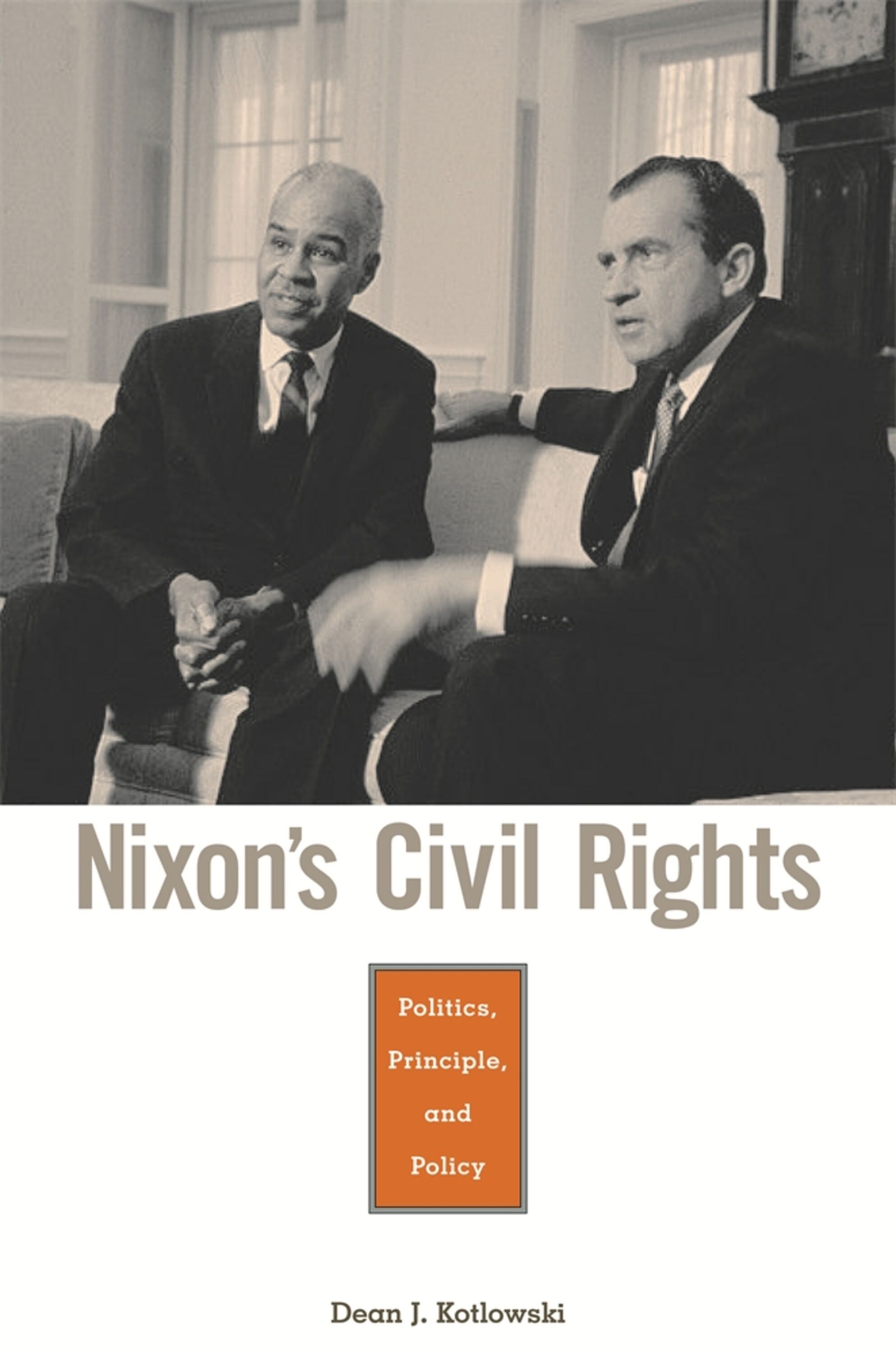
Nixon’s Civil Rights
Richard Nixon believed that history would show his administration in the forefront of civil rights progress. What does the record really say about civil rights under Nixon? In a groundbreaking new book, Dean Kotlowski offers a surprising study of an administration that redirected the course of civil rights in America. Nixon's policymaking recast the civil rights debate from an argument over racial integration to an effort to improve the economic station of disadvantaged groups. Kotlowski examines such issues as school desegregation, fair housing, voting rights, affirmative action, and minority businesses as well as Native American and women's rights. He details Nixon's role, revealing a president who favored deeds over rhetoric and who constantly weighed political expediency and principles in crafting civil rights policy. In moving the debate from the street to the system, Nixon set civil rights on a path whose merits and results are still debated. Nixon's Civil Rights is a revealing portrait of one of the most enigmatic figures of modern American politics and a major contribution to the study of civil rights in America.
eBook

One nation undecided : clear thinking about five hard issues that divide us
\" Let's be honest, we've all expressed opinions about difficult hot-button issues without always thinking them through. With so much media spin, political polarization, and mistrust of institutions, it's hard to know how to think about these tough challenges, much less what to do about them. One Nation Undecided takes on some of today's thorniest issues and walks you through each one step-by-step, explaining what makes it so difficult to grapple with and enabling you to think smartly about it. In this unique what-to-do book, Peter Schuck tackles poverty, immigration, affirmative action, campaign finance, and religious objections to gay marriage and transgender rights. For each issue, he provides essential context; defines key concepts and values; presents the relevant empirical evidence; describes and assesses the programs that now seek to address it; and considers many plausible solutions. Schuck looks at all sides with scrupulous fairness while analyzing them rigorously and factually. Each chapter is self-contained so that readers may pick and choose among the issues that interest and concern them most. His objective is to educate rather than proselytize you--the very nature of these five issues is that they resist clear answers; reasonable people can differ about where they come out on them. No other book provides such a comprehensive, balanced, and accessible analysis of these urgent social controversies. One Nation Undecided gives you the facts and competing values, makes your thinking about them more sophisticated, and encourages you to draw your own conclusions. \"-- Provided by publisher.
Book

The Myth of Affirmative Action
Many White people, and some conservative Black people, believe that affirmative action programs are unfairly depriving more deserving Whites of jobs and education opportunities. The author argues that is a myth. For example, University admissions data demonstrates that, despite affirmative action rhetoric, there remains systemic bias against Black students. Sociological data on criminal record, race, and employment, found that White people with a criminal record had a better chance of getting a call back, than Black people without one. Renowned Professor of Social Work Dr Rudolph Alexander Jr. analyses many examples which demonstrate that the claim that affirmative action programs have led to unfair discrimination against White people of equal ability, is a myth. Though not always comfortable reading, the book is an important addition to the literature on equality, diversity, and critical race theory.
eBook

The Policy Argument for Healthcare Workforce Diversity
This perspectives article considers the potential implications an affirmative action ban would have on patient care in the US. A physician’s race and ethnicity are among the strongest predictors of specialty choice and whether or not a physician cares for Medicaid and uninsured populations. Taking this into account, research suggests that an affirmative action ban in university admissions would sharply reduce the supply of primary care physicians to Medicaid and uninsured populations over the coming decade. Our article compares current conditions to the potential effect of an affirmative action ban by projecting how many future medical students will become primary care physicians for Medicaid and uninsured patients by 2025. Based on previous evidence and current medical student training patterns, we project that a ban could deny primary care access for 1.25 million of our nation’s most vulnerable patients, considerably worsening existing healthcare disparities. More broadly, we argue that the effects of eliminating affirmative action would be fundamentally contrary to the Association of American Medical Colleges’ stated goal of medical education—“to improve the health of all.”
Journal Article
Regents of the University of California v. Bakke
Regents of the University of California v. Bakke was a case brought to the Supreme Court over the use of Affirmative Action in the college admission process. The University of California at Davis Medical School created a minimum minority student quota for the admissions department to fill each year. Bakke, a two-time UC-Davis Med School rejected applicant, sued the school for violation of the Equal Protection Clause of the 14th Amendment and Title VI of the Civil Rights Acts. Ultimately, the Supreme Court justices ruled in support of the goals of Affirmative Action because of incorporation, the idea that the states must adhere to the protections of the Bill of Rights. They also stated that Bakke was, in fact, denied equal protection. This decision, because it was so muddled, did not set long-term precedents or clarifications concerning Affirmative Action. What is Affirmative Action? Affirmative Action is a policy, usually carried out by schools, businesses, government entities, and federal contractors, in which individuals of minority racial status are afforded preferential treatment on the basis of race. Affirmative action came about as part of a desire to rectify the traditional underrepresentation of minority peoples in desirable professions and universities, which negatively impacted their financial and social conditions.
Streaming Video