
Catalogue Search | MBRL


Are you sure you want to remove the book from the shelf?

{{itemTitle}}
75
result(s) for
"Africa -- History -- Autonomy and independence movements"
Sort by:


George Padmore and decolonization from below : pan-Africanism, the Cold War, and the end of empire
01
02
From his base in London, the Trinidad-born Marxist, George Padmore, was a central figure of mid-twentieth century pan-Africanism who became critically involved in debates about the nature and practice of European imperialism. Focusing on Padmore's political manoeuvring, Leslie James traces his politics through the ongoing influence of the Caribbean and the legacy of the Garvey movement; the international communist movement and Soviet decolonization; debates about fascism and colonialism; the new 'reform' rhetoric apparent in World War II; the beginnings of the Cold War; and, pivotally, post-war African politics that confronted a wealth of new dynamics including independent Ghana, apartheid South Africa, and the Mau Mau Emergency in Kenya. Within the ideas and political practice of this forthright man lie a number of common questions about the circulation of ideas, the shape of black radical thought, and the weight of Cold War politics within the modern history of European imperialism and the end of empire.
02
02
This book argues that the rising tide of anti-colonialism after the 1930s should be considered a turning point not just in harnessing a new mood or feeling of unity, but primarily as one that viewed empire, racism, and economic degradation as part of a system that fundamentally required the application of strategy to their destruction.
13
02
Leslie James is Leverhulme Early Career Fellow in the Department of African Studies and Anthropology, University of Birmingham. Prior to this, she was Lecturer in World History at the University of Cambridge. Other publications include the forthcoming volume, Decolonization and the Cold War: Negotiating Independence , co-edited with Elisabeth Leake.
04
02
Introduction: The Artful Anti-Colonialist
1. Origins: 'The Most Completely Political Negro'
2. Putting Empire in Black and White: Padmore's Ideas about Race and Empire
3. 'The Long, Long Night is Over': A War of Opportunity?
4. Writing Anti-Imperial Solidarity from London: George Padmore's Colonial Journalism, 1940-1951
5. The Psychological Moment: The Colonial Office, Pan-Africanism, and the Problem of the Soviet Union, 1946-1950
6. A Buttress for the 'Beacon Light'
7. The Era of Padmore the 'Outsider': Nation, Diaspora, and Modernity, 1950-1956
8. Ghana, Death, and the Afterlife
Conclusion: 'The Soliloquy of Africa'
eBook

African Voices of the Global Past
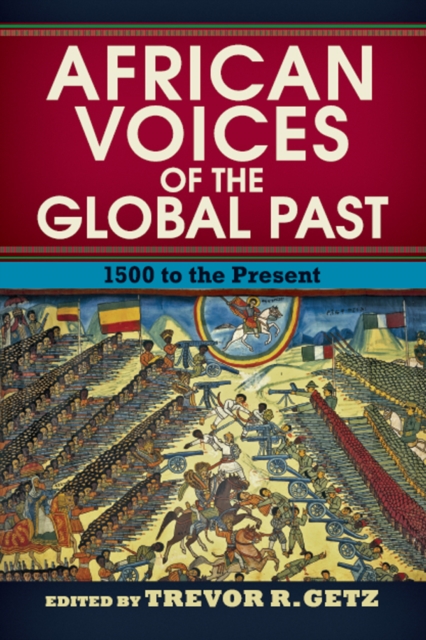
Global historical events are too often recounted exclusively through European and American voices. African Voices of the Global Past explores six major historical developments of global significance - the Atlantic slave trade, industrialization, colonialism, the World Wars, decolonization, and the development of modern feminism - from an African perspective. Voices emerge throughout the text in the form of primary sources that explore the personal accounts of individuals. These enable students to look beyond the indistinct figures of Africans in European and American accounts to see the people directly involved and affected by the major global changes they experienced. Featuring contributed chapters from renowned scholars, many from the continent of Africa or the African diaspora, African Voices of the Global Past offers a unique view of global history from a traditionally overlooked perspective. This book is a perfect supplement for world history and African history instructors seeking to relate a compelling narrative of major world events.
eBook


Self-Determination and Secession in Africa
This book provides a unique comparative study of the major secessionist and self-determination movements in post-colonial Africa, examining theory, international law, charters of the United Nations, and the Organisation of African Unity (OAU)/African Union's (AU) stance on the issue. The book explores whether self-determination and secessionism lead to peace, stability, development and democratisation in conflict-ridden societies, particularly looking at the outcomes in Eritrea and South Sudan.
The book covers all the major attempts at self-determination and secession on the continent, extensively analysing the geo-political, economic, security and ideological factors that determine the outcome of the quest for self-determination and secession. It reveals the lack of inherent clarity in international law, social science theories, OAU/AU Charter, UN Charters and international conventions concerning the topic.
This is a major contribution to the field and highly relevant for researchers and postgraduate students in African Studies, Development Studies, African Politics and History, and Anthropology.
eBook


Sure Road? Nationalisms in Angola, Guinea-Bissau and Mozambique
This book brings together new research on the subject of nations and nationalisms in Angola, Guinea-Bissau and Mozambique. It explores the history and politics of diverse nationalist discourses and ideologies, and it revisits the formation and contemporary developments of national imagined communities in Portuguese-speaking Africa. It does so by drawing on several disciplines and by exploring themes as diverse as Frelimo's liberation literature, UNITA's moral economy and the disaggregation of Guinea-Bissau. The authors provide novel insights in the hope of contributing to the academic and public debate on the subject, not least in those countries where, in the face of liberalisation, ruling parties and their opponents have been arguing intensively over, and have sometime struggled to re-invent, a sense of national community. Through their engagement with the subject, authors also make a contribution to the general discussion of the concepts of nations and nationalism.
eBook

Lusophone Africa
Lusophone Africa is a study of the contemporary cultural production of Portuguese-speaking Africa and its critical engagement with globalization in the aftermath of colonialism, especially since the advent of multiparty politics and market-oriented economies. Fernando Arenas puts forth a conceptual framework for understanding, for the first time, recent cultural and historical developments in Portuguese-speaking Africa.
eBook

The Hot 'Cold War'
This book analyses the causes of armed conflicts in Southern Africa during the Cold War. It examines the influence of the various external forces in the region during this period and their relationship to local movements and governments.
The book focuses on states experiencing violent internal conflict and foreign intervention, that is Angola, Mozambique, Namibia , South Africa and Zimbabwe.
The author provides an unique history of the key part that the Soviet Union played in these developments. Spanning 30 years, the book explores how each country struggled for genuine independence against colonialism and apartheid and their place in the wider conflicts encompassed by the Cold War.
eBook