
Catalogue Search | MBRL


Are you sure you want to remove the book from the shelf?

{{itemTitle}}
195
result(s) for
"Africa Social conditions 21st century."
Sort by:


The Outcast Majority
The Outcast Majorityinvites policymakers, practitioners, academics, students, and others to think about three commanding contemporary issues-war, development, and youth-in new ways. The starting point is the following irony: while African youth are demographically dominant, most see themselves as members of an outcast minority. The irony directly informs young people's lives in war-affected Africa, where differences separating the priorities of youth and those of international agencies are especially prominent.
Drawing on interviews with development experts and young people, Marc Sommers shines a light on this gap and offers guidance on how to close it. He begins with a comprehensive consideration of forces that shape and propel the lives of African youth today, particularly those experiencing or emerging from war. They are contrasted with forces that influence and constrain the international development aid enterprise. The book concludes with a framework for making development policies and practices significantly more relevant and effective for youth in areas affected by African wars and other places where vast and vibrant youth populations reside.
eBook


Fractured Militancy
Drawing on extensive ethnographic fieldwork and
interviews with activists, Fractured
Militancy tells the story of postapartheid
South Africa from the perspective of Johannesburg's impoverished
urban Black neighborhoods. Nearly three decades after
South Africa's transition from apartheid to democracy, widespread
protests and xenophobic attacks suggest that not all is well in the
once-celebrated \"rainbow nation.\"
Marcel Paret traces rising protests back to the process of
democratization and racial inclusion. This process dangled the
possibility of change but preserved racial inequality and economic
insecurity, prompting residents to use militant protests to express
their deep sense of betrayal and to demand recognition and
community development. Underscoring remarkable parallels to
movements such as Black Lives Matter in the United States, this
account attests to an ongoing struggle for Black liberation in the
wake of formal racial inclusion.
Rather than unified resistance, however, class struggles within
the process of racial inclusion produced a fractured militancy.
Revealing the complicated truth behind the celebrated \"success\" of
South African democratization, Paret uncovers a society divided by
wealth, urban geography, nationality, employment, and political
views. Fractured Militancy warns of the threat that
capitalism and elite class struggles present to social movements
and racial justice everywhere.
eBook


Morning in South Africa
This incisive, deeply informed book introduces post-apartheid South Africa to an international audience. South Africa has a history of racism and white supremacy. This crushing historical burden continues to resonate today. Under President Jacob Zuma, South Africa is treading water. Nevertheless, despite calls to undermine the 1994 political settlement characterized by human rights guarantees and the rule of law, distinguished diplomat John Campbell argues that the country's future is bright and that its democratic institutions will weather its current lackluster governance. The book opens with an overview to orient readers to South Africa's historical inheritance. A look back at the presidential inaugurations of Nelson Mandela and Jacob Zuma and Mandela's funeral illustrates some of the ways South Africa has indeed changed since 1994. Reviewing current demographic trends, Campbell highlights the persistent consequences of apartheid. He goes on to consider education, health, and current political developments, including land reform, with an eye on how South Africa's democracy is responding to associated thorny challenges. The book ends with an assessment of why prospects are currently poor for closer South African ties with the West. Campbell concludes, though, that South Africa's democracy has been surprisingly adaptable, and that despite intractable problems, the black majority are no longer strangers in their own country.
eBook

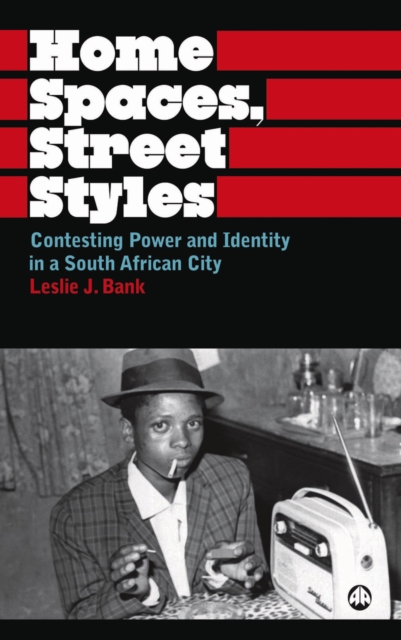
Home Spaces, Street Styles
This book revisits the classic anthropology study - the Xhosa in Town series - based on research in the South African city of East London conducted during the 1950s.
The original studies revealed that there were two opposed responses to urbanisation in East London's African locations, one embracing Westernisation, European values and Christianity and another opposed to it. Leslie Bank returned to the areas of East London studied in the 1950s to assess how social and political changes have transformed these areas, in particular the apartheid reconstruction of the 1960s and 1970s and the struggle for liberation followed by the post-Apartheid period in the 1980s and 1990s.
Bank has added important theoretical insights to this rich ethnography, and forged strong links with issues that transcend the particularities of his urban study.
eBook

The bright continent : breaking rules and making change in modern Africa
A Nigerian-American journalist attempts to dispel the warring, impoverished, and pitiful images of Africa so prevalent in the media with the joyful and innovative country she knows by highlighting the commercial opportunities and technological innovations to be found there.
Book

African Refugees
African Refugees is a comprehensive overview of the
context, causes, and consequences of refugee lives, discussing
issues, policies, and solutions for African refugees around the
world. It covers overarching topics such as human rights, policy
frameworks, refugee protection, and durable solutions, as well as
less-studied topics such as refugee youths, refugee camps, LGBTQ
refugees, urban refugees, and refugee women. It also takes on rare
but emergent topics such as citizenship and the creativity of
African refugees.
Toyin Falola and Olajumoke Yacob-Haliso showcase the voices and
experiences of individual refugees through the sweep of history to
tell the African refugee story from the historical past through
current developments, covering the full range of experience from
the causes of flight to living in exile, all while maintaining a
persistent focus on the complicated search for solutions.
African Refugees recognizes African agency and
contributions in pursuit of solutions for African refugees over
time but avoids the pitfalls of the colonial gaze-where refugees
are perpetually pathologized and Africa is always the sole cause of
its own problems-seeking to complicate these narratives by
recognizing African refugee issues within exploitative global,
colonial, and neo-colonial systems of power.
eBook