
Catalogue Search | MBRL


Are you sure you want to remove the book from the shelf?

{{itemTitle}}
719,911
result(s) for
"African–American"
Sort by:

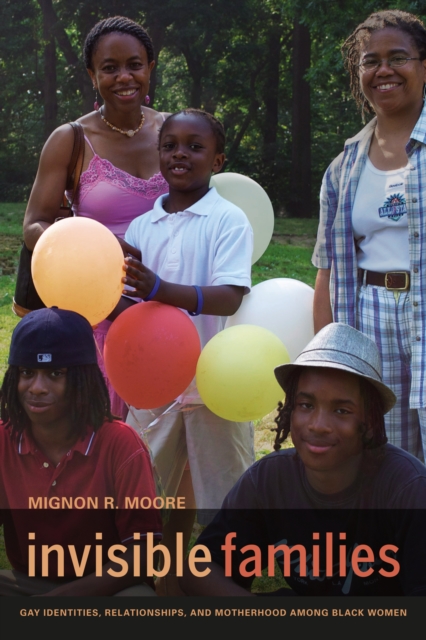
Invisible families
Mignon R. Moore brings to light the family life of a group that has been largely invisible—gay women of color—in a book that challenges long-standing ideas about racial identity, family formation, and motherhood. Drawing from interviews and surveys of one hundred black gay women in New York City, Invisible Families explores the ways that race and class have influenced how these women understand their sexual orientation, find partners, and form families. In particular, the study looks at the ways in which the past experiences of women who came of age in the 1960s and 1970s shape their thinking, and have structured their lives in communities that are not always accepting of their openly gay status. Overturning generalizations about lesbian families derived largely from research focused on white, middle-class feminists, Invisible Families reveals experiences within black American and Caribbean communities as it asks how people with multiple stigmatized identities imagine and construct an individual and collective sense of self.
eBook

Supreme models : iconic black women who revolutionized fashion
\"The first-ever book celebrating black models, filled with revealing essays, interviews, and stunning photographs\"--Provided by publisher.
BOOK

Your average nigga : performing race, literacy, and masculinity
An engrossing autobiographical exploration of black masculinity as a mode of racial and verbal performance.
eBook

Hear our truths : the creative potential of black girlhood
\"This volume examines how 'Saving Our Lives Hear Our Truths,' or SOLHOT, a radical youth intervention, provides a space for the creative performance and expression of Black girlhood and how this creativity informs other realizations about Black girlhood and womanhood.\"--Page 4 of cover.
BOOK
Finding Charity's Folk
Finding Charity's Folkhighlights the experiences of enslaved Maryland women who negotiated for their own freedom, many of whom have been largely lost to historical records. Based on more than fifteen hundred manumission records and numerous manuscript documents from a diversity of archives, Jessica Millward skillfully brings together African American social and gender history to provide a new means of using biography as a historical genre.
Millward opens with a striking discussion about how researching the life of a single enslaved woman, Charity Folks, transforms our understanding of slavery and freedom in Revolutionary America. For African American women such as Folks, freedom, like enslavement, was tied to a bondwoman's reproductive capacities. Their offspring were used to perpetuate the slave economy. Finding loopholes in the law meant that enslaved women could give birth to and raise free children. For Millward, Folks demonstrates the fluidity of the boundaries between slavery and freedom, which was due largely to the gendered space occupied by enslaved women. The gendering of freedom influenced notions of liberty, equality, and race in what became the new nation and had profound implications for African American women's future interactions with the state.
eBook

Contemporary plays by African American women : ten complete works
African American women have increasingly begun to see their plays performed from regional stages to Broadway. Yet many of these artists still struggle to gain attention. In this volume, Sandra Adell draws from the vital wellspring of works created by African American women in the twenty-first century to present ten plays by both prominent and up-and-coming writers. Taken together, the selections portray how these women engage with history as they delve into--and shake up--issues of gender and class to craft compelling stories of African American life. Gliding from gritty urbanism to rural landscapes, these works expand boundaries and boldly disrupt modes of theatrical representation.
Book

Ida B. Wells-Barnett and American reform, 1880-1930
Pioneering African American journalist Ida B. Wells-Barnett (18621931) is widely remembered for her courageous antilynching crusade in the 1890s; the full range of her struggles against injustice is not as well known. With this book, Patricia Schechter restores Wells-Barnett to her central, if embattled, place in the early reform movements for civil rights, womens suffrage, and Progressivism in the United States and abroad. Schechters comprehensive treatment makes vivid the scope of Wells-Barnetts contributions and examines why the political philosophy and leadership of this extraordinary activist eventually became marginalized. Though forced into the shadow of black male leaders such as W. E. B. Du Bois and Booker T. Washington and misunderstood and then ignored by white women reformers such as Frances E. Willard and Jane Addams, Wells-Barnett nevertheless successfully enacted a religiously inspired, female-centered, and intensely political vision of social betterment and empowerment for African American communities throughout her adult years. By analyzing her ideas and activism in fresh sharpness and detail, Schechter exposes the promise and limits of social change by and for black women during an especially violent yet hopeful era in U.S. history.
eBook

Heaven is all goodbyes
\"This is truly revolutionary poetry. From the corner store to the dilapidated school, from the alleys between downtown office buildings to the prison, voices that have been through too much to care and yet still struggle on, relate the post-industrial U.S. Black experience. A vortex of images, observations, inspired leaps and free associations spill forth from a choir living in oppression and transience, invisible to and dismissive of the mainstream bourgeoisie. Moments of political and spiritual convergence, gangsterism and revolution, surrealism and blunt materiality are captured in the music of metaphor and pure intention. A modern-day Mystic, a true Seer, the depth of the poet's own humanity is rooted in every line, creating a liberated space for pain and beauty through a healing love for his people\"-- Provided by publisher.
Book

Opportunity Denied
Blacks and Whites. Men and Women. Historically, each group has held very different types of jobs. The divide between these jobs was stark-clean or dirty, steady or inconsistent, skilled or unskilled. In such a rigidly segregated occupational landscape, race and gender radically limited labor opportunities, relegating Black women to the least desirable jobs.Opportunity Deniedis the first comprehensive look at changes in race, gender, and women's work across time, comparing the labor force experiences of Black women to White women, Black men and White men. Enobong Hannah Branch merges empirical data with rich historical detail, offering an original overview of the evolution of Black women's work.
From free Black women in 1860 to Black women in 2008, the experience of discrimination in seeking and keeping a job has been determinedly constant. Branch focuses on occupational segregation before 1970 and situates the findings of contemporary studies in a broad historical context, illustrating how inequality can grow and become entrenched over time through the institution of work.
eBook