
Catalogue Search | MBRL


Are you sure you want to remove the book from the shelf?

{{itemTitle}}
107,429
result(s) for
"African American Studies"
Sort by:

Black girls and adolescents : facing the challenges
\"This one-of-a kind book challenges the current thinking about Black girls to show how America has failed them--and what can be done to make their lives better\"-- Provided by publisher.
Book

The Sovereignty of Quiet
African American culture is often considered expressive, dramatic, and even defiant. InThe Sovereignty of Quiet, Kevin Quashie explores quiet as a different kind of expressiveness, one which characterizes a person's desires, ambitions, hungers, vulnerabilities, and fears. Quiet is a metaphor for the inner life, and as such, enables a more nuanced understanding of black culture.The book revisits such iconic moments as Tommie Smith and John Carlos's protest at the 1968 Mexico City Olympics and Elizabeth Alexander's reading at the 2009 inauguration of Barack Obama. Quashie also examines such landmark texts as Gwendolyn Brooks'sMaud Martha, James Baldwin'sThe Fire Next Time, and Toni Morrison'sSulato move beyond the emphasis on resistance, and to suggest that concepts like surrender, dreaming, and waiting can remind us of the wealth of black humanity.
eBook

The psychology of Black boys and adolescents
\"Drawing on personal insights and research-based knowledge, this important work facilitates understanding of the psychological struggles of young African American males and offers ameliorative strategies\"-- Provided by publisher.
Book

The Practice of Citizenship
In the years between the American Revolution and the U.S. Civil War, as legal and cultural understandings of citizenship became more racially restrictive, black writers articulated an expansive, practice-based theory of citizenship. Grounded in political participation, mutual aid, critique and revolution, and the myriad daily interactions between people living in the same spaces, citizenship, they argued, is not defined by who one is but, rather, by what one does.In The Practice of Citizenship, Derrick R. Spires examines the parallel development of early black print culture and legal and cultural understandings of U.S. citizenship, beginning in 1787, with the framing of the federal Constitution and the founding of the Free African Society by Absalom Jones and Richard Allen, and ending in 1861, with the onset of the Civil War. Between these two points he recovers understudied figures such as William J. Wilson, whose 1859 \"Afric-American Picture Gallery\" appeared in seven installments in The Anglo-African Magazine, and the physician, abolitionist, and essayist James McCune Smith. He places texts such as the proceedings of black state conventions alongside considerations of canonical figures such as Frances Ellen Watkins Harper and Frederick Douglass.Reading black print culture as a space where citizenship was both theorized and practiced, Spires reveals the degree to which concepts of black citizenship emerged through a highly creative and diverse community of letters, not easily reducible to representative figures or genres. From petitions to Congress to Frances Harper's parlor fiction, black writers framed citizenship both explicitly and implicitly, the book demonstrates, not simply as a response to white supremacy but as a matter of course in the shaping of their own communities and in meeting their own political, social, and cultural needs.
eBook

African American gothic : screams from shadowed places
\"African American Gothic: Screams from Shadowed Places is a new study of African American literary interventions into the gothic genre. The book investigates how African American authors have utilized the genre since its very beginnings in America to represent the real horrors of Black life in country haunted by racism. Re-reading major African American literary texts--such as Narrative of the Life of Frederick Douglass, Of One Blood, Cane, Invisible Man, and Corregidora--African American Gothic investigates texts from each major era in African American Culture to show how the gothic has consistently circulated throughout the African American literary canon\"-- Provided by publisher.
Book

Race and the Obama Administration
The election of Barack Obama marked a critical point in American political and social history. Did the historic election of a black president actually change the status of blacks in the United States? Did these changes (or lack thereof) inform blacks' perceptions of the President? This book explores these questions by comparing Obama's promotion of substantive and symbolic initiatives for blacks to efforts by the two previous presidential administrations. By employing a comparative analysis, the reader can judge whether Obama did more or less to promote black interests than his predecessors. Taking a more empirical approach to judging Barack Obama, this book hopes to contribute to current debates about the significance of the first African American presidency. It takes care to make distinctions between Obama's substantive and symbolic accomplishments and to explore the significance of both.
eBook


The Colored Conventions Movement
This volume of essays is the first to focus on the Colored Conventions movement, the nineteenth century's longest campaign for Black civil rights. Well before the founding of the NAACP and other twentieth-century pillars of the civil rights movement, tens of thousands of Black leaders organized state and national conventions across North America. Over seven decades, they advocated for social justice and against slavery, protesting state-sanctioned and mob violence while demanding voting, legal, labor, and educational rights. While Black-led activism in this era is often overshadowed by the attention paid to the abolition movement, this collection centers Black activist networks, influence, and institution building. Collectively, these essays highlight the vital role of the Colored Conventions in the lives of thousands of early organizers, including many of the most famous writers, ministers, politicians, and entrepreneurs in the long history of Black activism. Contributors: Erica L. Ball, Kabria Baumgartner, Daina Ramey Berry, Joan L. Bryant, Jim Casey, Benjamin Fagan, P. Gabrielle Foreman, Eric Gardner, Andre E. Johnson, Cheryl Janifer LaRoche, Sarah Lynn Patterson, Carla L. Peterson, Jean Pfaelzer, Selena R. Sanderfer, Derrick R. Spires, Jermaine Thibodeaux, Psyche Williams-Forson, and Jewon Woo. Explore accompanying exhibits and historical records at The Colored Conventions Project website: https://coloredconventions.org/
eBook

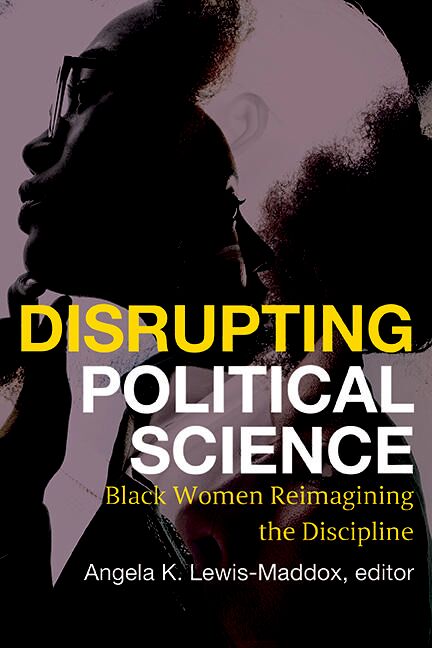
Disrupting Political Science
Nineteen Black women in political science share their
personal and professional journeys, shedding light on the state
of the discipline-and how it needs to change.
This volume brings to the fore Black women's experiences of,
and contributions to, political science-a field that never
intended to view them as subjects worthy of study and certainly
not as professors.
Disrupting Political Science demonstrates how Black
women blend creative resistance and self-care to overcome
obstacles and navigate the discipline's hegemonic demands.
Representing a range of career stages and types of
institutions, the nineteen contributors share stories of trauma
and triumph, as well as concrete guidance rooted in Black
feminist literature and reports on the profession. A witty,
searing, sometimes heart-wrenching catalyst to reimagine
political science,
Disrupting Political Science is essential reading for
everyone in the discipline and for faculty and administrators
across the university committed to recruiting and retaining
Black women.
eBook