
Catalogue Search | MBRL


Are you sure you want to remove the book from the shelf?

{{itemTitle}}
54
result(s) for
"African American girls Poetry."
Sort by:

Black girl you are Atlas
\"Poet Renée Watson looks back at her childhood and urges readers to look forward at their futures with love, understanding, and celebration in this fully illustrated poetry collection\"-- Provided by publisher.
Book

Aphrodite's Daughters
The Harlem Renaissance was a watershed moment for racial uplift, poetic innovation, sexual liberation, and female empowerment.Aphrodite's Daughtersintroduces us to three amazing women who were at the forefront of all these developments, poetic iconoclasts who pioneered new and candidly erotic forms of female self-expression.
Maureen Honey paints a vivid portrait of three African American women-Angelina Weld Grimké, Gwendolyn B. Bennett, and Mae V. Cowdery-who came from very different backgrounds but converged in late 1920s Harlem to leave a major mark on the literary landscape. She examines the varied ways these poets articulated female sexual desire, ranging from Grimké's invocation of a Sapphic goddess figure to Cowdery's frank depiction of bisexual erotics to Bennett's risky exploration of the borders between sexual pleasure and pain. Yet Honey also considers how they were united in their commitment to the female body as a primary source of meaning, strength, and transcendence.
The product of extensive archival research,Aphrodite's Daughtersdraws from Grimké, Bennett, and Cowdery's published and unpublished poetry, along with rare periodicals and biographical materials, to immerse us in the lives of these remarkable women and the world in which they lived. It thus not only shows us how their artistic contributions and cultural interventions were vital to their own era, but also demonstrates how the poetic heart of their work keeps on beating.
eBook
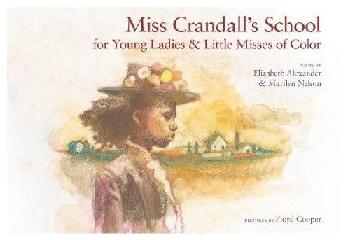
Miss Crandall's school for young ladies and little misses of color : poems
Poets Elizabeth Alexander and Marilyn Nelson tell the story of Prudence Crandall's school for African American girls opened in 1833.
Book

Anita's Plight: Challenging Low Expectations for a Black Girl in a Montreal High School
In this paper, I examine how a Black adolescent girl in a Montreal high school contests low teacher expectations that resulted in her being directed to a vocational program (Formation a un metier semi-specialise, FMS) in her high school. The FMS program prepares children for entry-level careers, defined in the Quebec curriculum as semi-skilled jobs. I (re)present her account in the form of a narrative found poem that explores how the use of found poetry as a heuristic device improves understanding of the school practices impacting the student's placement in the FMS program. The found poem offers a critical reading of her resistance as she tries to remain likable to power brokers who can determine her future. It also contributes to research on how a Black girl in high school may experience adultification when the child, parent, and school relationship is unproductive. This original research ultimately fills the knowledge gap by providing examples of everyday mundane Montreal school practices that can result in the exclusion of Black children from the regular academic school pathways that lead to a high school diploma. While broad implications cannot be drawn from this single case, the paper concludes with recommendations for, and further questions about, school practices that can support Black girls' dreams for themselves. Keywords: Black girls' education, found poetry, Montreal High School, education inequality, vocational program
Journal Article

The playbook : 52 rules to aim, shoot, and score in this game called life
\"Kwame Alexander shares poetry and inspiring lessons about the rules of life, as well as uplifting quotes from athletes such as Stephen Curry and Venus Williams and other exemplars like Sonia Sotomayor and Michelle Obama in this motivational and inspirational book just right for graduates of any age and anyone needing a little encouragement\"-- Provided by publisher.
Book

The Intellectual World of Phillis Wheatley and the Politics of Genius
This article examines the life and work of Phillis Wheatley and her interlocutors to consider how African-descended people conceptualized liberty and formed an intellectual community during the American Revolution. Her poetry and epistolary exchanges, shared with a range of acquaintances in the Atlantic World, reveal an intellectual universe that she created for herself and one that drew her into the political spotlight. Leaders of the founding generation began to question the intellectual possibilities for an African girl in ways that held political implications for the future of slavery. I argue that Wheatley's life and work opens critical avenues for exploring intellectualism as an aspiration of Black life in early America, and that her world of ideas sheds light on the possibilities of Black girlhood in the late eighteenth century.
Journal Article

Venus in Two Acts
This essay examines the ubiquitous presence of Venus in the archive of Atlantic slavery and wrestles with the impossibility of discovering anything about her that hasn't already been stated. As an emblematic figure of the enslaved woman in the Atlantic world, Venus makes plain the convergence of terror and pleasure in the libidinal economy of slavery and, as well, the intimacy of history with the scandal and excess of literature. In writing at the limit of the unspeakable and the unknown, the essay mimes the violence of the archive and attempts to redress it by describing as fully as possible the conditions that determine the appearance of Venus and that dictate her silence.
Journal Article

Creating Spaces for Black Adolescent Girls to \Write It Out!\
Identity and literacy development are two critical processes shaping the life trajectories of adolescents. Identity development in particular can present unique issues for Black adolescent girls, who are positioned in ways to negotiate their identity(ies) when presented with hegemonic language and representations of what is beauty and what is “Black.” Writing becomes a key literacy practice for Black adolescent girls to make meaning of their identity(ies). Although there are a growing number of studies on literacy and identity development of Black adolescent girls, few studies address writing. A single case study is conducted with a Black adolescent girl who struggles with selfhood to explore how she makes meaning of her identity through writing. She discusses writing within a Black adolescent female summer writing institute juxtaposed with school classrooms. Writing within the summer institute afforded opportunities for her to self‐exert selfhood, while in‐school writing assignments offer little opportunities for self‐expression.
FREE author podcast
Journal Article

Spiritual Interrogations
The late eighteenth century witnessed an influx of black women to the slave-trading ports of the American Northeast. The formation of an early African American community, bound together by shared experiences and spiritual values, owed much to these women's voices. The significance of their writings would be profound for all African Americans' sense of their own identity as a people.
Katherine Clay Bassard's book is the first detailed account of pre-Emancipation writings from the period of 1760 to 1863, in light of a developing African American religious culture and emerging free black communities. Her study--which examines the relationship among race, culture, and community--focuses on four women: the poet Phillis Wheatley and poet and essayist Ann Plato, both Congregationalists; and the itinerant preacher Jarena Lee, and Shaker eldress Rebecca Cox Jackson, who, with Lee, had connections with African Methodism.
Together, these women drew on what Bassard calls a \"spirituals matrix,\" which transformed existing literary genres to accommodate the spiritual music and sacred rituals tied to the African diaspora. Bassard's important illumination of these writers resurrects their path-breaking work. They were cocreators, with all black women who followed, of African American intellectual life.
eBook

Ntozake Shange and a Literary Genealogy of Black Girlhood
Wright presents an essay which honors Ntozake Shange's contributions to the field of black girlhood studies by considering her poems within a broader network of writing on girlhood in African American literature. The author places Shange in a literary genealogy of black girlhood from its earliest iterations in the nineteenth century to the 1970s. Representations of black girls in the nineteenth and early decades of the twentieth centuries were expressed in various rhetorical iterations- nurtured and protected, self-directed and self-protected, corrected and domesticated- by black women and black men wielding community standards of conduct, demands, and values to mold her into a shifting notion of the definitive citizenship model for the race.
Journal Article