
Catalogue Search | MBRL


Are you sure you want to remove the book from the shelf?

{{itemTitle}}
95
result(s) for
"African American women -- Biography -- History and criticism"
Sort by:

New media in Black women's autobiography : intrepid embodiment and narrative innovation
\" Using 1980 as a starting point, Curtis explores how black women's insistence on writing embodiment into their narratives addresses and supplants images deployed against them. She argues that although many stereotypes rely on the notion that black female identity comes only from and through the body, emphasis on corporeality serves these women well. Joining somatic experience with complicated inner lives compels at least understanding and perhaps empathy. Privileging their experiences as the only road to truths about their lives succeeds across formats. Deployed by black women, new media facilitate well-executed, defiant, creative autobiographical gestures that should be considered among the most effective and innovative in their respective milieus\"-- Provided by publisher.
Book

Speaking Power
In Speaking Power, DoVeanna S. Fulton explores and analyzes the use of oral traditions in African American women's autobiographical and fictional narratives of slavery. African American women have consistently employed oral traditions not only to relate the pain and degradation of slavery, but also to celebrate the subversions, struggles, and triumphs of Black experience. Fulton examines orality as a rhetorical strategy, its role in passing on family and personal history, and its ability to empower, subvert oppression, assert agency, and create representations for the past. In addition to taking an insightful look at obscure or little-studied slave narratives like Louisa Picquet, the Octoroon and the Narrative of Sojourner Truth, Fulton also brings a fresh perspective to more familiar works, such as Harriet Jacobs's Incidents in the Life of a Slave Girl and Harriet Wilson's Our Nig, and highlights Black feminist orality in such works as Zora Neale Hurston's Their Eyes Were Watching God and Gayl Jones's Corregidora.
eBook

The life and times of Hannah Crafts : the true story of The Bondwoman's Narrative
\"A groundbreaking study of the first Black female novelist and her life as an enslaved woman, from the biographer who solved the mystery of her identity, with a preface by Henry Louis Gates Jr.\"-- Provided by publisher.
Book

Harriet Tubman
Harriet Tubman’s name is known world-wide and her exploits as a self-liberated Underground Railroad heroine are celebrated in children’s literature, film, and history books, yet no major biography of Tubman has appeared since 1943. Jean M. Humez’s comprehensive Harriet Tubman is both an important biographical overview based on extensive new research and a complete collection of the stories Tubman told about her life—a virtual autobiography culled by Humez from rare early publications and manuscript sources. This book will become a landmark resource for scholars, historians, and general readers interested in slavery, the Underground Railroad, the Civil War, and African American women. Born in slavery in Maryland in or around 1820, Tubman drew upon deep spiritual resources and covert antislavery networks when she escaped to the north in 1849. Vowing to liberate her entire family, she made repeated trips south during the 1850s and successfully guided dozens of fugitives to freedom. During the Civil War she was recruited to act as spy and scout with the Union Army. After the war she settled in Auburn, New York, where she worked to support an extended family and in her later years founded a home for the indigent aged. Celebrated by her primarily white antislavery associates in a variety of private and public documents from the 1850s through the 1870s, she was rediscovered as a race heroine by woman suffragists and the African American women’s club movement in the early twentieth century. Her story was used as a key symbolic resource in education, institutional fundraising, and debates about the meaning of \"race\" throughout the twentieth century. Humez includes an extended discussion of Tubman’s work as a public performer of her own life history during the nearly sixty years she lived in the north. Drawing upon historiographical and literary discussion of the complex hybrid authorship of slave narrative literature, Humez analyzes the interactive dynamic between Tubman and her interviewers. Humez illustrates how Tubman, though unable to write, made major unrecognized contributions to the shaping of her own heroic myth by early biographers like Sarah Bradford. Selections of key documents illustrate how Tubman appeared to her contemporaries, and a comprehensive list of primary sources represents an important resource for scholars.
eBook
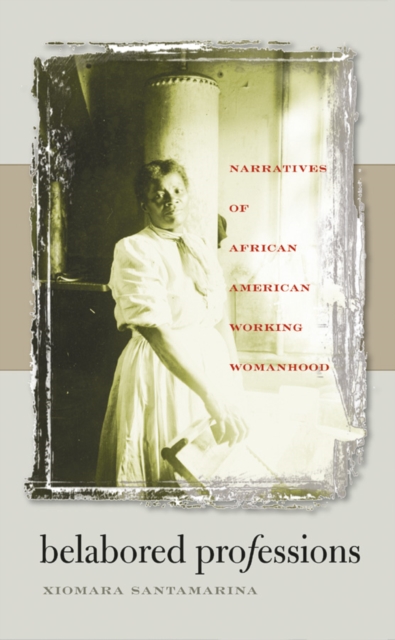
Belabored professions : narratives of African American working womanhood
According to nineteenth-century racial uplift ideology, African American women served their race best as reformers and activists, or as \"doers of the word.\" In Belabored Professions, Xiomara Santamarina examines the autobiographies of four women who diverged from that ideal and defended the legitimacy of their self-supporting wage labor. Santamarina focuses on The Narrative of Sojourner Truth, Eliza Potters A Hairdressers Experience in High Life, Harriet Wilsons Our Nig, and Elizabeth Keckleys Behind the Scenes. She argues that beyond black reformers' calls for abolitionist work, these former slaves and freeborn black women wrote about their own overlooked or disparaged work as socially and culturally valuable to the nation. They promoted the status of wage labor as a mark of self-reliance and civic virtue when many viewed African American working women as \"drudges.\" As Santamarina demonstrates, these texts offer modern readers new perspectives on the emergence of the vital African American autobiographical tradition, dramatizing the degree to which black working women participated in and shaped American rhetorics of labor, race, and femininity.
eBook

Sites of Southern Memory
In southern graveyards through the first decades of the twentieth century, the Confederate South was commemorated by tombstones and memorials, in Confederate flags, and in Memorial Day speeches and burial rituals. Cemeteries spoke the language of southern memory, and identity was displayed in ritualistic form-inscribed on tombs, in texts, and in bodily memories and messages. Katharine DuPre Lumpkin, Lillian Smith, and Pauli Murray wove sites of regional memory, particularly Confederate burial sites, into their autobiographies as a way of emphasizing how segregation divided more than just southern landscapes and people.
Darlene O'Dell here considers the southern graveyard as one of three sites of memory-the other two being the southern body and southern memoir-upon which the region's catastrophic race relations are inscribed. O'Dell shows how Lumpkin, Smith, and Murray, all witnesses to commemorations of the Confederacy and efforts to maintain the social order of the New South, contended through their autobiographies against Lost Cause versions of southern identity. Sites of Southern Memory elucidates the ways in which these three writers joined in the dialogue on regional memory by placing the dead southern body as a site of memory within their texts.
In this unique study of three women whose literary and personal lives were vitally concerned with southern race relations and the struggle for social justice, O'Dell provides a telling portrait of the troubled intellectual, literary, cultural, and social history of the American South.
eBook

Autobiography as Activism
A study of three Black Power narratives as instruments for radical social change
Angela Davis, Assata Shakur (a.k.a. JoAnne Chesimard), and Elaine Brown are the only women activists of the Black Power movement who have published book-length autobiographies. In bearing witness to that era, these militant newsmakers wrote in part to educate and to mobilize their anticipated readers.
In this way, Davis'sAngela Davis: An Autobiography(1974), Shakur'sAssata(1987), and Brown'sA Taste of Power: A Black Woman's Story(1992) can all be read as extensions of the writers' political activism during the 1960s.
Margo V. Perkins's critical analysis of their books is less a history of the movement (or of women's involvement in it) than an exploration of the politics of storytelling for activists who choose to write their lives. Perkins examines how activists use autobiography to connect their lives to those of other activists across historical periods, to emphasize the link between the personal and the political, and to construct an alternative history that challenges dominant or conventional ways of knowing.
The histories constructed by these three women call attention to the experiences of women in revolutionary struggle, particularly to the ways their experiences have differed from men's. The women's stories are told from different perspectives and provide different insights into a movement that has been much studied from the masculine perspective. At times they fill in, complement, challenge, or converse with the stories told by their male counterparts, and in doing so, hint at how the present and future can be made less catastrophic because of women's involvement.
The multiple complexities of the Black Power movement become evident in reading these women's narratives against each other as well as against the sometimes strikingly different accounts of their male counterparts.
As Davis, Shakur, and Brown recount events in their lives, they dispute mainstream assumptions about race, class, and gender and reveal how the Black Power struggle profoundly shaped their respective identities.
Recipient of Mississippi University for Women's Eudora Welty Prize, 1999
Margo V. Perkins is an assistant professor of English and American studies at Trinity College in Hartford, Connecticut.
eBook

Aphrodite's Daughters
The Harlem Renaissance was a watershed moment for racial uplift, poetic innovation, sexual liberation, and female empowerment.Aphrodite's Daughtersintroduces us to three amazing women who were at the forefront of all these developments, poetic iconoclasts who pioneered new and candidly erotic forms of female self-expression.
Maureen Honey paints a vivid portrait of three African American women-Angelina Weld Grimké, Gwendolyn B. Bennett, and Mae V. Cowdery-who came from very different backgrounds but converged in late 1920s Harlem to leave a major mark on the literary landscape. She examines the varied ways these poets articulated female sexual desire, ranging from Grimké's invocation of a Sapphic goddess figure to Cowdery's frank depiction of bisexual erotics to Bennett's risky exploration of the borders between sexual pleasure and pain. Yet Honey also considers how they were united in their commitment to the female body as a primary source of meaning, strength, and transcendence.
The product of extensive archival research,Aphrodite's Daughtersdraws from Grimké, Bennett, and Cowdery's published and unpublished poetry, along with rare periodicals and biographical materials, to immerse us in the lives of these remarkable women and the world in which they lived. It thus not only shows us how their artistic contributions and cultural interventions were vital to their own era, but also demonstrates how the poetic heart of their work keeps on beating.
eBook

Black Women of the Harlem Renaissance Era
The Harlem Renaissance is considered one of the most significant periods of creative and intellectual expression for African Americans.Beginning as early as 1914 and lasting into the 1940s, this era saw individuals reject the stereotypes of African Americans and confront the racist, social, political, and economic ideas that denied them.
eBook

Phillis Wheatley
WithPoems on Various Subjects, Religious and Moral(1773), Phillis Wheatley (1753?-1784) became the first English-speaking person of African descent to publish a book and only the second woman-of any race or background- to do so in America. Written in Boston while she was just a teenager, and when she was still a slave, Wheatley's work was an international sensation. InPhillis Wheatley, Vincent Carretta offers the first full-length biography of a figure whose origins and later life have remained shadowy despite her iconic status.
A scholar with extensive knowledge of transatlantic literature and history, Carretta uncovers new details about Wheatley's origins, her upbringing, and how she gained freedom. Carretta solves the mystery of John Peters, correcting the record of when he and Wheatley married and revealing what became of him after her death. Assessing Wheatley's entire body of work, Carretta discusses the likely role she played in the production, marketing, and distribution of her writing. Wheatley developed a remarkable transatlantic network that transcended racial, class, political, religious, and geographical boundaries. Carretta reconstructs that network and sheds new light on her religious and political identities. In the course of his research he discovered the earliest poem attributable to Wheatley and has included it and other unpublished poems in the biography.
Carretta relocates Wheatley from the margins to the center of her eighteenth-century transatlantic world, revealing the fascinating life of a woman who rose from the indignity of enslavement to earn wide recognition, only to die in obscurity a few years later.
eBook