
Catalogue Search | MBRL


Are you sure you want to remove the book from the shelf?

{{itemTitle}}
2,397
result(s) for
"African Americans -- Social life and customs"
Sort by:


Sacral Grooves, Limbo Gateways
\"We're seeing people that we didn't know exist,\" the director of FEMA acknowledged in the wake of Hurricane Katrina. Sacral Grooves, Limbo Gateways offers a corrective to some of America's institutionalized invisibilities by delving into the submerged networks of ritual performance, writing, intercultural history, and migration that have linked the coastal U.S. South with the Caribbean and the wider Atlantic world. This interdisciplinary study slips beneath the bar of rigid national and literary periods, embarking upon deeper-more rhythmic and embodied-signatures of time. It swings low through ecologies and symbolic orders of creolized space. And it reappraises pluralistic modes of knowledge, kinship, and authority that have sustained vital forms of agency (such as jazz) amid abysses of racialized trauma. Drawing from Haitian Vodou and New Orleanian Voudou and from Cuban and South Floridian Santería, as well as from Afro-Baptist (Caribbean, Geechee, and Bahamian) models of encounters with otherness, this book reemplaces deep-southern texts within the counterclockwise ring-stepping of a long Afro-Atlantic modernity. Turning to an orphan girl's West African initiation tale to follow a remarkably traveled body of feminine rites and writing (in works by Paule Marshall, Zora Neale Hurston, Lydia Cabrera, William Faulkner, James Weldon Johnson, and LeAnne Howe, among others), Cartwright argues that only in holistic form, emergent from gulfs of cross-cultural witness, can literary and humanistic authority find legitimacy. Without such grounding, he contends, our educational institutions blind and even poison students, bringing them to \"swallow lye,\" like the grandson of Phoenix Jackson in Eudora Welty's \"A Worn Path.\" Here, literary study may open pathways to alternative medicines-fetched by tenacious avatars like Phoenix (or an orphan Kumba or a shell-shaking Turtle)-to remedy the lies our partial histories have made us swallow.
eBook

To serve the living : funeral directors and the African American way of death
\"From antebellum slavery to the twenty-first century, African American funeral directors have orchestrated funerals or \"home-going\" ceremonies with dignity and pageantry. As entrepreneurs in a largely segregated trade, they were among the few black individuals in any community who were economically independent and not beholden to the local white power structure. Most important, their financial freedom gave them the ability to support the struggle for civil rights and, indeed, to serve the living as well as bury the dead.\" \"During the Jim Crow era, black funeral directors relied on racial segregation to secure their foothold in America's capitalist marketplace. With the dawning of the civil rights age, these entrepreneurs were drawn into the movement to integrate American society, but were also uncertain how racial integration would affect their business success. From the beginning, this tension between personal gain and community service shaped the history of African American funeral directing.\" \"For African Americans, death was never simply the end of life, and funerals were not just occasions to mourn. In the \"hush harbors\" of the slave quarters, African Americans first used funerals to bury their dead and to plan a path to freedom. Similarly, throughout the long - and often violent - struggle for racial equality in the twentieth century, funeral directors aided the cause by honoring the dead while supporting the living. To Serve the Living offers a history of how African American funeral directors have been integral to the fight for freedom.\"--BOOK JACKET.
Book

Urban Nightlife
Sociologists have long been curious about the ways in which city dwellers negotiate urban public space. How do they manage myriad interactions in the shared spaces of the city? InUrban Nightlife, sociologist Reuben May undertakes a nuanced examination of urban nightlife, drawing on ethnographic data gathered in a Deep South college town to explore the question of how nighttime revelers negotiate urban public spaces as they go about meeting, socializing, and entertaining themselves.
May's work reveals how diverse partiers define these spaces, in particular the ongoing social conflict on the streets, in bars and nightclubs, and in the various public spaces of downtown. To explore this conflict, May develops the concept of \"integrated segregation\"-the idea that diverse groups are physically close to one another yet rarely have meaningful interactions-rather, they are socially bound to those of similar race, class, and cultural backgrounds. May's in-depth research leads him to conclude that social tension is stubbornly persistent in part because many participants fail to make the connection between contemporary relations among different groups and the historical and institutional forces that perpetuate those very tensions; structural racism remains obscured by a superficial appearance of racial harmony.
Through May's observations,Urban Nightlifeclarifies the complexities of race, class, and culture in contemporary America, illustrating the direct influence of local government and nightclub management decision-making on interpersonal interaction among groups.
Watch a video with Reuben A. Buford May:Watch video now. (http://www.youtube.com/watch?v=VCs1xExStPw).
eBook


The Jim Crow Routine
The South's system of Jim Crow racial oppression is usually understood in terms of legal segregation that mandated the separation of white and black Americans. Yet, as Stephen A. Berrey shows, it was also a high-stakes drama that played out in the routines of everyday life, where blacks and whites regularly interacted on sidewalks and buses and in businesses and homes. Every day, individuals made, unmade, and remade Jim Crow in how they played their racial roles--how they moved, talked, even gestured. The highly visible but often subtle nature of these interactions constituted the Jim Crow routine.In this study of Mississippi race relations in the final decades of the Jim Crow era, Berrey argues that daily interactions between blacks and whites are central to understanding segregation and the racial system that followed it. Berrey shows how civil rights activism, African Americans' refusal to follow the Jim Crow script, and national perceptions of southern race relations led Mississippi segregationists to change tactics. No longer able to rely on the earlier routines, whites turned instead to less visible but equally insidious practices of violence, surveillance, and policing, rooted in a racially coded language of law and order. Reflecting broader national transformations, these practices laid the groundwork for a new era marked by black criminalization, mass incarceration, and a growing police presence in everyday life.
eBook


The Beat
The Beat!was the first book to explore the musical, social, and cultural phenomenon of go-go music. In this new edition, updated by a substantial chapter on the current scene, authors Kip Lornell and Charles C. Stephenson, Jr., place go-go within black popular music made since the middle 1970s--a period during which hip-hop has predominated. This styling reflects the District's African American heritage. Its super-charged drumming and vocal combinations of hip-hop, funk, and soul evolved and still thrive on the streets of Washington, D.C., and in neighboring Prince George's County, making it the most geographically compact form of popular music.
Go-go--the only musical form indigenous to Washington, D.C.--features a highly syncopated, nonstop beat and vocals that are spoken as well as sung. The book chronicles its development and ongoing popularity, focusing on many of its key figures and institutions, including established acts such as Chuck Brown (the Godfather of Go-Go), Experience Unlimited, Rare Essence, and Trouble Funk; well-known DJs, managers, and promoters; and filmmakers who have incorporated it into their work. Now updated and back in print,The Beat!provides longtime fans and those who study American musical forms a definitive look at the music and its makers.
eBook

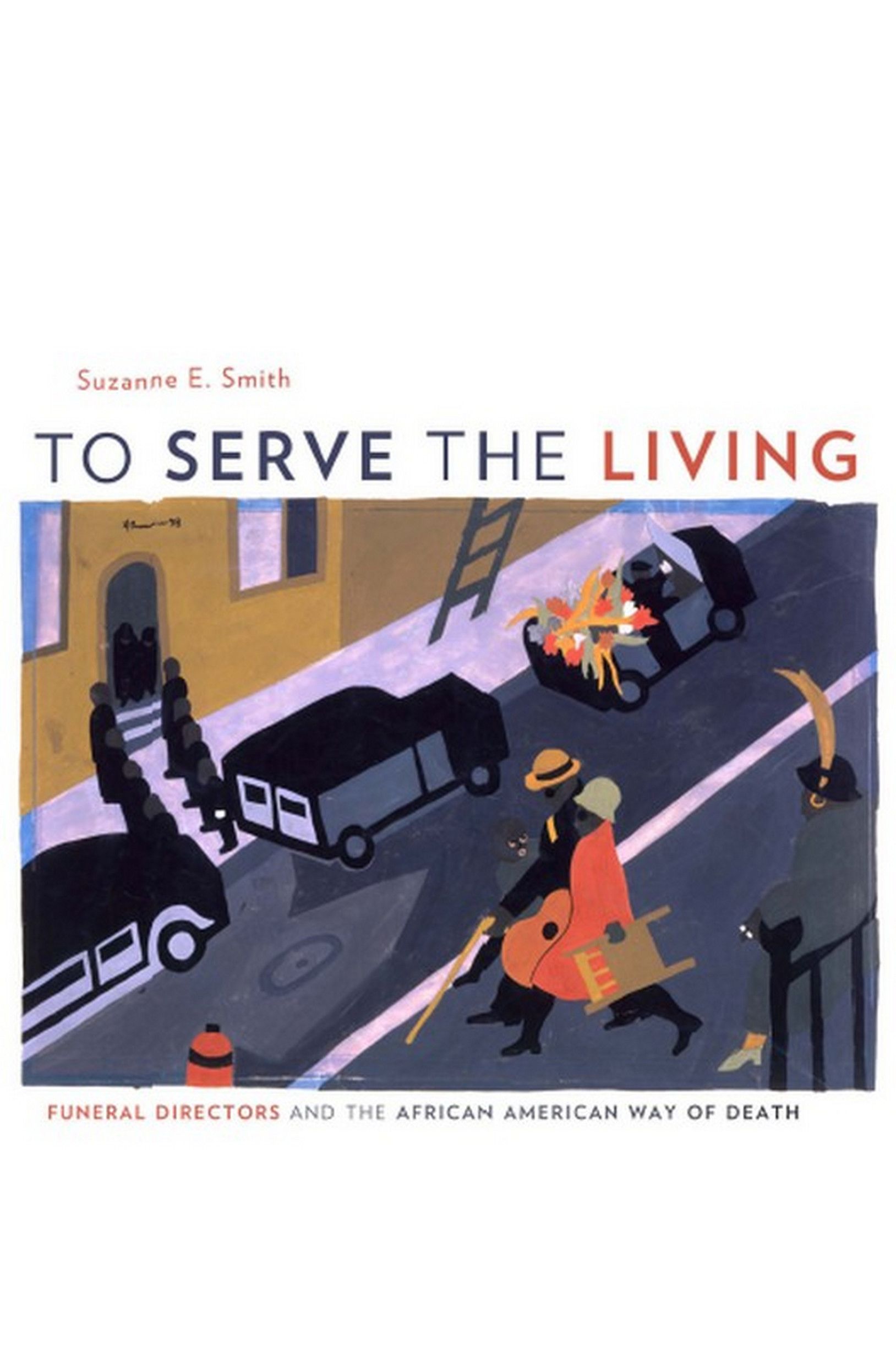
To serve the living : funeral directors and the African American way of death
From antebellum slavery to the twenty-first century, African American funeral directors have orchestrated funerals or \"homegoing\" ceremonies with dignity and pageantry. As entrepreneurs in a largely segregated trade, they were among the few black individuals in any community who were economically independent and not beholden to the local white power structure. Most important, their financial freedom gave them the ability to support the struggle for civil rights and, indeed, to serve the living as well as bury the dead.
During the Jim Crow era, black funeral directors relied on racial segregation to secure their foothold in America's capitalist marketplace. With the dawning of the civil rights age, these entrepreneurs were drawn into the movement to integrate American society, but were also uncertain how racial integration would affect their business success. From the beginning, this tension between personal gain and community service shaped the history of African American funeral directing.
For African Americans, death was never simply the end of life, and funerals were not just places to mourn. In the \"hush harbors\" of the slave quarters, African Americans first used funerals to bury their dead and to plan a path to freedom. Similarly, throughout the long—and often violent—struggle for racial equality in the twentieth century, funeral directors aided the cause by honoring the dead while supporting the living. To Serve the Living offers a fascinating history of how African American funeral directors have been integral to the fight for freedom.
eBook