
Catalogue Search | MBRL


Are you sure you want to remove the book from the shelf?

{{itemTitle}}
2,299
result(s) for
"African Americans Folklore."
Sort by:

The annotated African American folktales
\"[This text] includes introductory essays, nearly 150 African American stories, 20 seminal African tales as historical background, the familiar Brer Rabbit classics, as well as news-making vernacular tales from the 1890s' Southern Workman, a section of Caribbean and Latin American folktales, and approximately 200 museum-quality images and illustrations throughout\"--Amazon.com.
Book

Black Folklore and the Politics of Racial Representation
Before the innovative work of Zora Neale Hurston, folklorists
from the Hampton Institute collected, studied, and wrote about
African American folklore. Like Hurston, these folklorists worked
within but also beyond the bounds of white mainstream institutions.
They often called into question the meaning of the very folklore
projects in which they were engaged.
Shirley Moody-Turner analyzes this output, along with the
contributions of a disparate group of African American authors and
scholars. She explores how black authors and folklorists were
active participants--rather than passive observers--in
conversations about the politics of representing black folklore.
Examining literary texts, folklore documents, cultural
performances, legal discourse, and political rhetoric, Black
Folklore and the Politics of Racial Representation
demonstrates how folklore studies became a battleground across
which issues of racial identity and difference were asserted and
debated at the turn of the twentieth century. The study is framed
by two questions of historical and continuing import. What role
have representations of black folklore played in constructing
racial identity? And, how have those ideas impacted the way African
Americans think about and creatively engage black traditions?
Moody-Turner renders established historical facts in a new light
and context, taking figures we thought we knew--such as Charles
Chesnutt, Anna Julia Cooper, and Paul Laurence Dunbar--and
recasting their place in African American intellectual and cultural
history.
eBook


Frankie and Johnny
Originating in a homicide in St. Louis in 1899, the ballad of “Frankie and Johnny\" became one of America’s most familiar songs during the first half of the twentieth century. It crossed lines of race, class, and artistic genres, taking form in such varied expressions as a folk song performed by Huddie Ledbetter (Lead Belly); a ballet choreographed by Ruth Page and Bentley Stone under New Deal sponsorship; a mural in the Missouri State Capitol by Thomas Hart Benton; a play by John Huston; a motion picture, She Done Him Wrong, that made Mae West a national celebrity; and an anti-lynching poem by Sterling Brown. In this innovative book, Stacy I. Morgan explores why African American folklore—and “Frankie and Johnny\" in particular—became prized source material for artists of diverse political and aesthetic sensibilities. He looks at a confluence of factors, including the Harlem Renaissance, the Great Depression, and resurgent nationalism, that led those creators to engage with this ubiquitous song. Morgan’s research uncovers the wide range of work that artists called upon African American folklore to perform in the 1930s, as it alternately reinforced and challenged norms of race, gender, and appropriate subjects for artistic expression. He demonstrates that the folklorists and creative artists of that generation forged a new national culture in which African American folk songs featured centrally not only in folk and popular culture but in the fine arts as well.
eBook

The people could fly : the picture book
In this retelling of a folktale, a group of slaves, unable to bear their sadness and starvation any longer, calls upon the African magic that allows them to fly away.
Book

Born in a mighty bad land : the violent man in African American folklore and fiction
The figure of the violent man in the African American imagination has a long history. He can be found in 19th-century bad man ballads like Stagolee and John Hardy, as well as in the black convict recitations that influenced gangsta rap. Born in a Mighty Bad Land connects this figure with similar characters in African American fiction. Many writers -- McKay and Hurston in the Harlem Renaissance; Wright, Baldwin, and Ellison in the '40s and '50s; Himes in the '50s and '60s -- saw the bad nigger as an archetypal figure in the black imagination and psyche. Blaxploitation novels in the '70s made him a virtually mythical character. More recently, Mosley, Wideman, and Morrison have presented him as ghetto philosopher and cultural adventurer. Behind the folklore and fiction, many theories have been proposed to explain the source of the bad man's intra-racial violence. Jerry H. Bryant explores all of these elements in a wide-ranging and illuminating look at one of the most misunderstood figures in African American culture.
eBook

African American folktales
Gathers together nearly 50 of the most important African American folktales along with introductions and suggestions for further reading.
Book
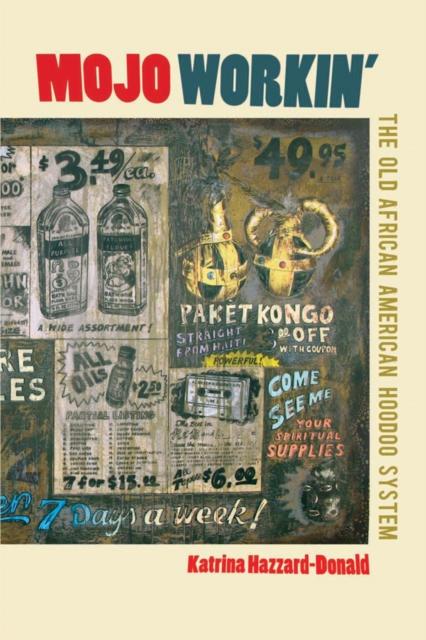
Mojo Workin
Katrina Hazzard-Donald explores African Americans' experience and practice of the herbal, healing folk belief tradition known as Hoodoo. She examines Hoodoo culture and history by tracing its emergence from African traditions to religious practices in the Americas. Working against conventional scholarship, Hazzard-Donald argues that Hoodoo emerged first in three distinct regions she calls \"regional Hoodoo clusters\" and that after the turn of the nineteenth century, Hoodoo took on a national rather than regional profile. The spread came about through the mechanism of the \"African Religion Complex,\" eight distinct cultural characteristics familiar to all the African ethnic groups in the United States. _x000B__x000B_The first interdisciplinary examination to incorporate a full glossary of Hoodoo culture, Mojo Workin': The Old African American Hoodoo System lays out the movement of Hoodoo against a series of watershed changes in the American cultural landscape. Hazzard-Donald examines Hoodoo material culture, particularly the \"High John the Conquer\" root, which practitioners employ for a variety of spiritual uses. She also examines other facets of Hoodoo, including rituals of divination such as the \"walking boy\" and the \"Ring Shout,\" a sacred dance of Hoodoo tradition that bears its corollaries today in the American Baptist churches. Throughout, Hazzard-Donald distinguishes between \"Old tradition Black Belt Hoodoo\" and commercially marketed forms that have been controlled, modified, and often fabricated by outsiders; this study focuses on the hidden system operating almost exclusively among African Americans in the Black spiritual underground._x000B_
eBook

The tales of Uncle Remus : the adventures of Brer Rabbit
A retelling of the African-American tales about the adventures and misadventures of Brer Rabbit and his friends and enemies.
Book

From trickster to badman : the Black folk hero in slavery and freedom
To protect their identity and values, Africans enslaved in America transformed various familiar character types to create folk heroes who offered models of behavior both recognizable to them as African people and adaptable to their situation in America.
Roberts specifically examines the Afro-American trickster and the trickster tale tradition, the conjurer as folk hero, the biblical heroic tradition, and the badman as outlaw hero.
eBook