
Catalogue Search | MBRL


Are you sure you want to remove the book from the shelf?

{{itemTitle}}
32
result(s) for
"African Americans Music Political aspects History 20th century."
Sort by:


Freedom Song
Melding memorable music and inspiring history, Freedom Song presents a fresh perspective on the civil rights movement by showing how songs of hope, faith, and freedom strengthened the movement and served as its voice. In this eye-opening account, you'll discover how churches and other groups--from the SNCC Freedom Singers to the Chicago Children's Choir--transformed music both religious and secular into electrifying anthems that furthered the struggle for civil rights. From rallies to marches to mass meetings, music was ever-present in the movement. People sang songs to give themselves courage and determination, to spread their message to others, to console each other as they sat in jail. The music they shared took many different forms, including traditional spirituals once sung by slaves, jazz and blues music, and gospel, folk, and pop songs. Freedom Song explores in detail the galvanizing roles of numerous songs, including \"Lift Every Voice and Sing,\" \"The Battle of Jericho,\" \"Wade in the Water,\" and \"We Shall Overcome.\" As Rosa Parks, Martin Luther King Jr., and many others took a stand against prejudice and segregation, a Chicago minister named Chris Moore started a children's choir that embraced the spirit of the civil rights movement and brought young people of different races together, young people who lent their voices to support African Americans struggling for racial equality. More than 50 years later, the Chicago Children's Choir continues its commitment to freedom and justice. An accompanying CD, Songs on the Road to Freedom, features the CCC performing the songs discussed throughout the book.
eBook


Pulse of the People
Hip-Hop music encompasses an extraordinarily diverse range of approaches to politics. Some rap and Hip-Hop artists engage directly with elections and social justice organizations; others may use their platform to call out discrimination, poverty, sexism, racism, police brutality, and other social ills. InPulse of the People, Lakeyta M. Bonnette illustrates the ways rap music serves as a vehicle for the expression and advancement of the political thoughts of urban Blacks, a population frequently marginalized in American society and alienated from electoral politics.
Pulse of the Peoplelays a foundation for the study of political rap music and public opinion research and demonstrates ways in which political attitudes asserted in the music have been transformed into direct action and behavior of constituents. Bonnette examines the history of rap music and its relationship to and extension from other cultural and political vehicles in Black America, presenting criteria for identifying the specific subgenre of music that is political rap. She complements the statistics of rap music exposure with lyrical analysis of rap songs that espouse Black Nationalist and Black Feminist attitudes. Touching on a number of critical moments in American racial politicsincluding the 2008 and 2012 elections and the cases of the Jena 6, Troy Davis, and Trayvon MartinPulse of the Peoplemakes a compelling case for the influence of rap music in the political arena and greatly expands our understanding of the ways political ideologies and public opinion are formed.
eBook

Anthem : social movements and the sound of solidarity in the African diaspora
\"For people of African descent, music constitutes a unique domain of expression. From traditional West African drumming to South African kwaito, from spirituals to hip-hop, Black life and history has been dynamically displayed and contested through sound. Shana Redmond excavates the sonic histories of these communities through a genre emblematic of Black solidarity and citizenship: anthems. An interdisciplinary cultural history, Anthem reveals how this \"sound franchise\" contributed to the growth and mobilization of the modern, Black citizen. Providing new political frames and aesthetic articulations for protest organizations and activist-musicians, Redmond reveals the anthem as a crucial musical form following World War I. Beginning with the premise that an analysis of the composition, performance, and uses of Black anthems allows for a more complex reading of racial and political formations within the twentieth century, Redmond expands our understanding of how and why diaspora was a formative conceptual and political framework of modern Black identity. By tracing key compositions and performances around the world--from James Weldon Johnson's \"Lift Ev'ry Voice and Sing\" that mobilized the NAACP to Nina Simone's \"To Be Young, Gifted & Black\" which became the Black National Anthem of the Congress of Racial Equality (CORE)--Anthem develops a robust recording of Black social movements in the twentieth century that will forever alter the way you hear race and nation. Shana L. Redmond is Assistant Professor of American Studies and Ethnicity at the University of Southern California. She is a former musician and labor organizer\"-- Provided by publisher.
Book

The Great White Way
Broadway musicals are one of America's most beloved art forms and play to millions of people each year. But what do these shows, which are often thought to be just frothy entertainment, really have to say about our country and who we are as a nation?
The Great White Wayis the first book to reveal the racial politics, content, and subtexts that have haunted musicals for almost one hundred years fromShow Boat(1927) toThe Scottsboro Boys(2011). Musicals mirror their time periods and reflect the political and social issues of their day. Warren Hoffman investigates the thematic content of the Broadway musical and considers how musicals work on a structural level, allowing them to simultaneously present and hide their racial agendas in plain view of their audiences. While the musical is informed by the cultural contributions of African Americans and Jewish immigrants, Hoffman argues that ultimately the history of the American musical is the history of white identity in the United States.
Presented chronologically,The Great White Wayshows how perceptions of race altered over time and how musicals dealt with those changes. Hoffman focuses first on shows leading up to and comprising the Golden Age of Broadway (1927-1960s), then turns his attention to the revivals and nostalgic vehicles that defined the final quarter of the twentieth century. He offers entirely new and surprising takes on shows from the American musical canon-Show Boat(1927),Oklahoma!(1943),Annie Get Your
Gun(1946),The Music Man(1957),West Side Story(1957),A Chorus Line(1975), and42nd Street(1980), among others.New archival research on the creators who produced and wrote these shows, including Leonard Bernstein, Jerome Robbins, Stephen Sondheim, and Edward Kleban, will have theater fans and scholars rethinking forever how they view this popular American entertainment.
eBook
Thinking While Black
This uniquely interdisciplinary study of Black cultural critics Armond White and Paul Gilroy spans continents and decades of rebellion and revolution. Drawing on an eclectic mix of archival research, politics, film theory, and pop culture, Daniel McNeil examines two of the most celebrated and controversial Black thinkers working today. Thinking While Black takes us on a transatlantic journey through the radical movements that rocked against racism in 1970s Detroit and Birmingham, the rhythms of everyday life in 1980s London and New York, and the hype and hostility generated by Oscar-winning films like 12 Years a Slave. The lives and careers of White and Gilroy—along with creative contemporaries of the post–civil rights era such as Bob Marley, Toni Morrison, Stuart Hall, and Pauline Kael—should matter to anyone who craves deeper and fresher thinking about cultural industries, racism, nationalism, belonging, and identity.
eBook
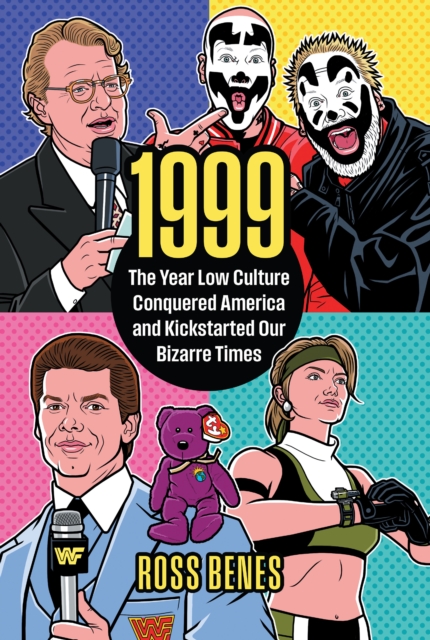
1999
From pro wrestling and Pokémon to Insane Clown Posse
and Jerry Springer, this look at the low culture of the late
’90s reveals its profound impact and how it continues to
affect our culture and society today.
The year 1999 was a high-water mark for popular culture.
According to one measure, it was the “best movie year
ever.” But as journalist Ross Benes shows, the end of the
’90s was also a banner year for low culture. This was the
heyday of Jerry Springer, Jenna Jameson, and Vince McMahon, among
many others. Low culture had come into its own and was poised for
world domination. The reverberations of this takeover continue to
shape American society.
During its New Year’s Eve countdown, MTV entered 1999
with Limp Bizkit covering Prince’s famous anthem to the new
year. The highlights of the lowlights continued when WCW and WWE
drew 35 million American viewers each week with sex appeal and
stories about insurrections. Insane Clown Posse emerged from the
underground with a Woodstock set and platinum records about magic
and murder. Later that year,
Dance Dance Revolution debuted in North America and
Grand Theft Auto emerged as a major video game
franchise. Beanie Babies and Pokémon so thoroughly seized
the wallets and imagination of collectors that they created
speculative investment bubbles that anticipated the faddish
obsession over nonfungible tokens (NFTs). The trashy talk show
Jerry Springer became daytime TV’s most-watched
program and grew so mainstream that
Austin Powers ,
Sabrina the Teenage Witch ,
The Wayans Bros. ,
The Simpsons , and
The X-Files incorporated Springer into their own plots
during the late ’90s. Donald Trump even explored a
potential presidential nomination with the Reform Party in 1999
and wanted his running mate to be Oprah Winfrey, whose own talk
show would make Dr. Oz a household name.
Benes shows us how so
many of the strangest features of culture in 1999 predicted and
influenced American life today. This wild ride through pop
culture uncovers the connections between the kayfabe of WWE and
the theatrics of politics, between the faddish obsession with
Beanie Babies and with NFTs, between faithful fans and political
loyalists, between violent video games and society’s
scapegoats, and much more.
1999 is not just a nostalgic look at the past. It is
also a window into our contentious present.
eBook

Freedom Sounds
An insightful examination of the impact of the Civil Rights Movement and African Independence on jazz in the 1950s and 60s, this book traces the complex relationships among music, politics, aesthetics, and activism through the lens of the hot button racial and economic issues of the time. It illustrates how the contentious and soul-searching debates in the Civil Rights, African Independence, and Black Power movements shaped aesthetic debates and exerted a moral pressure on musicians to take action. Throughout, its arguments show how jazz musicians' quest for self-determination as artists and human beings also led to fascinating and far-reaching musical explorations and a lasting ethos of social critique and transcendence. Across a broad body of issues of cultural and political relevance, the book considers the discursive, structural, and practical aspects of life in the jazz world of the 1950s and 1960s. In domestic politics, the book explores the desegregation of the American Federation of Musicians, the politics of playing to segregated performance venues in the 1950s, the participation of jazz musicians in benefit concerts, and strategies of economic empowerment. Issues of transatlantic importance such as the effects of anticolonialism and African nationalism on the politics and aesthetics of the music are also examined, from Paul Robeson's interest in Africa, to the State Department jazz tours, to the interaction of jazz musicians such as Art Blakey and Randy Weston with African diasporic aesthetics. It explores musicians' aesthetic agency in synthesizing influential forms of musical expression from a multiplicity of stylistic and cultural influences—African American music, popular song, classical music, African diasporic aesthetics, and other world music—through examples from cool jazz, hard bop, modal jazz, and the avant-garde. By considering the differences between aesthetic and socio-economic mobility, it presents a fresh interpretation of debates over cultural ownership, racism, reverse racism, and authenticity.
eBook

See Me Naked
Pleasure refers to the freedom to pursue a desire, deliberately sought in order to satisfy the self. Putting pleasure first is liberating. During their extraordinary lives, Lena Horne, Moms Mabley, Yolande DuBois, and Memphis Minnie enjoyed pleasure as they gave pleasure to both those in their lives and to the public at large. They were Black women who, despite their public profiles, whether through Black society or through the world of entertainment, discovered ways to enjoy pleasure.They left home, undertook careers they loved, and did what they wanted, despite perhaps not meeting the standards for respectability in the interwar era. See Me Naked looks at these women as representative of other Black women of the time, who were watched, criticized, and judged by their families, peers, and, in some cases, the government, yet still managed to enjoy themselves. Among the voyeurs of Black women was Langston Hughes, whose novel Not Without Laughter was clearly a work of fiction inspired by women he observed in public and knew personally, including Black clubwomen, blues performers, and his mother. How did these complicated women wrest loose from the voyeurs to define their own sense of themselves? At very young ages, they found and celebrated aspects of themselves. Using examples from these women's lives, Green explores their challenges and achievements.
eBook