
Catalogue Search | MBRL


Are you sure you want to remove the book from the shelf?

{{itemTitle}}
37,732
result(s) for
"African Americans Research."
Sort by:


Beyond Stock Stories and Folktales: African Americans' Paths to STEM Fields
Ask practically any academic department chair why they do not have more African Americans among faculty members and they generally respond with stock stories or folktales, which stimulated the title of this volume. Stock stories are akin to grand narratives that explain 'why things are' in ways that satisfy those in dominant positions. Frierson and Tate argue it is time to move beyond these. The purpose of the book is to provide historical, conceptual, and empirically-based analyses focused on the development of African Americans in STEM fields. There is rarely any real understanding of the uneven contours of the education pipeline or the transition to academic life experienced in these situations and this volume will shed light on opportunities to advance African American attainment in STEM disciplines throughout the academic and professional spectra, and the mitigation of disparities that continue to be so prevalent. The editors hope that it will generate discussions and actions that are based on empirical evidence and policy analyses, rather than long standing stock stories and folktales that misrepresent the paths linked to African Americans' attainment in STEM fields.
eBook

Historical Foundations of Black Reflective Sociology
John H. Stanfield II, a leading historian of Black social science, distills decades of his research and thinking in a set of articles—some original to the volume, others from fugitive sources—that trace the trajectories of Black scholars and scholarship in relationship to the broader African American experience over the past two centuries. Stanfield’s signature contributions to this research tradition range from the role of philanthropy in the study and life of African Americans to institutional racism in sociology and the impacts of race on scholarly careers. His analyses run from global formulations to individual biographies, including his own, and stretch from the early decades of social science to the present. This work creates a nuanced historical context for reflective Black sociology that will be of interest to social historians, sociologists, and scholars of color from all disciplines.
eBook

Blaming the Poor : The Long Shadow of the Moynihan Report on Cruel Images about Poverty
\"In 1965, the late Senator Daniel Patrick Moynihan--then a high-ranking official in the Department of Labor--sparked a firestorm when he released his report \"The Negro Family,\" which came to be regarded by both supporters and detractors as an indictment of African American culture. Blaming the Poor examines the regrettably durable impact of the Moynihan Report for race relations and social policy in America, challenging the humiliating image the report cast on poor black families and its misleading explanation of the causes of poverty. A leading authority on poverty and racism in the United States, Susan D. Greenbaum dismantles Moynihan's main thesis--that the so called matriarchal structure of the African American family \"feminized\" black men, making them inadequate workers and absent fathers, and resulting in what he called a tangle of pathology that led to a host of ills, from teen pregnancy to adult crime. Drawing on extensive scholarship, Greenbaum highlights the flaws in Moynihan's analysis. She reveals how his questionable ideas have been used to redirect blame for substandard schools, low wages, and the scarcity of jobs away from the societal forces that cause these problems, while simultaneously reinforcing stereotypes about African Americans. Greenbaum also critiques current policy issues that are directly affected by the tangle of pathology mindset--the demonization and destruction of public housing; the criminalization of black youth; and the continued humiliation of the poor by entrepreneurs who become rich consulting to teachers, non-profits, and social service personnel. A half century later, Moynihan's thesis remains for many a convenient justification for punitive measures and stingy indifference to the poor. Blaming the Poor debunks this infamous thesis, proposing instead more productive and humane policies to address the enormous problems facing us today. \"-- Provided by publisher.
Book
Black Reflective Sociology
John H. Stanfield II, the leading contemporary Black sociologist of knowledge, distills decades of his research and thinking in a set of articles-some original to the volume, others from fugitive sources-that address race in the formation of epistemologies, theories, and methodologies in social science. Stanfield's contributions to the discipline, such as the adoption of restorative justice as an anti-racism solution in multiracial societies and the development of African diasporic sociological reasoning, are highlighted here. Ranging widely across theoretical, methodological, and substantive topics, Stanfield creates a reflective sociology viewed through an African diasporic lens that enriches the thinking and practice of social science.
eBook

Black Power 50
\"Published in conjunction with a major 2016 exhibit at New York's Schomburg Center for Research in Black Culture, Black Power 50 includes original interviews with key figures from the movement, essays from today's leading Black Power scholars, and more than one hundred ... images from the Schomburg's ... archives, offering [an] ... introduction to the history and meaning of this ... movement\"-- Provided by publisher.
Book
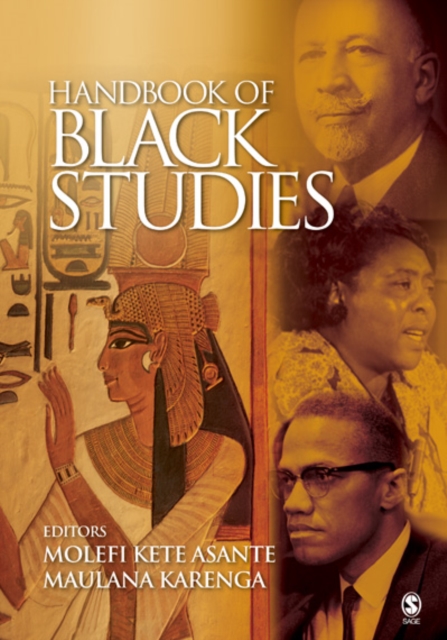
Handbook of black studies
The Handbook of Black Studies is the first resource to bring together research and scholarship in the field of African-American studies in one volume. Editors Molefi Kete Asante and Maulana Karenga, along with a pre-eminent group of contributors, examine various aspects of the field of Black Studies. Organized into three parts, this Handbook explores historical and cultural foundations, philosophical and conceptual bases, and critical and analytical concepts.
eBook
Africana Methodology
This book critically examines the collection, interpretation, and analysis of quantitative and qualitative data from an Afrocentric perspective. The necessity of interpretive Afrocentric research is relevant to position agency and to locate Africana studies in place, space, and time. This study will provide readers with a compilation of literary, historical, philosophical, and social science essays that describe and evaluate the Africana experience from a methodological perspective. Paradoxically, the collection presents measurable and qualitative research, in order to flush out a global Pan-Africanist consciousness.
eBook

A Qualitative Examination of Health Barriers and Facilitators Among African American Mothers in a Subsidized Housing Community
Although African American families are at particular risk for obesity and its associated health comorbidities, few interventions have directly targeted low-income members of this group living in subsidized public housing. Using a consensual qualitative research approach, we conducted 11 interviews with African American mothers living in two public housing communities to enhance understanding of their perceived barriers and facilitators to health. Five primary domains emerged, including barriers (access, financial, personal, and neighborhood concerns), resources (personal and community), current behaviors (diet, physical activity, and program participation), definition of health (mental well-being, physical well-being, and health behaviors), and needs/interests in programming (health behavior-specific programs, non–health-related programs, child-focused programming, and qualities of programs and their leaders). Results demonstrate the complex interaction among social, environmental, and personal factors on health behaviors for this priority population, and highlight the need for community members’ involvement in the development of community-based obesity prevention programming.
Journal Article