
Catalogue Search | MBRL


Are you sure you want to remove the book from the shelf?

{{itemTitle}}
1,441
result(s) for
"African Americans Socialization."
Sort by:


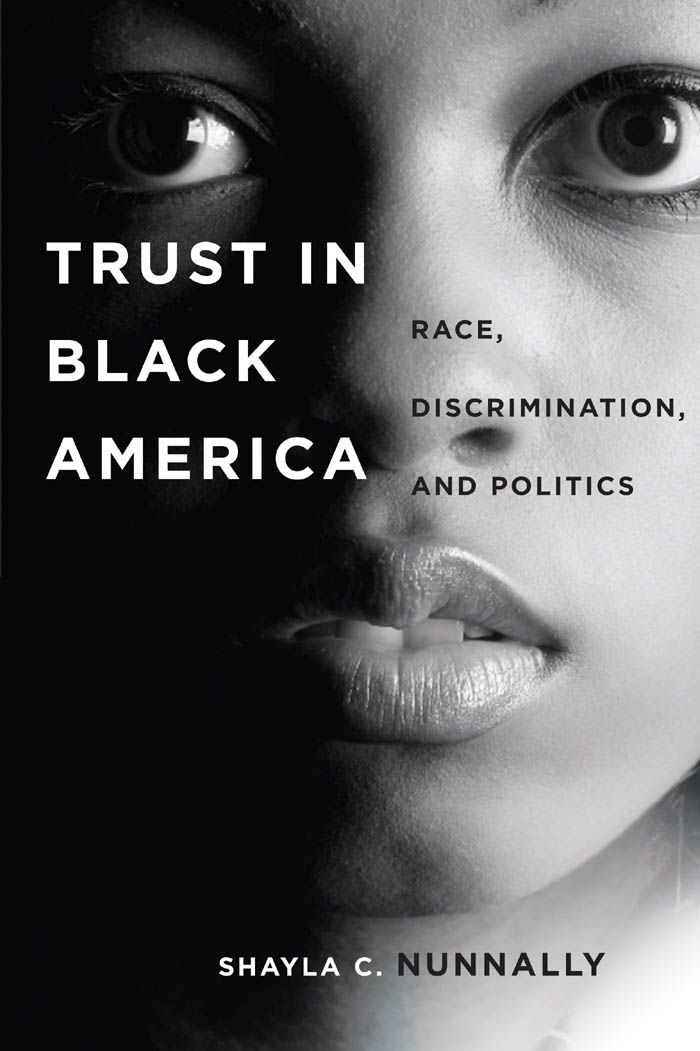
Trust in Black America
The more citizens trust their government, the better democracy functions. However, African Americans have long suffered from the lack of equal protection by their government, and the racial discrimination they have faced breaks down their trust in democracy. Rather than promoting democracy, the United States government has, from its inception, racially discriminated against African American citizens and other racial groups, denying them equal access to citizenship and to protection of the law. Civil rights violations by ordinary citizens have also tainted social relationships between racial groups-social relationships that should be meaningful for enhancing relations between citizens and the government at large. Thus, trust and democracy do not function in American politics the way they should, in part because trust is not color blind.Based on the premise that racial discrimination breaks down trust in a democracy,Trust in Black Americaexamines the effect of race on African Americans' lives. Shayla Nunnally analyzes public opinion data from two national surveys to provide an updated and contemporary analysis of African Americans' political socialization, and to explore how African Americans learn about race. She argues that the uncertainty, risk, and unfairness of institutionalized racial discrimination has led African Americans to have a fundamentally different understanding of American race relations, so much so that distrust has been the basis for which race relations have been understood by African Americans. Nunnally empirically demonstrates that race and racial discrimination have broken down trust in American democracy.
eBook


Racial Discrimination, Ethnic-Racial Socialization, and Crime: A Micro-sociological Model of Risk and Resilience
Dominant theoretical explanations of racial disparities in criminal offending overlook a key risk factor associated with race: interpersonal racial discrimination. Building on recent studies that analyze race and crime at the micro-level, we specify a social psychological model linking personal experiences with racial discrimination to an increased risk of offending. We add to this model a consideration of an adaptive facet of African American culture: ethnicracial socialization, and explore whether two forms—cultural socialization and preparation for bias—provide resilience to the criminogenic effects of interpersonal racial discrimination. Using panel data from several hundred African American male youth from the Family and Community Health Study, we find that racial discrimination is positively associated with increased crime in large part by augmenting depression, hostile views of relationships, and disengagement from conventional norms. Results also indicate that preparation for bias significantly reduces the effects of discrimination on crime, primarily by reducing the effects of these social psychological mediators on offending. Cultural socialization has a less influential but beneficial effect. Finally, we show that the more general parenting context within which preparation for bias takes place influences its protective effects.
Journal Article

Parental Racial Socialization as a Moderator of the Effects of Racial Discrimination on Educational Success Among African American Adolescents
This study investigated whether parental racial socialization practices moderated the relation between racial discrimination in school and adolescents' educational outcomes. Using data from a longitudinal study of an economically diverse sample of 630 African American adolescents (mean age = 14.5) from a major East Coast metropolis, the results revealed that cultural socialization attenuated the effect of teacher discrimination on grade point average (GPA) and educational aspirations, as well as the effect of peer discrimination on GPA. Also, preparation for bias and cultural socialization interacted to make unique contributions to African American adolescents' educational outcomes. Finally, there was some evidence that teacher discrimination was more detrimental to the academic engagement of African American males than females. Implications for research and practice are discussed.
Journal Article

The Role of Race and Ethnicity in Parental Ethnic-Racial Socialization: A Scoping Review of Research
Over the past 35 years, ethnic-racial socialization (ERS) has been a widely studied topic in psychological and cultural research. Most popular among the populations that ERS research centers are Black/African American families and youth. However, a small, but emerging body of research on the ERS processes of other racial/ethnic groups suggest that ERS is not limited to Black/African American families. Recently, scholars have begun to ask more critical questions regarding the differential effects of ethnic-racial socialization on non-Black youth’s psychological development. Therefore, the current review of research draws together studies on Black/African American, Biracial, Latinx, Asian American, and White American families to demonstrate the role of racial/ethnic group identification in soliciting the exchange of ERS messages from parents to children. The methodology used to execute this review follows a modified framework which includes four key phases of searching and selecting appropriate studies. From three multidisciplinary and psychological databases, 24 studies were selected based on the inclusion criteria set by the researcher. The studies discussed in this scoping review all revealed how racial/ethnic group identification solicits the exchange of ERS messages from parents to children in some way.
Highlights
24 research studies revealed that the dynamic nature of a family’s ethnic/racial identification drives the types and frequency of certain ethnic-racial socialization messages communicated from parents to children.
Black/African American families have an extensive history of prioritizing conversations that prepare Black youth for racial bias.
ERS studies centering Latinx and Asian American families revealed that generational/immigration status was an important factor for what types of ERS messages were discussed in those households.
White American families were more likely to engage their children in egalitarian socialization to reinforce the idea that everyone is the same and possesses equal opportunities to succeed.
Journal Article

Associations of Racial Discrimination and Parental Discrimination Coping Messages with African American Adolescent Racial Identity
Research links racial identity to important developmental outcomes among African American adolescents, but less is known about the contextual experiences that shape youths’ racial identity. In a sample of 491 African American adolescents (48 % female), associations of youth-reported experiences of racial discrimination and parental messages about preparation for racial bias with adolescents’ later racial identity were examined. Cluster analysis resulted in four profiles of adolescents varying in reported frequency of racial discrimination from teachers and peers at school and frequency of parental racial discrimination coping messages during adolescents’ 8th grade year. Boys were disproportionately over-represented in the cluster of youth experiencing more frequent discrimination but receiving fewer parental discrimination coping messages, relative to the overall sample. Also examined were clusters of adolescents’ 11th grade racial identity attitudes about the importance of race (centrality), personal group affect (private regard), and perceptions of societal beliefs about African Americans (public regard). Girls and boys did not differ in their representation in racial identity clusters, but 8th grade discrimination/parent messages clusters were associated with 11th grade racial identity cluster membership, and these associations varied across gender groups. Boys experiencing more frequent discrimination but fewer parental coping messages were over-represented in the racial identity cluster characterized by low centrality, low private regard, and average public regard. The findings suggest that adolescents who experience racial discrimination but receive fewer parental supports for negotiating and coping with discrimination may be at heightened risk for internalizing stigmatizing experiences. Also, the findings suggest the need to consider the context of gender in adolescents’ racial discrimination and parental racial socialization.
Journal Article

“Race was something we didn't talk about”: Racial Socialization in Asian American Families
Objective Our goal was to explore racial socialization practices in Asian American families during a time of heightened racial tension. Background Asian Americans hold a complex racial position in the United States, made even more complicated by an increase in public protests regarding socioracial injustices in the United States experienced by racial minority groups. Discussions about race and ethnicity occur within Asian American families but often focus on cultural heritage rather than awareness of discrimination and the historical roots of racism. Method Our study used an inductive–deductive thematic analysis to collect data from 12 Asian American young adults. Semistructured interviews queried participants' experiences with racial socialization in their nuclear families and their own racial identity. Findings Qualitative analysis revealed the following themes: (a) Participants received limited messages regarding racial issues, (b) participants engaged in “bottom‐up” racial socialization and taught their parents about race, and (c) participants felt left out of society's racial dialogue. Conclusion During this time of heightened racial tension, Asian American young adults struggle to find their place, despite wanting to participate in community building. Implications Without strong Asian American racial socialization practices in families, young adults must educate themselves and initiate racial meaning‐making in their families.
Journal Article
Observed Racial Socialization and Maternal Positive Emotions in African American Mother-Adolescent Discussions About Racial Discrimination
This study examined patterns of (a) observed racial socialization messages in dyadic discussions between 111 African American mothers and adolescents (Mage = 15.50) and (b) mothers' positive emotions displayed during the discussion. Mothers displayed more advocacy on behalf of their adolescents in response to discrimination by a White teacher than to discrimination by a White salesperson. Mothers displayed consistent emotional support of adolescents' problem solving across both dilemmas but lower warmth in response to the salesperson dilemma. Findings illustrate evidence of the transactional nature of racial socialization when presented with adolescents' racial dilemmas. The role of adolescent gender in mothers' observed racial socialization responses is also discussed. A framework for a process-oriented approach to racial socialization is presented.
Journal Article