
Catalogue Search | MBRL


Are you sure you want to remove the book from the shelf?

{{itemTitle}}
36
result(s) for
"African Americans Suffrage History 19th century."
Sort by:

Fighting chance : the struggle over woman suffrage and Black suffrage in Reconstruction America
The advocates of woman suffrage and black suffrage came to a bitter falling-out in the midst of Reconstruction, when Elizabeth Cady Stanton opposed the 15th Amendment because it granted the vote to black men but not to women. How did these two causes, so long allied, come to this?
Book

Suffrage Reconstructed
The Fourteenth Amendment, ratified on July 9, 1868, identified all legitimate voters as \"male.\" In so doing, it added gender-specific language to the U.S. Constitution for the first time. Suffrage Reconstructed is the first book to consider how and why the amendment's authors made this decision. Vividly detailing congressional floor bickering and activist campaigning, Laura E. Free takes readers into the pre- and postwar fights over precisely who should have the right to vote. Free demonstrates that all men, black and white, were the ultimate victors of these fights, as gender became the single most important marker of voting rights during Reconstruction.
Free argues that the Fourteenth Amendment's language was shaped by three key groups: African American activists who used ideas about manhood to claim black men's right to the ballot, postwar congressmen who sought to justify enfranchising southern black men, and women's rights advocates who began to petition Congress for the ballot for the first time as the Amendment was being drafted. To prevent women's inadvertent enfranchisement, and to incorporate formerly disfranchised black men into the voting polity, the Fourteenth Amendment's congressional authors turned to gender to define the new American voter. Faced with this exclusion some woman suffragists, most notably Elizabeth Cady Stanton, turned to rhetorical racism in order to mount a campaign against sex as a determinant of one's capacity to vote. Stanton's actions caused a rift with Frederick Douglass and a schism in the fledgling woman suffrage movement. By integrating gender analysis and political history, Suffrage Reconstructed offers a new interpretation of the Civil War-era remaking of American democracy, placing African American activists and women's rights advocates at the heart of nineteenth-century American conversations about public policy, civil rights, and the franchise.
The Fourteenth Amendment, ratified on July 9, 1868, identified all legitimate voters as \"male.\" In so doing, it added gender-specific language to the U.S. Constitution for the first time.Suffrage Reconstructedis the first book to consider how and why the amendment's authors made this decision. Vividly detailing congressional floor bickering and activist campaigning, Laura E. Free takes readers into the pre- and postwar fights over precisely who should have the right to vote. Free demonstrates that all men, black and white, were the ultimate victors of these fights, as gender became the single most important marker of voting rights during Reconstruction.Free argues that the Fourteenth Amendment's language was shaped by three key groups: African American activists who used ideas about manhood to claim black men's right to the ballot, postwar congressmen who sought to justify enfranchising southern black men, and women's rights advocates who began to petition Congress for the ballot for the first time as the Amendment was being drafted. To prevent women's inadvertent enfranchisement, and to incorporate formerly disfranchised black men into the voting polity, the Fourteenth Amendment's congressional authors turned to gender to define the new American voter. Faced with this exclusion some woman suffragists, most notably Elizabeth Cady Stanton, turned to rhetorical racism in order to mount a campaign against sex as a determinant of one's capacity to vote. Stanton's actions caused a rift with Frederick Douglass and a schism in the fledgling woman suffrage movement. By integrating gender analysis and political history,Suffrage Reconstructedoffers a new interpretation of the Civil War-era remaking of American democracy, placing African American activists and women's rights advocates at the heart of nineteenth-century American conversations about public policy, civil rights, and the franchise.
eBook


An Example for All the Land
An Example for All the Land reveals Washington, D.C. as a laboratory for social policy in the era of emancipation and the Civil War. In this panoramic study, Kate Masur provides a nuanced account of African Americans' grassroots activism, municipal politics, and the U.S. Congress. She tells the provocative story of how black men's right to vote transformed local affairs, and how, in short order, city reformers made that right virtually meaningless. Bringing the question of equality to the forefront of Reconstruction scholarship, this widely praised study explores how concerns about public and private space, civilization, and dependency informed the period's debate over rights and citizenship.
eBook

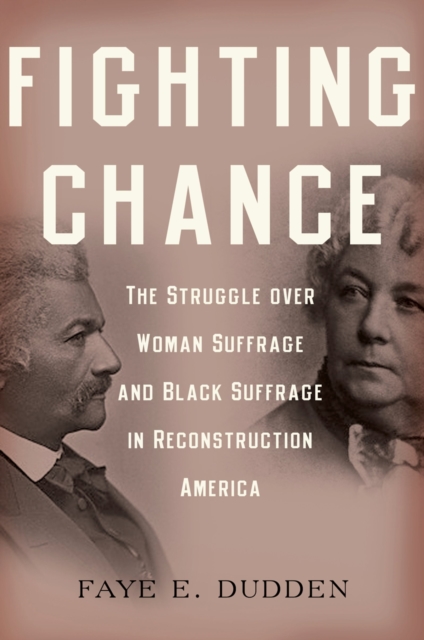
Fighting chance : the struggle over woman suffrage and black suffrage in reconstruction America
The advocates of woman suffrage and black suffrage came to a bitter falling-out in the midst of Reconstruction, when Elizabeth Cady Stanton opposed the Fifteenth Amendment for granting black men the right to vote but not women. How did these two causes, so long allied, come to this? This book offers answers to this question and reveals that racism was not the only cause, but that the outcome also depended heavily on money and political maneuver. The book shows that Stanton and Susan B. Anthony, believing they had a fighting chance to win woman suffrage after the Civil War, tried but failed to exploit windows of political opportunity, especially in Kansas. When they became most desperate, they succeeded only in selling out their long-held commitment to black rights and their invaluable friendship and alliance with Frederick Douglass.
eBook

Woodrow Wilson : the light withdrawn
\"More than a century after he dominated American politics, Woodrow Wilson still fascinates. With panoramic sweep, Woodrow Wilson: The Light Withdrawn reassesses his life and his role in the movements for racial equality and women's suffrage. The Wilson that emerges is a man superbly unsuited to the moment when he ascended to the presidency in 1912, as the struggle for women's voting rights in America reached the tipping point. The first southern Democrat to occupy the White House since the Civil War era brought with him to Washington like-minded men who quickly set to work segregating the federal government. Wilson's own sympathy for Jim Crow and states' rights animated his years-long hostility to the Susan B. Anthony Amendment, which promised universal suffrage backed by federal enforcement. Women demonstrating for voting rights found themselves demonized in government propaganda, beaten and starved while illegally imprisoned, and even confined to the insane asylum. When, in the twilight of his second term, two-thirds of Congress stood on the threshold of passing the Anthony Amendment, Wilson abruptly switched his position. But in sympathy with like-minded southern Democrats, he acquiesced in a \"race rider\" that would protect Jim Crow. The heroes responsible for the eventual success of the unadulterated Anthony Amendment are brought to life by Christopher Cox, an author steeped in the ways of Washington and political power. This is a brilliant, carefully researched work that puts you at the center of one of the greatest advances in the history of American democracy\"-- Provided by publisher.
BOOK

The Precious Birthright
In 1842, Black Rhode Islanders secured a stunning victory, a success rarely seen in antebellum America: they won the right to vote. Amid heightened public discourse around shifting ideas of race, citizenship, and political rights, they methodically deconstructed the arguments against their enfranchisement, exposing the arbitrariness of the color line in delineating citizenship rights and choosing the perfect moments in which to act forcefully. At the head of this movement, a cohort of prominent business and community members formed an early example of a Black leadership class in the US.
CJ Martin draws upon a wealth of sources—including personal correspondences, government and organizational documents, tax records, and petitions—to argue that Black leaders employed a unique combination of agitation and accommodation to ensure the success of the movement. By investigating their tactics, Martin deepens the story of how race played a crucial role in American citizenship, and by focusing on Black leadership, he relates this history through the people who lived it—who thought, debated, petitioned, and enacted their own liberation. Telling the story of a fight that was as important to the pioneers of interracial democracy as it was for the civil rights activists of the twentieth century, The Precious Birthright provides new insight into the larger story of Black freedom.
eBook

Nellie Francis
The life and work of an African American suffragist and
activist devoted to equality and freedom At her last
public appearance in 1962, at 88 years old, a frail, deaf, and
blind Nellie Francis was honored for her church and community
service in Nashville, Tennessee. No mention was made of her early
groundbreaking work as an activist in Minnesota and nationally.
Even today, while her advocacy for women's suffrage and racial
justice resonates through current issues, her efforts remain
largely unrecognized. In telling Nellie Francis's complete story
for the first time, William D. Green finally brings the remarkable
accomplishments of her complicated life into clear view, detailing
her indefatigable work to advance the causes of civil rights,
anti-lynching, and women's suffrage. Green's account follows
Francis's path from her first public event (giving a speech on race
relations to a white audience at her high school graduation) to her
return to Nashville and retirement from the national stage. In the
years between, she campaigned in Minnesota for racial dignity,
women's suffrage, an anti-lynching law (after the infamous lynching
in Duluth in 1920), and interracial collaboration through the
women's club movement. She came to know most of the prominent civil
rights leaders of the twentieth century and met three presidents
and countless business leaders of both Black and white societies.
But she also faced intense and vicious reprisals, as when, as
leader of the local chapter of the NAACP, she and her husband, a
prominent African American civil rights lawyer, experienced the
fury of the Ku Klux Klan after moving into a white neighborhood in
St. Paul. Green retrieves Nellie Francis's story from obscurity,
giving this pioneer for gender and racial equality her due and
providing a long-awaited service to the history of Black activism
and civil rights, both regional and national. His book offers
welcome insight into the universal, yet often unacknowledged,
challenges that strong and engaged Black women are forced to endure
when their drive to enact justice confronts racism, cultural
pressure, and societal expectations.
eBook

Disability in the Civil War Era
This essay features a discussion among several scholars of disability in the Civil War era on the major themes and issues within this small field. The panelists, including both historians and literature scholars, reflect the interdisciplinary nature of disability studies and make the case for why disability analysis is critical to understanding of the Civil War era. Disability, they argue, enriches our studies of slavery and freedom, military service, federal power and bureaucracy, the home front and veteranhood. The panelists also consider paths for future research, such as increasing our use of material history and exploring disabled lives during Reconstruction.
Journal Article