
Catalogue Search | MBRL


Are you sure you want to remove the book from the shelf?

{{itemTitle}}
10
result(s) for
"African Americans-Texas-Biography"
Sort by:

Black like me
\"In the Deep South of the 1950s, a color line was etched in blood across Louisiana, Mississippi, Alabama, and Georgia. Journalist John Howard Griffin decided to cross that line. Using medication that darkened his skin to deep brown, he exchanged his privileged life as a Southern white man for the disenfranchised world of an unemployed black man. What happened to John Howard Griffin, from the outside and within himself, as he made his way through the segregated Deep South is recorded in this searing work of nonfiction\"--P. [4] of cover.
Book


The strange career of William Ellis : the Texas slave who became a Mexican millionaire
\"A prize-winning historian tells a new story of the black experience in America through the life of a mysterious entrepreneur. To his contemporaries in Gilded Age Manhattan, Guillermo Eliseo was a fantastically wealthy Mexican, the proud owner of a luxury apartment overlooking Central Park, a busy Wall Street office, and scores of mines and haciendas in Mexico. But for all his obvious riches and his elegant appearance, Eliseo was also the possessor of a devastating secret: he was not, in fact, from Mexico at all. Rather, he had begun life as a slave named William Ellis, born on a cotton plantation in southern Texas during the waning years of King Cotton. After emancipation, Ellis, capitalizing on the Spanish he learned during his childhood along the Mexican border and his ambivalent appearance, engaged in a virtuoso act of reinvention. He crafted an alter ego, the Mexican Guillermo Eliseo, who was able to access many of the privileges denied to African Americans at the time: traveling in first-class train berths, staying in upscale hotels, and eating in the finest restaurants. The Strange Career of William Ellis reads like a novel but offers fresh insights on the history of the Reconstruction era, the US-Mexico border, and the abiding riddle of race. At a moment when the United States is deepening its connections with Latin America and recognizing that race is more than simply black or white, Ellis's story could not be more timely or important\"--Provided by publisher.
Book
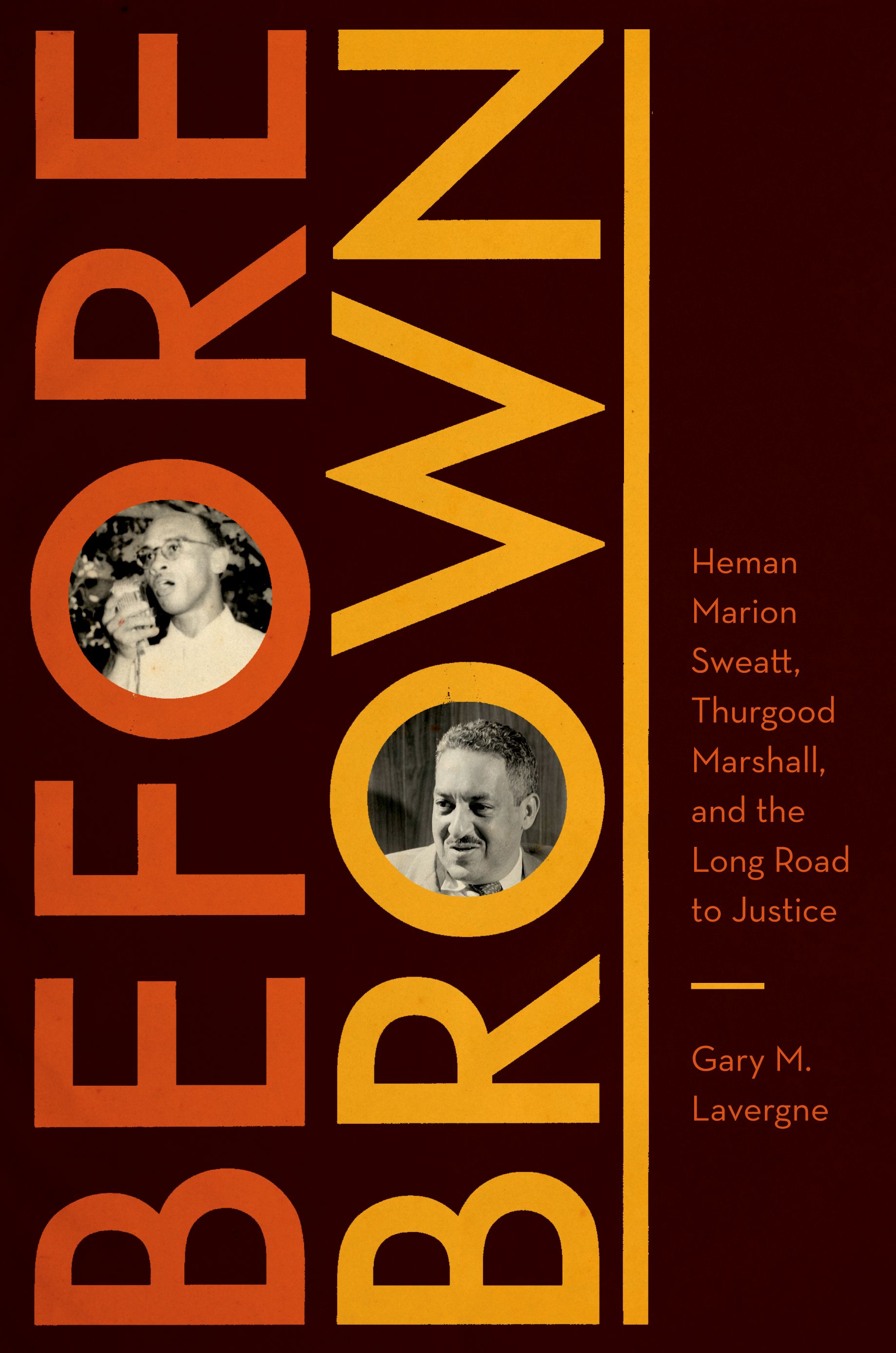
Before Brown
On February 26, 1946, an African American from Houston applied for admission to the University of Texas School of Law. Although he met all of the school's academic qualifications, Heman Marion Sweatt was denied admission because he was black. He challenged the university's decision in court, and the resulting case, Sweatt v. Painter, went to the U.S. Supreme Court, which ruled in Sweatt's favor. The Sweatt case paved the way for the landmark Brown v. Board of Education of Topeka rulings that finally opened the doors to higher education for all African Americans and desegregated public education in the United States. In this engrossing, well-researched book, Gary M. Lavergne tells the fascinating story of Heman Sweatt's struggle for justice and how it became a milestone for the civil rights movement. He reveals that Sweatt was a central player in a master plan conceived by the National Association for the Advancement of Colored People (NAACP) for ending racial segregation in the United States. Lavergne masterfully describes how the NAACP used the Sweatt case to practically invalidate the \"separate but equal\" doctrine that had undergirded segregated education for decades. He also shows how the Sweatt case advanced the career of Thurgood Marshall, whose advocacy of Sweatt taught him valuable lessons that he used to win the Brown v. Board of Education case in 1954 and ultimately led to his becoming the first black Associate Justice of the Supreme Court.
eBook


A southern family in white & Black : the Cuneys of Texas
The complex issues of race and politics in nineteenth-century Texas may be nowhere more dramatically embodied than in three generations of the family of Norris Wright Cuney, mulatto labor and political leader. Douglas Hales explores the birthright Cuney received from his white plantation-owner father, Philip Cuney, and the way his heritage played out in the life of his daughter Maud Cuney-Hare. This intergenerational study casts light on the experience of race in the South before Emancipation, after Reconstruction, and in the diaspora that eventually led cultural leaders of African American heritage into the cities of the North.
Most Texas history books name Norris Wright Cuney as one of the most influential African American politicians in nineteenth-century Texas, but they tell little about him beyond his elected positions. In The Cuneys, Douglas Hales not only fills in the details of Cuney’s life and contributions but places him in the context of his family’s generations.
A politically active plantation owner and slaveholder in Austin County, Philip Cuney participated in the annexation of Texas to the United States and supported the role of slavery and cotton in the developing economy of the new state. Wealthy and powerful, he fathered eight slave children whom he later freed and saw educated. Hales explores how and why Cuney differed from other planters of his time and place.
He then turns to the better-known Norris Wright Cuney to study how the black elite worked for political and economic opportunity in the reactionary period that followed Reconstruction in the South. Cuney led the Texas Republican Party in those turbulent years and, through his position as collection of customs at Galveston, distributed federal patronage to both white and black Texans. As the most powerful African American in Texas, and arguably in the entire South, Cuney became the focal point of white hostility, from both Democrats and members of the “Lily White” faction of his own party. His effective leadership won not only continued office for him but also a position of power within the Republican Party for Texas blacks at a time when the party of Lincoln repudiated African Americans in many other Southern states. From his position on the Galveston City Council, Cuney worked tirelessly for African American education and challenged the domination of white labor within the growing unions.
Norris Wright Cuney’s daughter, Maud, who was graced with a prestigious education, pursued a successful career in the arts as a concert pianist, musicologist, and playwright. A friend of W. E. B. Du Bois, she became actively involved in the racial uplift movement of the early twentieth century. Hales illuminates her role in the intellectual and political “awakening” of black America that culminated in the Harlem Renaissance of the 1920s. He adroitly explores her decision against “passing” as white and her commitment to uplift.
Through these three members of a single mixed-race family, Douglas Hales gives insight into the issues, challenges, and strengths of individuals. His work adds an important chapter to the history of Texas and of African Americans more broadly.
eBook

My Remembers
A black sharecropper's recollections of the Depression. An opportunity to view rural life in Texas during the Depression and its aftermath.
eBook

Jack Johnson, rebel sojourner
In his day, Jack Johnson—born in Texas, the son of former slaves—was the most famous black man on the planet. As the first African American World Heavyweight Champion (1908–1915), he publicly challenged white supremacy at home and abroad, enjoying the same audacious lifestyle of conspicuous consumption, masculine bravado, and interracial love wherever he traveled. Jack Johnson, Rebel Sojourner provides the first in-depth exploration of Johnson's battles against the color line in places as far-flung as Sydney, London, Cape Town, Paris, Havana, and Mexico City. In relating this dramatic story, Theresa Runstedtler constructs a global history of race, gender, and empire in the early twentieth century.
eBook

Texas blues : the rise of a contemporary sound
Texas Blues allows artists to speak in their own words, revealing the dynamics of blues, from its beginnings in cotton fields and shotgun shacks to its migration across boundaries of age and race to seize the musical imagination of the entire world. Fully illustrated with 495 dramatic, high-quality color and black-and-white photographs—many never before published—Texas Blues provides comprehensive and authoritative documentation of a musical tradition that has changed contemporary music. Award-winning documentary filmmaker and author Alan Govenar here builds on his previous groundbreaking work documenting these musicians and their style with the stories of 110 of the most influential artists and their times. From Blind Lemon Jefferson and Aaron “T-Bone” Walker of Dallas, to Delbert McClinton in Fort Worth, Sam “Lightnin’” Hopkins in East Texas, Baldemar (Freddie Fender) Huerta in South Texas, and Stevie Ray Vaughan in Austin, Texas Blues shows the who, what, where, and how of blues in the Lone Star State.
eBook

My Remembers
\"I grow up a dirt farmer and retired a dirt farmer. Never got rich and didn't want to be. My childhood stomping ground is now concrete, stores and houses. I remember the good times and bad. It was not the money we made but how to stretch that last dime. It was not the wind, rain or snow. It was about the love that flow. It was not the hot sunshine nor the clouds that hung low. It was the grace of God that help us swang that hoe. I want my grandchildren to understand. My grands, your grands and their grands.\" In 1929, near Plano, Texas, Eddie Stimpson, Jr., weighing 15-1/2 pounds, was born to a 19-year-old father and a 15-year-old mother. The boy, his two sisters and mother all \"grew up together,\" with the father sharecropping along the old Preston Road, the route used by many freedmen trying to escape Texas after the Civil War. His childhood was void of luxuries, but full of country pleasures. The editors have retained the simplicity of Stimpson's folk speech and spelling patterns, allowing the good-natured humility and wisdom of his personality to shine through the narrative. \"Tough time never last,\" he writes, \"but tough people all way do.\" The details of ordinary family life and community survival include descriptions of cooking, farming, gambling, visiting, playing, doctoring, hunting, bootlegging, and picking cotton, as well as going to school, to church, to funerals, to weddings, to Juneteenth celebrations. This book will be of extraordinary value to folklorists, historians, sociologists, and anyone enjoying a good story. \"My spelling is bad, my hand writing is bad, and my language is bad,\" Stimpson writes. \"But my remembers is still in tack.\"
eBook