
Catalogue Search | MBRL


Are you sure you want to remove the book from the shelf?

{{itemTitle}}
10,038
result(s) for
"African Union."
Sort by:


Blacks, Reds, and Russians
One of the most compelling, yet little known stories of race relations in the twentieth century is the account of blacks who chose to leave the United States to be involved in the Soviet Experiment in the 1920s and 1930s. Frustrated by the limitations imposed by racism in their home country, African Americans were lured by the promise of opportunity abroad. A number of them settled there, raised families, and became integrated into society. The Soviet economy likewise reaped enormous benefits from the talent and expertise that these individuals brought, and the all around success story became a platform for political leaders to boast their party goals of creating a society where all members were equal.In Blacks, Reds, and Russians, Joy Gleason Carew offers insight into the political strategies that often underlie relationships between different peoples and countries. She draws on the autobiographies of key sojourners, including Harry Haywood and Robert Robinson, in addition to the writings of Claude McKay, W.E.B. Du Bois, and Langston Hughes. Interviews with the descendents of figures such as Paul Robeson and Oliver Golden offer rare personal insights into the story of a group of emigrants who, confronted by the daunting challenges of making a life for themselves in a racist United States, found unprecedented opportunities in communist Russia.
eBook


Punching above Weight
Conventional narratives suggest that the African Union Commission (AUC), like most international public administrations and international organisations (IOs) housed in the less materially endowed regions of the world, exercises no meaningful agency on international issues. This article however seeks to show that the AUC is neither a glorified messenger and docile follower of orders of governments nor is it an empty vessel that timidly goes where the wind of governments blows. Rather, the AUC exercises significant agency on issues that affect not just the African continent but also the broader international system. The AUC is often at the heart of international agenda-setting, norm development, decisionmaking, rule creation, policy development, and it sometimes offer strategic leadership. The article demonstrates six pathways through which the AUC acts like a tail wagging a dog.
Die gängige Meinung ist, dass die Kommission der Afrikanischen Union (AUC), wie die meisten internationalen öffentlichen Verwaltungen und internationalen Organisationen (IO), die in ärmeren Regionen der Welt beheimatet sind, keine bedeutende Handlungsfähigkeit in internationalen Fragen besitzt. Dieser Artikel versucht zu zeigen, dass die AUC weder ein Bote und fügsamer Erfüllungsgehilfe von Regierungsbefehlen ist noch ein williges Fähnchen im Wind der Regierungen. Vielmehr übt die AUC einen bedeutenden Einfluss auf Themen aus, die nicht nur den afrikanischen Kontinent, sondern auch das internationale System betreffen. Die AUC steht oft im Mittelpunkt von internationalem Agenda-Setting, der Entwicklung von Normen, Entscheidungsfindungen, der Schaffung von Regeln, der Politikentwicklung, und bietet ab und zu sogar strategische Führung. Dieser Artikel zeigt sechs Wege auf, wie es der AUC gelingt, als Underdog Führung zu übernehmen.
Journal Article

Peacebuilding in the African Union : law, philosophy and practice
\"Particularly in the context of internal conflicts, international law is frequently unable to create and sustain frameworks for peace in Africa. In Peacebuilding in the African Union, Abou Jeng explores the factors which have prevented such steps forward in the interaction between the international legal order and postcolonial Africa. In the first work of its kind, Jeng considers whether these limitations necessitate recasting the existing conceptual structure and whether the Constitutive Act of the African Union provides exactly this opportunity through its integrated peace and security framework. Through the case studies of Burundi and Somalia, Jeng examines the structures and philosophy of the African Union and assesses the capacity of its practices in peacemaking. In so doing, this book will be of great practical value to scholars and legal practitioners alike\"-- Provided by publisher.
Book

THE CREATION OF THE AFRICAN CRIMINAL COURT: CHALLENGES AND PERSPECTIVES OF AN ALTERNATIVE JUSTICE TO THE INTERNATIONAL CRIMINAL COURT / LA CREATION DE LA COUR PENALE AFRICAINE : DEFIS ET PERSPECTIVES D’UNE JUSTICE ALTERNATIVE A LA COUR PENALE INTERNATIONALE
The creation of the future African Criminal Court (ACC) was envisaged by the African Union (AU) as the African states’ collective response to the \"politicization\" of the International Criminal Court (ICC). Eight years following its signature, the Maloba Protocol has never obtained the fifteen ratifications required to spearhead the operationalisation of the ACC. This article attempts to address two fundamental questions: - what are the challenges hindering the creation of the CCA? - and how effective will the CCA be in trying Africans for crimes they have committed on their own soil? It reveals, on the one hand obstacles that hinder the implementation of the Malabo protocol; and on the other hand, challenges that could hamper the CCA's effectiveness as soon as it becomes operational.
Journal Article


The ICC indictment against Al-Bashir and its repercussions for peacekeeping and humanitarian operations in Darfur
The impact of the International Criminal Court (ICC) on peace processes has received much scholarly attention. We argue, based on the ICC arrest warrant against Sudanese President Omar al-Bashir, that ICC indictments against government officials not only can be detrimental to the prospects for peace, but can also negatively affect everyday practices of peacekeepers and humanitarian workers. We draw on a combination of quantitative and qualitative data in order to develop our argument. We interrogate some measurable consequences of the indictment in relation to the work of the United Nations - African Union Mission in Darfur (UNAMID) as well as humanitarian actors in Darfur. We do so using a data set compiled to support the work of UNAMID. We also draw on interviews with UN and UNAMID staff, aid workers, and representatives of the conflict parties. Our analysis shows that the indictment of President al-Bashir was perceived by the Sudanese government as the continuation of a confrontational approach pursued by the international community. We further show that the indictment accelerated patterns of obstruction and intimidation of peacekeeping actors, other third-party actors, and local staff associated with these. This complicated the everyday activities of peacekeepers and humanitarian efforts.
Journal Article
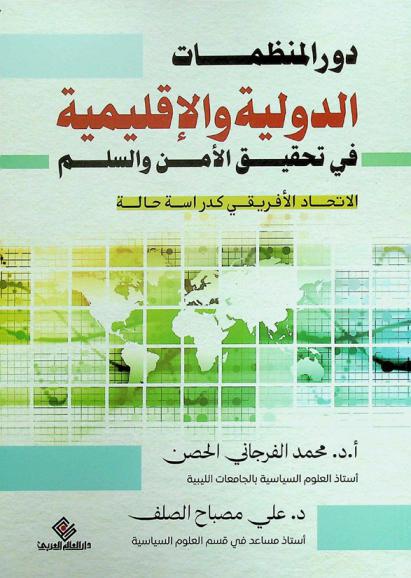
دور المنظمات الدولية والإقليمية في تحقيق الأمن والسلم : الاتحاد الأفريقي كدراسة حالة
تتناول هذه الدراسة الطريقة التي تتعاون بها المنظمات الدولية (كالأمم المتحدة) والإقليمية (أبرزها الاتحاد الأفريقي) لتحقيق الأمن والاستقرار في إفريقيا. وتبرز الأدوار التكاملية بين مجلس السلم والأمن الأفريقي، وقادة المنظمات الاقتصادية الإقليمية مثل الإيكواس، في التعامل مع النزاعات في كل من جزر القمر، دارفور، وليبيريا. رغم بعض النجاحات المحدودة، فإن التحديات البنيوية والمالية المثقلة للاتحاد الأفريقي قد حدت من قدرته على إدارة الأزمات، مما دفع إلى التأكيد على أهمية شراكة فعالة مع الأمم المتحدة وتحديث آليات العمل لتحقيق الأمن الشامل والاستجابة الفورية للنزاعات.
BOOK

A Renegade Union
Dedicated to organizing workers from diverse racial, ethnic, and religious backgrounds, many of whom were considered \"unorganizable\" by other unions, the progressive New York City-based labor union District 65 counted among its 30,000 members retail clerks, office workers, warehouse workers, and wholesale workers. In this book, Lisa Phillips presents a distinctive study of District 65 and its efforts to secure economic equality for minority workers in sales and processing jobs in small, low-end shops and warehouses throughout the city. Phillips shows how organizers fought tirelessly to achieve better hours and higher wages for \"unskilled,\" unrepresented workers and to destigmatize the kind of work they performed. _x000B__x000B_Closely examining the strategies employed by District 65 from the 1930s through the early Cold War years, Phillips assesses the impact of the McCarthy era on the union's quest for economic equality across divisions of race, ethnicity, and skill. Though their stories have been overshadowed by those of auto, steel, and electrical workers who forced American manufacturing giants to unionize, the District 65 workers believed their union provided them with an opportunity to re-value their work, the result of an economy inclining toward fewer manufacturing jobs and more low-wage service and processing jobs._x000B__x000B_Phillips recounts how District 65 first broke with the CIO over the latter's hostility to left-oriented politics and organizing agendas, then rejoined to facilitate alliances with the NAACP. In telling the story of District 65 and detailing community organizing efforts during the first part of the Cold War and under the AFL-CIO umbrella, A Renegade Union continues to revise the history of the left-led unions of the Congress of Industrial Organizations. _x000B_
eBook