
Catalogue Search | MBRL


Are you sure you want to remove the book from the shelf?

{{itemTitle}}
932
result(s) for
"African fiction (English)"
Sort by:

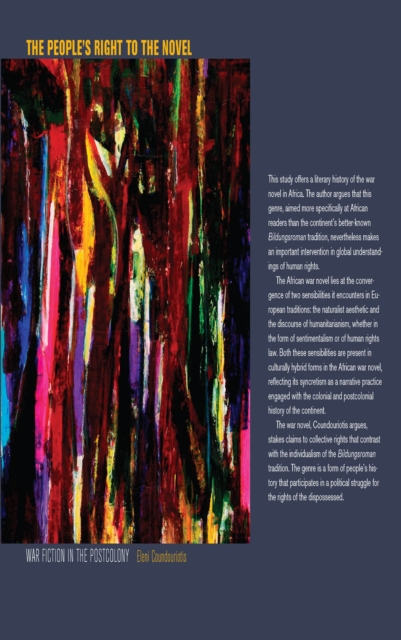
The People's Right to the Novel: War Fiction in the Postcolony
This study offers a literary history of the war novel in Africa. Coundouriotis argues that this genre, aimed more specifically at African readers than the continent's better-known bildungsroman tradition, nevertheless makes an important intervention in global understandings of human rights. The African war novel lies at the convergence of two sensibilities it encounters in European traditions: the naturalist aesthetic and the discourse of humanitarianism, whether in the form of sentimentalism or of human rights law. Both these sensibilities are present in culturally hybrid forms in the African war novel, reflecting its syncretism as a narrative practice engaged with the colonial and postcolonial history of the continent. The war novel, Coundouriotis argues, stakes claims to collective rights that contrast with the individualism of the bildungsroman tradition. The genre is a form of people's history that participates in a political struggle for the rights of the dispossessed.
eBook


Our Mothers, Our Powers, Our Texts
\"Washington writes supple and thoughtful prose and creatively integrates African and African-derived terminology, which never distract the reader. I consider Our Mothers, Our Powers, Our Texts not only a brilliant study, but also a model to be emulated.\" -- Ousseynou B. Traore, William Patterson UniversityÀjé is a Yoruba word that signifies a spiritual power of vast potential, as well as the human beings who exercise that power. Although both men and women can have Àjé, its owners and controllers are women, the literal and cosmic Mothers who are revered as the gods of society. Because of its association with female power, its invisibility and profundity, Àjé is often misconstrued as witchcraft. However, as Teresa N. Washington points out in Our Mothers, Our Powers, Our Texts, Àjé is central to the Yoruba ethos and cosmology. Not only does it underpin the concepts of creation and creativity, but as a force of justice and retribution, Àjé is essential to social harmony and balance. As Africans were forced into exile and enslavement, they took Àjé with them and continued its work of creating, destroying, harming, and healing in the New World.Washington seeks out Àjé's subversive power of creation and re-creation in a diverse range of Africana texts, from both men and women, from both oral and contemporary literature, and across space and time. She guides readers to an understanding of the symbolic, methodological, and spiritual issues that are central to important works by Africana writers but are rarely elucidated by Western criticism. She begins with an examination of the ancient forms of Àjé in Yoruba culture, which creates a framework for innovative readings of important works by Africana writers, including Zora Neale Hurston, Toni Morrison, Ben Okri, Wole Soyinka, Jamaica Kincaid, and Ntozake Shange. This rich analysis will appeal to readers of
Africana literature, African religion and philosophy, feminist studies, and comparative literature.
eBook

Narrative Shape-Shifting
Responding to many of the same neo-colonial concerns as earlier African writers, Ben Okri, B. Kojo Laing and Yvonne Vera bring contemporary, hybrid voices to their novels that explore spiritual, cultural and feminist solutions to Africa's complex post-independence dilemmas. Their work is informed by both African and western traditions, especially the influences of traditional oral storytelling and post-modern fictional experimentation. Yet each is unique: Ben Okri is a religious writer steeped in the metaphysical complexities of a traditional symbiosis of physical and spiritual co-existence; B. Kojo Laing's humor grounds itself in linguistic play and outrageous characterization; Yvonne Vera translates her eco-feminist hope in political and social transformation with a focus on the developing political actions of Zimbabwean women. All three reflect on the colonial and post-independence turmoil in their respective countries of birth - Nigeria, Ghana and Zimbabwe. Together, they represent the evolution of a brilliant contemporary generation of post-independence voices. ARLENE A. ELDER is Professor of Women's Studies at the University of Cincinnati. She is the author of The Hindered Hand: Cultural Implications of Nineteenth-Century African-American Fiction and has published essays and articles on African, African-American, Native-American and Australian Aboriginal literatures and orature.
eBook

Love interrupted
\"In her debut collection of short fiction. Reneilwe Malatji invites us into the intimate lives of South African women--their whispered conversations, their love lives, their triumphs and heartbreaks. This diverse chorus of female voices recounts misadventures with love, family, and community in powerful stories woven together with anger, politics, and wit. Malatji crafts an engaging collection full of rich, memorable characters who navigate work, love, patriarchy, and racism with thoughtfulness, strength, and humor\"--Back cover.
Book


Africa Writes Back to Self
The profound effects of colonialism and its legacies on African cultures have led postcolonial scholars of recent African literature to characterize contemporary African novels as, first and foremost, responses to colonial domination by the West. In Africa Writes Back to Self, Evan Maina Mwangi argues instead that the novels are primarily engaged in conversation with each other, particularly over emergent gender issues such as the representation of homosexuality and the disenfranchisement of women by male-dominated governments. He covers the work of canonical novelists Nadine Gordimer, Chinua Achebe, NguÅgiÅ wa Thiong'o, and J. M. Coetzee, as well as popular writers such as Grace Ogot, David Maillu, Promise Okekwe, and Rebeka Njau. Mwangi examines the novels' self-reflexive fictional strategies and their potential to refigure the dynamics of gender and sexuality in Africa and demote the West as the reference point for cultures of the Global South.
eBook