
Catalogue Search | MBRL


Are you sure you want to remove the book from the shelf?

{{itemTitle}}
536
result(s) for
"African indigenous knowledge"
Sort by:

Perceptions of black employees regarding the psychological contract within an African context
OrientationThere is a need for researchers to investigate the constructs of psychological contract, work engagement and turnover intention within the context of the African knowledge system (AKS).Research purposeThe objective of this article is to expand knowledge on how African black employees perceive and experience their psychological contract, work engagement and turnover intention. The article explains how these perceptions and lived experiences are influenced by the race and culture of African blacks.Motivation for the studyAlthough the constructs of relevance are continually studied, not enough emphasis is placed on the given constructs from an AKS perspective.Research approach/design and methodAn explorative, qualitative, interpretive phenomenological research approach with open-ended interviews for data collection was implemented. A non-probability and purposeful sampling (N = 16) strategy was followed. Thematic analysis was used to analyse the data.Main findingsAfrican black employees’ perceptions and experiences regarding the psychological contract, work engagement and turnover intention are influenced by their race, culture and traditions (e.g. the spirit of ubuntu, weddings, traditional callings, funerals and church customs).Practical/managerial implicationsAfrican indigenous knowledge consciousness and diversity appreciation should be developed to ensure the effective implementation of human resources strategies and policies.Contribution/value-addA unifying organisational culture and diversity management strategy that considers the needs of African black employees should be cultivated.
Journal Article

The problem with decolonisation: entanglements in the politics of knowledge
In the heat of the decolonisation struggles of the 2000s, there has been little space or tolerance for conceptual criticism of this important moment in global history. Using the South African case, this article outlines some of the dilemmas of decolonisation as a concept and method for dealing with legacy knowledge in the aftermath of colonialism and apartheid. The status of whites as citizens rather than colonials, the lack of determination of meanings of decolonisation within public universities, and the defanging of a potentially radical concept are among the concerns raised in this critical work on the uptake of the idea in post-apartheid society. What this criticism points to is the need for a theory of institutions when dealing with radical curriculum change rather than a politics that relies so much on the rhetorical, the symbolic and the performative in the demand for decolonisation.
Journal Article

An Exploration of African Indigenous Knowledge Systems for Nature Conservation in Thohoyandou
The natural environment has been degrading over time, and this has negative effects on future generations as it affects the sustainability of natural ecosystems. The use of modern mechanisms to control and preserve nature seems to be a mammoth task that is neither sustainable nor expensive. African indigenous knowledge, which is arguably sustainable and resonates with African indigenous communities, has been sidelined and not incorporated into policies. Consequently, the exclusion of African indigenous knowledge from conserving nature is swiftly leading to the degeneration and depletion of indigenous natural ecosystems, with certain species and resources slowly disappearing. This study adopted an exploratory qualitative research approach and utilised interviews, focus group discussion, and observations to collect primary data. The findings of the study showed that human factors such as population growth, urbanisation, and climate change contribute to the degeneration of the natural ecosystem. The study recommends the need to enhance and restore the AIKS on nature conservation by means of documentation, education, awareness creation, campaigns, and decolonisation of the education system. Emphasis must also be placed on the role of traditional leaders and the government in conserving and preserving the natural environment.
Journal Article

Based Governance for Indigenous African People
Governance challenges in South Africa, rooted in colonial, slavery, and apartheid legacies, have led to widespread corruption and systemic failures. This study examines Ubuntu-Botho, an indigenous African philosophical framework system, as an alternative governance model. This research, using a case study of the Royal Bafokeng Nation (RBN) and an indigenous research methodology, investigated how the principles of Ubuntu-Botho are applied within contemporary governance structures. Using qualitative methods involving interviews, participant observation, and document analysis, the study revealed four key pillars of Ubuntu-Botho governance: spiritual soul, cultural, governance, and operational aspects, with governance focused on humanity, productivity performance, and sustainability. These pillars support a self-regulating, principles and values-driven model that prioritises moral and ethical responsibility and communal well-being that serves humanity. The study concluded that the Ubuntu-Botho framework system offers a viable, spiritual soul and culturally appropriate alternative to existing Eurocentric governance models, with potential applications for broader institutional contexts in Africa and anywhere. Further research is needed to test its wider applicability and implementation beyond traditional African governance structures.
Journal Article

Exploring relationality in African knowledge systems as a contribution to decoloniality in sustainability science
ABSTRACT The current solutions offered by Western sustainability science to address prevailing global environmental destruction and social injustice are still largely embedded in the Western knowledge system established by colonisation, limiting the efficacy of these solutions for a large part of the planet. Conversely, it may be reasonable to imagine that the concept of relationality is beneficial in all cultures and knowledge systems. Relationality, elementally referring to a web of relationships, as considered from an African Indigenous and local knowledge perspective, could play an important role in decolonising Western sustainability science. Two valuable approaches, namely ubuntu (humanness) and ukama (relatedness), as predominantly observed in southern Africa, are essentially immersed in human-nature relationality. This type of relationality considers everything as interconnected, and therefore that nothing happens in isolation, and that the well-being of humans is inextricable from the well-being of nature. The way relationality is approached in African Indigenous knowledge systems is inclusive, holistic and perpetual, broadening its usefulness to a large audience, making it a sensible contributor to decoloniality in sustainability science. A collective knowledge could emerge, including cooperative, multidirectional interactions with different types of information from diverse human and non-human sources, increasingly eradicating the relational divide among knowledge systems caused by persistent colonial discourse and attitudes.
Journal Article

Integrating African Indigenous Knowledge Systems (AIKSs) into Public Theology: Towards Contextualized Theological Engagement in Southern Africa
The call to decolonize South African university curricula continues to shape academic discourse, highlighting the urgency of integrating African Indigenous Knowledge Systems (AIKSs) into theological education. While Western epistemologies have long dominated theology in Africa, this article argues for a paradigm shift by positioning public theology as a viable framework for engaging AIKS in meaningful and transformative ways. The article examines how AIKSs—expressed through oral traditions, communal spiritualities, and indigenous ethics—can enrich theological discourse, enhance contextual relevance, and address issues such as social justice, identity, and community cohesion. Drawing on the decoloniality discourse, this study critically explores the epistemological, institutional, and pedagogical challenges hindering integration and proposes concrete strategies including curriculum reform, faculty training, and community-based theological formation. The article contributes to the decolonization of theological education by offering a context-specific framework that repositions AIKSs as legitimate theological resources. In doing so, it advances a model of public theology that is inclusive, rooted in African realities, and responsive to the transformative needs of Southern African societies.
Journal Article
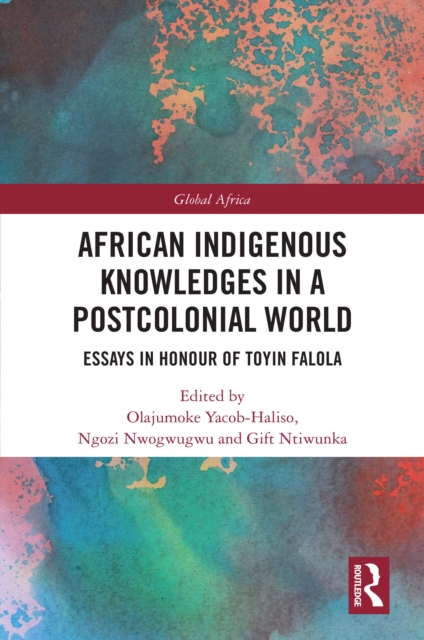
African Indigenous Knowledges in a Postcolonial World
This book argues that ancient and modern African indigenous knowledges remain key to Africa’s role in global capital, technological and knowledge development and to addressing her marginality and postcoloniality.
The contributors engage the unresolved problematics of the historical and contemporary linkages between African knowledges and the African academy, and between African and global knowledges. The book relies on historical and comparative political analysis to explore the global context for the application of indigenous knowledges for tackling postcolonial challenges of knowledge production, conflict and migration, and women’s rights on the continent in transcontinental African contexts.
Asserting the enduring potency of African indigenous knowledges for the transformation of policy, the African academy and the study of Africa in the global academy, this book will be of interest to scholars of African Studies, postcolonial studies and decolonisation and global affairs.
eBook


Going Back to the Roots: Indigenous Language, Media Performance, and Change in Kenya
The introduction of indigenous languages to Kenyan media, following pre- and post-independence realities, opened the floodgate of communications within the country, with both positive and negative consequences. Indigenous languages found expression in creative works, civic communication, and other areas previously reserved solely for English and Kiswahili. Kanana and Kinyua discuss this trajectory within the context of media liberalization, digital migration, and gains from the period of state crackdown on media to the promulgation of the 2010 Kenyan Constitution and devolution of government units reflecting traditional boundaries. Employing secondary research methodologies, they argue the advantages of indigenous languages in the media over the disadvantages highlighted in the literature.
Journal Article

African eco-spiritualities and climate justice: Afro-ecofeminism perspectives on Genesis 2:4–17
Genesis 2:4–17 offers a foundational account of human–earth relations within the Eden narrative, portraying Mother Earth as a divinely crafted habitat and humanity as both nurtured by and responsible for the land. This article presents an exegetical reading of the passage, engaging historical–critical scholarship and Ancient Near Eastern contexts to unpack its theological emphasis on the interdependence between human beings אָדָם [adam] and the soil אֲדָמָה [adamah] from which they are formed. Drawing on insights from biblical scholars and Eco-theologians, the study foregrounds the ecological dimensions inherent in the text, including themes of cultivation, care and divinely instituted limits on human consumption. Through an Afro-ecofeminism lens, the article then correlates these findings with Indigenous African knowledge systems, where women have historically served as custodians of ecological wisdom. In many African communities, Afro-Indigenous practices have long guided environmental stewardship, from forecasting climatic shifts to sustaining biodiversity through spiritual and communal traditions. Women, deeply embedded in these eco-spiritual roles, preserve and transmit ancestral ecological knowledge and practices that resonate with the biblical portrayal of humanity’s sacred duty towards the earth. By integrating exegetical insights with African eco-spiritualities, this study reimagines Genesis 2:4–17 as a text of interdependence, care and ethical responsibility. In doing so, it contributes to climate justice discourse by bridging biblical scholarship with Indigenous African religious traditions.ContributionThis article employed an Afro-ecofeminism lens to explore Genesis 2:4–17 alongside Indigenous African ecological perspectives, foregrounding the role of African women as custodians of ecological wisdom. It argued that Afro-Indigenous spiritual and environmental knowledge offers vital insights for addressing climate challenges. By integrating biblical and African ecological ethics, the study underscores how traditional ecological knowledge can advance sustainable practices, food security and climate justice. In doing so, it contributes to decolonial theological discourse and reclaims Indigenous African eco-spiritualities as essential to global ecological sustainability.
Journal Article