
Catalogue Search | MBRL


Are you sure you want to remove the book from the shelf?

{{itemTitle}}
28,014
result(s) for
"African leadership"
Sort by:


What Has This Got to Do with the Liberation of Black People?
It is rare that a major leader of a protest movement also becomes
an accomplished scholar who provides valuable insight into the
movement in which he participated. Yet this was precisely what
Ronald W. Walters (1938-2010) did. Born in Wichita, Kansas, the
young Walters led the first modern sit-in protest during the summer
of 1958, nearly two years before the more famous Greensboro sit-in
of 1960. After receiving a doctorate from American University,
Walters embarked on an extraordinary career of scholarship and
activism. Shaped by the civil rights and black power movements and
the African and Caribbean liberation struggles, Walters was a
pioneer in the development of black studies and \"black science\" in
political science. A public intellectual, as well as advisor and
strategist to African American leaders, Walters founded numerous
organizations that shaped the post-civil rights era. A must read
for scholars, students, pundits, political leaders, and activists,
What Has This Got to Do with the Liberation of Black
People? is a major contribution to the historiography of the
civil rights and black power movements, African American
intellectual history, political science, and black studies.
eBook


The business strategy of Booker T. Washington
Michael Boston offers a radical departure from other interpretations of Booker T. Washington by focusing on the latter's business ideas and practices.
More specifically, Boston examines Washington as an entrepreneur, spelling out his business philosophy at great length and discussing the influence it had on black America. He analyzes the national and regional economies in which Washington worked and focuses on his advocacy of black business development as the key to economic uplift for African Americans.
The result is a revisionist book that responds to the skewed literature on Washington even as it offers a new framework for understanding him. Based upon a deep reading of the Tuskegee archives, it acknowledges Washington not only as a champion of black business development but one who conceived and implemented successful strategies to promote it as well.
The Business Strategy of Booker T. Washington makes abundantly clear that Washington was not an accommodationist; it will be required reading for any future discussion of this titan of history.
eBook


Between Homeland and Motherland
InBetween Homeland and Motherland, Alvin B. Tillery Jr. considers the history of political engagement with Africa on the part of African Americans, beginning with the birth of Paul Cuffe's back-to-Africa movement in the Federal Period to the Congressional Black Caucus's struggle to reach consensus on the African Growth and Opportunity Act of 2000. In contrast to the prevailing view that pan-Africanism has been the dominant ideology guiding black leaders in formulating foreign policy positions toward Africa, Tillery highlights the importance of domestic politics and factors within the African American community.
Employing an innovative multimethod approach that combines archival research, statistical modeling, and interviews, Tillery argues that among African American elites-activists, intellectuals, and politicians-factors internal to the community played a large role in shaping their approach to African issues, and that shaping U.S. policy toward Africa was often secondary to winning political battles in the domestic arena. At the same time, Africa and its interests were important to America's black elite, and Tillery's analysis reveals that many black leaders have strong attachments to the \"motherland.\"
Spanning two centuries of African American engagement with Africa, this book shows how black leaders continuously balanced national, transnational, and community impulses, whether distancing themselves from Marcus Garvey's back-to-Africa movement, supporting the anticolonialism movements of the 1950s, or opposing South African apartheid in the 1980s.
eBook

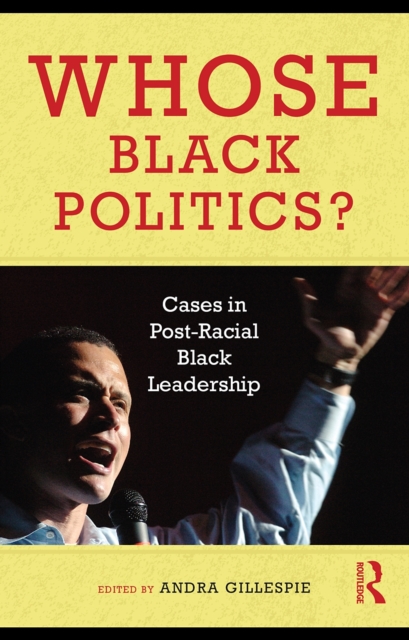
Whose Black Politics?
The past decade has witnessed the emergence of a new vanguard in African American political leaders. They came of age after Jim Crow segregation and the Civil Rights Movement, they were raised in integrated neighborhoods and educated in majority white institutions, and they are more likely to embrace deracialized campaign and governance strategies. Members of this new cohort, such as Cory Booker, Artur Davis, and Barack Obama, have often publicly clashed with their elders, either in campaigns or over points of policy. And because this generation did not experience codified racism, critics question whether these leaders will even serve the interests of African Americans once in office.
With these pressing concerns in mind, this volume uses multiple case studies to probe the implications of the emergence of these new leaders for the future of African American politics. Editor Andra Gillespie establishes a new theoretical framework based on the interaction of three factors: black leaders’ crossover appeal, their political ambition, and connections to the black establishment. She sheds new light on the changing dynamics not only of Black politics but of the current American political scene.
Introduction: 1. Meet the New Class: Theorizing Young Black Leadership in a \"Post-Racial\" Era ( Andra Gillespie ) Part I: Creating Opportunity: How Young Black Politicians Break Into the Political Scene 2. Racial Authenticity and Redistricting: A Comparison of Artur Davis' 2000 and 2002 Congressional Campaigns ( Andra Gillespie and Emma Tolbert ) 3. Losing and Winning: Cory Booker's Ascent to Newark's Mayoralty ( Andra Gillespie ) Part II: Inheritance and Governance: What Political Scions Do Once They Get Elected 4. Like Father, Like Son? Jesse Jackson Jr.'s Tenure As A US Congressman ( Randolph Burnside and Antonio Rodriguez ) 5. Hype, Hip Hop and Heartbreak: The Rise and Fall of Kwame Kilpatrick ( Todd Shaw, Athena King and Lester Spence ) Part III: The Rise of Barack Obama: Its Implications for Black Politics 6. The Burden of Jekyll and Hyde: Barack Obama, Racial Identity, and Black Political Behavior ( Lorrie Frasure ) 7. Leadership, Legitimacy and Public Perceptions Of Barack Obama ( Charlton McIlwain ) Part IV: New Perspectives on Deracialization 8. Between Generations: Deval Patrick's Election As Massachusetts' First Black Governor ( Angela Lewis ) 9. The Declining Significance of Race: Adrian Fenty and the Smooth Electoral Transition ( Rachel Yon ) 10. Situational Deracialization, Harold Ford, and the 2006 U.S. Senate Race In Tennessee ( Sekou Franklin ) 11. The 'Steele Problem' and the New Republican Battle for Black Votes: Legacy, Loyalty, and Lexicon in Maryland's 2006 Senate Contest ( Tyson King-Meadows ) Part V: Intersectionality and African American Politics in the 21st Century 12. Race, Religion and Post-9/11 America: The Election Of Keith Ellison ( Andra Gillespie and Amber Perez ) 13. Young, Gifted, Black and Female: Why Aren't There More Yvette Clarkes In Congress? ( Katrina Gamble ) 14. Conclusion: Where Do We Go From Here?
Andra Gillespie is assistant professor of political science at Emory University, where she teaches courses in African American Politics, political participation and experimental methods.
\"Scholars and observers of African American politics will want to take note of this volume. Over the past decade, a new generation of African American leaders has emerged on the political landscape. With them have surfaced old and new questions about the state of black politics. This volume is one of the first works to systematically analyze these new leaders and their political styles. Professor Gillespie and her contributors offer fresh theoretical insights and a compelling framework and typology for studying this next wave of African American politicians. This book is essential reading for anyone seeking to understand the contemporary black politics and its significance for broader American politics.\" — Kerry L. Haynie , Duke University
\"These empirically sagacious and theoretically provocative case studies are the best work yet on the transformations in African American politics that produced Barack Obama.\" — Robert C. Smith , San Francisco State University
\" Whose Black Politics is an important text that tracks a generational shift in black politics. Gillespie offers a compelling analysis of how we might understand the transition of black politicians from grassroots activists to Harvard trained attorneys. Students of black politics will learn a lot and find much to debate from Gillespie's work.\" — Mark Sawyer , University of California Los Angeles
eBook

A crisis of leadership and the role of citizens in Black America
This book investigates the role, duties, and obligations of leaders and citizens through examining post-Civil Rights Black leaders and the patterns of behavior within the African American community. The major themes of this book include the significance of service, sacrifice, and commitment to the common good as the core characteristics of effective leadership and models of citizenship.
eBook