
Catalogue Search | MBRL


Are you sure you want to remove the book from the shelf?

{{itemTitle}}
4
result(s) for
"Aga Khan Development Network"
Sort by:


Scaling value: transnationalism and the Aga Khan’s English as a “second language” policy
Against the backdrop of growing sociolinguistic interest in transnationalism, this paper uses the notion of “scale” as an “ideological project” (Irvine in Scale. Discourse and dimensions of social life, University of California Press, California,
2016
: 214) to study situated discursive performances of transnationalism amongst Shia Ismaili Muslims in a village in Hunza, Northern Pakistan and the city of Khorog, Eastern Tajikistan. By virtue of the ideological importance granted to English by the Ismaili community’s spiritual leader, the Aga Khan IV, transnational scaling is studied through the window of discourse on English. Specifically, the paper analyses how Ismailis in these two localities appropriate the Aga Khan’s English as a “second language” policy. Drawing on data collected during ethnographic fieldwork, the paper demonstrates how Ismailis make English into an economic and symbolic resource, which is simultaneously used to underscore community-internal sameness and index Ismaili progress. In bringing together an analysis of the discursive construction of local policy appropriation with reflections on transnational scaling practices, the paper makes a novel contribution to both current debates on the spatialisation of language policy discourse (Canagarajah in Reclaming the local in language policy and practice (xiii–xxx), Routledge, London and New York,
2005
; Hult in Int J Sociol Lang 202:7–24, Hult
2010
; Mortimer and Wortham in Annu Rev Appl Linguist 35:160–172,
2015
) and language commodification and value (Heller in J Sociolinguist 7(4):473–492,
2003
, Heller in Annu Rev Anthropol 39:101–114,
2010
; Tan and Rubdy in Language as commodity: global structures, local market places, Continuum, London,
2008
; Duchêne and Heller in Language in late capitalism: pride and profit, Routledge, London and New York,
2012
; Park and Wee in Markets of English. Linguistic capital and language policy in a globalizing world, Routledge, London and New York,
2012
).
Journal Article
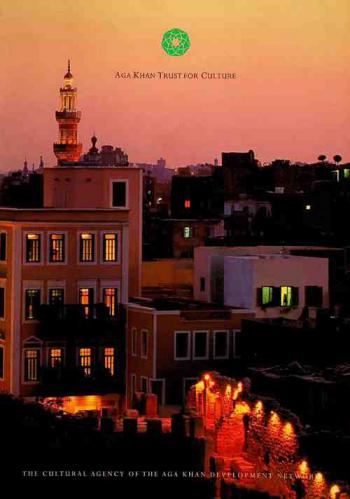

Cairo : renewing the historic city
This book reveals how the Aga Khan Development Network and its Historic Cities Programme transformed an area of Cairo's urban blight into a dynamic public space. Once a city of verdant gardens and parks, Cairo in the 1980s was severely overcrowded, economically struggling, and many of its inhabitants lived in unsanitary conditions. Historic Cairo, a World Heritage Site centered on the original Fatimid settlement of Cairo, has presented a challenge to conservationists and urban planners over the years as they have sought to protect the city's heritage while it remains a living city. Understanding how the process of decline could be reversed by restoring monuments and building a new park, the Aga Khan Development Network (AKDN) set about revitalizing the Darb al Ahmar area and creating Al Azhar Park. This book features numerous scholarly contributors and authors who participated in the program, and shows how the conservation effort paid off in countless ways.
BOOK