
Catalogue Search | MBRL


Are you sure you want to remove the book from the shelf?

{{itemTitle}}
516
result(s) for
"Agile software development Management."
Sort by:

Agile project management
\"Manage projects with speed and flexibility Agile project management is a fast and flexible approach to managing all projects, not just software development. By learning the principles and techniques in this book, you will be able to create a product roadmap, schedule projects, and prepare for product launches with the ease of agile software developers. You'll discover how to manage scope, time, and cost, as well as team dynamics, quality, and risk of every project. Inside: Why agile techniques work; Steps for putting agile into action; Define product vision and features; Plan releases and sprints; Manage scope and procurement; Simplify and increase project reporting; Create an agile environment.\"--Provided by publisher.
Book

Adapting Configuration Management for Agile Teams
Adapting Configuration Management for Agile Teams provides very tangible approaches on how Configuration Management with its practices and infrastructure can be adapted and managed in order to directly benefit agile teams. Written by Mario E. Moreira, author of Software Configuration Management Implementation Roadmap, columnist for CM Crossroads online community and writer for the Agile Journal, this unique book provides concrete guidance on tailoring CM for Agile projects without sacrificing the principles of Configuration Management.
eBook

Scrum for dummies
\"Scrum is an agile project management framework that allows for flexibility and collaboration to be a part of your workflow. Primarily used by software developers, scrum can be used across many job functions and industries. Scrum can also be used in your personal life to help you plan for retirement, a trip, or even a wedding or other big event. Scrum provides a small set of rules that create just enough structure for teams to be able to focus their innovation on solving what might otherwise be an insurmountable challenge. Scrum For Dummies shows you how to assemble a scrum taskforce and use it to implement this popular Agile methodology to make projects in your professional and personal life run more smoothly--from start to finish...No matter your career path or job title, the principles of scrum are designed to make your life easier. Why not give it a try?\"--Amazon.com.
Book

Agile Approaches on Large Projects in Large Organizations
Creativity and productivity, rapid adaptation to change, value for the customer—these are just some of the advantages of implementing agile practices in project work. However, agile practices have been most widely and successfully undertaken in the context of small, colocated teams working on small software projects, known as the “agile sweet spot.”In this monograph, Brian Hobbs and Yvan Petit explore the use and impact of agile outside of the agile sweet spot. Through a case study and survey questionnaire, they uncover research questions that have remained largely unexamined in the literature, on the project level as well as on the organizational level, namely:• What challenges are encountered when applying agile approaches to large, multi-team software projects and what practices have been developed to alleviate these challenges?• How does the context of large, complex organizations affect the adaptation and adoption of agile approaches and vice versa?An illuminating study of this emerging field, Agile Approaches on Large Projects in Large Organizations opens the door to further investigation on the future role of project managers, the use of scaling frameworks at the program and portfolio levels, and the effects of DevOps, one of the recent trends in agile software development.
eBook


Agile Practice Guide
Agile Practice Guide has been developed as a resource to understand, evaluate, and use agile and hybrid agile approaches. This practice guide provides guidance on when, where, and how to apply agile approaches and provides practical tools for practitioners and organizations wanting to increase agility. This practice guide is aligned with other PMI standards, including this book and was developed as the result of collaboration between the Project Management Institute and the Agile Alliance.
eBook


Agile Approaches on Large Projects in Large Organizations
Creativity and productivity, rapid adaptation to change, value for the customer-these are just some of the advantages of implementing agile practices in project work. However, agile practices have been most widely and successfully undertaken in the context of small, colocated teams working on small software projects, known as the \"agile sweet spot.\" In this monograph, Brian Hobbs and Yvan Petit explore the use and impact of agile outside of the agile sweet spot. Through a case study and survey questionnaire, they uncover research questions that have remained largely unexamined in the literature, on the project level as well as on the organizational level
Publication
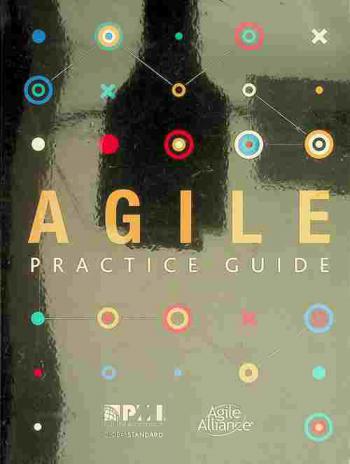
Agile practice guide
\"The Project Management Institute and Agile Alliance® chartered this practice guide to create a greater understanding of Agile approaches in their communities. The vision for this practice guide is to equip project teams with tools, situational guidelines, and an understanding of the available Agile techniques and approaches to enable better results. Project teams are using Agile approaches in a variety of industries beyond software development. Both organizations realize that expansion has created a need for a common language, open mindedness, and the willingness to be flexible in how products and deliverables are brought to market. In addition, both organizations realize there are multiple ways to achieve successful delivery. There are a broad range of tools, techniques, and frameworks; teams have choices for approaches and practices that fit their project and the organizational culture in order to achieve the desired outcome. The Agile Practice Guide core committee members are from varying backgrounds and use various approaches. Some of the committee members are consultants and some work inside organizations. All have worked in Agile ways for many years\"-- Provided by publisher.
Book

Introduction
This chapter contains sections titled:
Meaning of the Word “Agile”
Meaning of the Word “Waterfall”
Polarization of Agile and Traditional Waterfall Approaches
The Program du Jour Effect
Impact on Project Management
Common Agile Misconceptions
What Agile Doesn't Tell You
Book Chapter