
Catalogue Search | MBRL


Are you sure you want to remove the book from the shelf?

{{itemTitle}}
419
result(s) for
"Aging Humor."
Sort by:


Laughter before sleep
One of America's most eminent nature poets, Robert Pack has won the acclaim of writers, critics, and readers from Stephen Jay Gould to Mark Strand. In his latest collection, Laughter Before Sleep, Pack carries on his themes of family and friends, responsibility to the natural world of evolved diversity, the transience of life, the fragility of happiness, and the consolations offered by art and music.
Laughter Before Sleep weighs the nature of endings from the perspective of old age and embraces the humor and play of memory that keep mortality at bay.As we are carried along with Pack's lyrical, sensitive, and intelligent verse, he takes us on a moving but often comic journey toward the end of life. In the opening section, Pack composes poems that meditate upon a sense of his own diminishing and the meaning of absences. The middle sections form episodes of a memoir in verse, moving from family to history and back again, reflecting on the power of anecdote to shape a life in retrospect. With the final section, Pack recalls his unfulfilled plan to raise penguins in Montana, offers a panegyric on Darwin's nose, and makes the mistake of trying to impress a police officer with a book of poems.
Filled with charm and wit but also with philosophical melancholy, Laughter Before Sleep is a superb addition to the poet's oeuvre.
eBook


Difference in redox status of serum and aqueous humor in senile cataract patients as monitored via the albumin thiol-redox state
Purpose
To clarify the redox states of the aqueous humor and serum in senile cataract patients.
Methods
We analyzed the reduced and oxidized albumin fractions in 58 patients. The patients had no detectable evidence of other eye or systemic diseases and were divided into two age groups (53–75 and 76-96 years). Analysis was performed with a high-performance liquid chromatographic system with a fluorescence detector.
Results
Extremely small amounts of reduced albumin (3.8% and 3.6% in the younger and older groups, respectively) and markedly large amounts of oxidized albumin (96.2% and 96.4%, respectively) were found in the aqueous humor. Moreover, a higher percentage of oxidized albumin, particularly a highly oxidized irreversible form of albumin, was found in the aqueous humor (12.3% and 12.0%) than in the serum (2.4% and 3.0%).
Conclusions
In senile cataract patients with no complications, the redox state of albumin in the aqueous humor differs considerably, both quantitatively and qualitatively, from that in the serum.
Journal Article
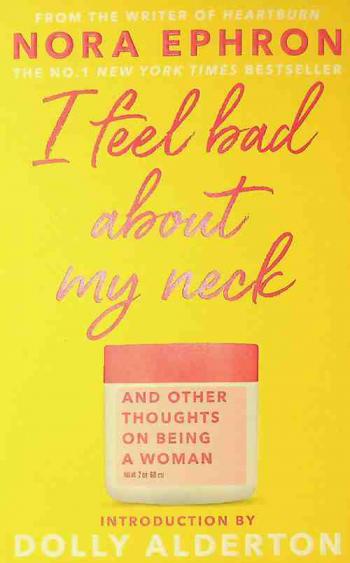
I feel bad about my neck : and other thoughts on being a woman
Now with an introduction from Dolly Alderton, author of Everything I Know About Love, revealing how a new generation of women can take inspiration from Nora's sharp wit and wisdom about life.* Never marry a man you wouldn't want to be divorced from.* If the shoe doesn't fit in the shoe store, it's never going to fit.* When your children are teenagers, it's important to have a dog so that someone in the house is happy to see you.* If only one third of your clothes are mistakes, you're ahead of the game.* Anything you think is wrong with your body at the age of thirty-five you will be nostalgic for by the age of forty-five.

Humor and Aging - A Mini-Review
Humor is one of the most important human activities, one that is enjoyed daily by people in every culture and at every age. However, very little is known about how aging affects humor experiences. Research suggests that elderly people enjoy humor more than younger people, but they have increasing difficulties in understanding jokes. Several cognitive mechanisms that may help explain this trend are discussed. Also, the amount of laughter exhibited by the elderly is smaller compared to young adults. In addition, the older population seems not to enjoy aggressive types of humor as much as the younger ones, and the elderly are especially sensitive to jokes referring to old age. Because most studies are cross-sectional, we cannot ignore possible cohort effects that might influence age differences in humor production and humor appreciation. Several future directions are mentioned with the hope for further research on the subject to follow.
Journal Article

Lessons from Lucy : the simple joys of an old, happy dog
\"A bestselling humorist shows how to age gracefully, taking cues from his dog, Lucy\"-- Provided by publisher.
Book

Pragmatics and theory of mind in older adults’ humor comprehension
Jokes understanding is an important part of people’s social life, especially in aging. However, little is known about older adults’ humor understanding and the role of the cognitive skills underpinning social communication, mainly pragmatics and theory of mind (ToM). To fill this gap, we created the Phonological and Mental Jokes (PMJ) task, a fine-grained task distinguishing two types of jokes based on the mentalistic load. The PMJ task was administered, together with the Assessment of Pragmatic Abilities and Cognitive Substrates (APACS) test for pragmatics and the Strange Stories for ToM, to 147 older adults (age-range 60–85). Through structural equation modeling (SEM), we analyzed: i) the latent structure of the PMJ task; ii) the relationships between humor comprehension, pragmatics, and ToM, controlling for other background variables (vocabulary, education, and age). Results revealed a two-latent-factor model for the PMJ task, which separated phonological from mental jokes. Furthermore, pragmatic skills predicted humor comprehension irrespective of the type of joke, whereas the relationship between humor understanding and ToM skills was specific, being significant for mental, but not for phonological, jokes. These results suggest that humor understanding is part of the larger pragmatic competence of older adults and that it may additionally tax ToM skills when reasoning about the mental states of the joke’s characters is required. These findings pave the way to a lifespan consideration of humor in social communication and add to the debate over the relationship between pragmatics and ToM, showing the different role of these abilities in humor.
Journal Article

Calypso
Personal essays share the author's adventures after buying a vacation house on the Carolina coast and his reflections on middle age and mortality.
Book

Aging and intraocular pressure homeostasis in mice
Age and elevated intraocular pressure (IOP) are the two primary risk factors for glaucoma, an optic neuropathy that is the leading cause of irreversible blindness. In most people, IOP is tightly regulated over a lifetime by the conventional outflow tissues. However, the mechanistic contributions of age to conventional outflow dysregulation, elevated IOP and glaucoma are unknown. To address this gap in knowledge, we studied how age affects the morphology, biomechanical properties and function of conventional outflow tissues in C57BL/6 mice, which have an outflow system similar to humans. As reported in humans, we observed that IOP in mice was maintained within a tight range over their lifespan. Remarkably, despite a constellation of age‐related changes to the conventional outflow tissues that would be expected to hinder aqueous drainage and impair homeostatic function (decreased cellularity, increased pigment accumulation, increased cellular senescence and increased stiffness), outflow facility, a measure of conventional outflow tissue fluid conductivity, was stable with age. We conclude that the murine conventional outflow system has significant functional reserve in healthy eyes. However, these age‐related changes, when combined with other underlying factors, such as genetic susceptibility, are expected to increase risk for ocular hypertension and glaucoma. Age and elevated intraocular pressure (IOP) are the two primary risk factors for the second leading cause of blindness in the world, glaucoma. Despite a number of age‐related changes to the IOP‐regulating tissues of the eye that should impair homeostatic function (decreased cellularity, increased pigment accumulation, increased cellular senescence and increased stiffness), we observed that IOP was stable with age. Thus, healthy eyes appear to have significant functional reserve for IOP regulation, but when combined with other underlying factors, such as genetic susceptibility, are predicted to increase risk for elevated IOP and glaucoma.
Journal Article