
Catalogue Search | MBRL


Are you sure you want to remove the book from the shelf?

{{itemTitle}}
561
result(s) for
"Agricultural development projects Developing countries."
Sort by:

Forty chances : finding hope in a hungry world
The son of legendary investor Warren Buffet relates how he set out to help nearly a billion individuals who lack basic food security through his passion of farming, in forty stories of lessons learned.
Book

The world bank group and the global food crisis
The unanticipated spike in international food prices in 2007-08 hit many developing countries hard. International prices for food and other agricultural products increased by more than 100 percent between early 2007 and mid-2008. Prices for food cereals more than doubled; and those for rice doubled in the space of just a few months. The food price increases were particularly hard on the poor and near-poor in developing countries, many of whom spend a large share of their income on food and have limited means to cope with price shocks. An estimated 1.29 billion people in 2008 lived on less than {dollar}1.25 a day, equivalent to 22.4 percent of the developing world population. In addition, the Food and Agriculture Organization estimated that 923 million people were undernourished in 2007. Simulation models suggested that poverty rose by 100-200 million people and the undernourished increased by 63 million in 2008. The World Bank organized rapidly for short-term support in the crisis, launching a fast-track program of loans and grants, the Global Food Crisis Response Program (GFRP). The GFRP mainly targeted low-income countries, and provided detailed policy advice to governments and its own staff on how to respond to the crisis. The Bank also scaled up lending for agriculture and social protection to support the building of medium-term resilience to future food price shocks. The International Finance Corporation responded by sharply increasing access to liquidity for agribusinesses and agricultural traders in the short and medium term, as well as new programs to improve incentives for agricultural market participants. This evaluation assesses the effectiveness of the World Bank Group response in addressing the short-term impacts of the food price crisis and in enhancing the resilience of countries to future shocks.
eBook

Reaching the rural poor : a renewed strategy for rural development
The world confronts major challenges in rural development as it enters the 21st century. Most of the world’s poverty is in rural areas, and will remain so, yet there is a pro-urban bias in most countries’ development strategies, and in their allocation of public investment funds. Rural people, and ethnic minorities, in particular, have little political clout to influence public policy to attract more public investment in rural areas.This document outlines a holistic and spatial approach that tackles some tough and long-ignored issues and also addresses old issues in new ways. The revised action-oriented strategy provides guidelines and focal points for enhancing the effectiveness of the World Bank’s rural development efforts.
eBook

Agriculture investment sourcebook
Investing to promote agricultural growth and poverty reduction is a central pillar of the World Bank{u0092}s current rural strategy, Reaching the Rural Poor (2003). One major thrust of the strategy outlines the priorities and the approaches that the public sector, private sector, and civil society can employ to enhance productivity and competitiveness of the agricultural sector in ways that reduce the rural poverty and sustain the natural resource base. These actions involve a rich mixture of science, technology, people, communication, management, learning, research, capacity building, institutional development, and grassroots participation. This Sourcebook addresses how to implement the rural strategy, by sharing information on investment options and identifying innovative approaches that will aid the design of future lending programs for agriculture. It provides generic good practices and many examples that demonstrate investment in agriculture can provide rewarding and sustainable returns to development efforts. It is divided into eleven self-contained modules. Each module contains three different types of subunits that can also be stand-alone documents: I. Module Overview, II. Agricultural Investment Notes, III. Innovative Activity Profiles. The stand-alone nature of the subunits allows flexibility and adaptability of the material, as well selected readings and web links are provided for readers who seek more in-depth information. The Sourcebook draws on a wide range of experience from donor agencies, governments, institutions, and other groups active in agricultural development. It is an invaluable reference tool for policy makers, professionals, academics and students, and anyone with an interest in agricultural investments.
eBook
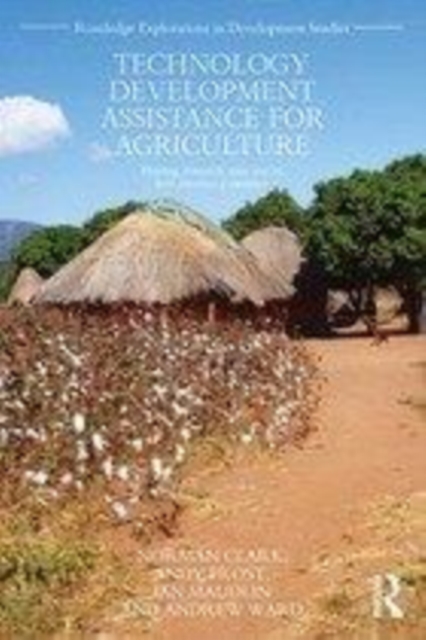
Technology Development Assistance for Agriculture
Stemming from an 11-year DFID funded programme under its Renewable Natural Resources Research Strategy (RNRRS), Technology Development Assistance for Agriculture: Putting Research into Low Income Countries reviews part of this programme as a case study of a broader issue of technology development for Africa. Controversially, it critiques current international technology development assistance and focuses on the potential role of the private sector in agricultural technology development as well as providing insights for future cognate science policy and practice.
The book focuses on the RIU \"Best Bets\" Africa sub-programme. This identified promising proposals to take existing agriculture research products and put these into use in ways that would benefit the poor in developing countries. The sum set aside for this was £5 million. The empirical sections of the book cover project selection, progress and programme management over a 2009-2012 period with special attention paid to lessons learned that may have implications for future cognate technology development assistance.
This topical book gives direct evidence of meeting objectives and delivering real changes in technology development for Africa to postgraduate students, researchers, international bodies, NGOs, policy makers and government organisations working on natural resource management, technology development assistance, and low income country agriculture.
eBook

Agricultural growth for the poor : an agenda for development
The majority of the world's poor depend directly or indirectly on agriculture. Despite the strong linkages between broad-based agricultural growth and poverty reduction, international support to agriculture sharply declined from the late 1980s. The need to raise agriculture's prominence in the development agenda has never been greater. This book seeks to articulate the World Bank's Rural Strategy on agriculture to the wider development community. It provides decision makers with the rationale for supporting agriculture by presenting the lessons learned on the policies, institutions, and priority investments that can sustain pro-poor agricultural growth.
eBook

Globalization and the developing countries: emerging strategies for rural development and poverty alleviation
The globalization process and the internal policy reforms that the developing countries have implemented during the past decade have changed the relative prices of practically all their inputs and outputs. Agricultural producers have therefore been forced to change the structure and methods of their production.This book reviews the impact of globalization on the economics of developing countries in general and their agricultural and rural sectors in particular.
eBook

Sustainable Poverty Reduction in Less Favoured Areas
Through the study of less-favoured areas in Africa, Latin America, and South and East Asia, this work explores the development pathways allowing for the careful adjustment of resource use strategies at the field, farm-household and village level.
eBook
Sustainable poverty reduction in less-favoured areas
Less-favoured areas with limited agricultural potential or difficult access conditions, support 40 percent of the world's rural population suffering from chronic poverty. While agricultural innovations and rural development programs have begun to be implemented within developing countries, they do not address the specific obstacles faced by this large population. Instead, a targeted approach is needed to identify different resource management strategies for particular types of households and communities as well as creating balanced investments aimed at sustainable intensification of rural livelihoods. Such efforts have been the focus of the research program on Regional Food Security Policies for Natural Resource Management and Sustainable Economies (RESPONSE). Through the study of less-favoured areas in Africa, Latin America, and South and East Asia, development pathways allowing for the careful adjustment of resource use strategies at the field, farm-household and village level are explored.
eBook
Agricultural Growth for the Poor
The majority of the world's poor depend directly or indirectly on agriculture. Despite the strong linkages between broad-based agricultural growth and poverty reduction, international support to agriculture sharply declined from the late 1980s. The need to raise agriculture's prominence in the development agenda has never been greater. This book seeks to articulate the World Bank's Rural Strategy on agriculture to the wider development community. It provides decision makers with the rationale for supporting agriculture by presenting the lessons learned on the policies, institutions, and priori
Book