
Catalogue Search | MBRL


Are you sure you want to remove the book from the shelf?

{{itemTitle}}
3,145
result(s) for
"Agriculture and state Japan."
Sort by:

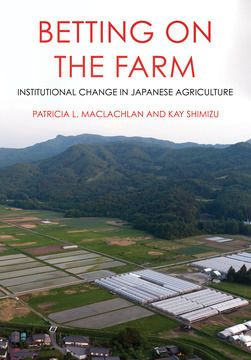
Betting on the Farm
Japan Agricultural Cooperatives (JA), a nationwide network of
farm cooperatives, is under increasing pressure to expand farmer
incomes by adapting coop strategies to changing market incentives.
Some coops have adapted more successfully than others. In
Betting on the Farm , Patricia L. Maclachlan and Kay
Shimizu attribute these differences to three sets of local
variables: resource endowments and product-specific market
conditions, coop leadership, and the organization of farmer-members
behind new coop strategies.
Using in-depth case studies and profiles of different types of
farmers, Betting on the Farm also explores the evolution
of the formal and informal institutional foundations of postwar
agriculture; the electoral sources of JA's influence; the
interactive effects of economic liberalization and demographic
pressures (an aging farm population and acute shortage of farm
successors) on the propensity for change within the farm sector;
and the diversification of Japan's traditional farm households and
the implications for farmer ties with JA.
eBook

Japan's Interventionist State
Japan's Interventionist State gives a detailed examination of Japan's Ministry of Agriculture, Forestry and Fisheries and its role in promoting, protecting and preserving the regime of agricultural support and protection. This account is integral to the author's extended and multidimensional explanation for why Japan continues to provide high levels of assistance to its farmers and why it continues to block market access concessions in the WTO and other agricultural trade talks.
eBook

Japanese agriculture: a comparative economic analysis
Food prices in Japan are extremely high by international standards, and its agricultural sector is beset by low productivity. This book determines what the real level of Japanese agricultural productivity is by comparing it with other developed countries and with less developed countries. Japan has set itself the goal of catching up with the European Community in agricultural productivity, and so the book makes an extended comparison of Japanese and Dutch agriculture to try and determine the likelihood of this happening. Extended inter-country comparisons with Taiwan and the United States are also undertaken.
The book analyses how various political and economic factors have interacted to prevent Japan achieving high agricultural productivity at the same time as it was experiencing remarkable growth in its industrial productivity. Solutions to the current problem are suggested and the book concludes by discussing the relevance of Japan's experience to other developing economies.
eBook

Japan's interventionist state
This book gives a detailed examination of Japan's Ministry of Agriculture, Forestry and Fisheries and its role in promoting, protecting and preserving the regime of agricultural support and protection
Book


Trans-ancestry mutational landscape of hepatocellular carcinoma genomes
Tatsuhiro Shibata, David Wheeler, Hiroyuki Aburatani and colleagues report the genomic, exomic and oncoviral sequencing of hundreds of liver cancers from the United States and Japan. The authors analyzed mutation patterns and identified signatures unique to the Asian cases.
Diverse epidemiological factors are associated with hepatocellular carcinoma (HCC) prevalence in different populations. However, the global landscape of the genetic changes in HCC genomes underpinning different epidemiological and ancestral backgrounds still remains uncharted. Here a collection of data from 503 liver cancer genomes from different populations uncovered 30 candidate driver genes and 11 core pathway modules. Furthermore, a collaboration of two large-scale cancer genome projects comparatively analyzed the trans-ancestry substitution signatures in 608 liver cancer cases and identified unique mutational signatures that predominantly contribute to Asian cases. This work elucidates previously unexplored ancestry-associated mutational processes in HCC development. A combination of hotspot
TERT
promoter mutation,
TERT
focal amplification and viral genome integration occurs in more than 68% of cases, implicating
TERT
as a central and ancestry-independent node of hepatocarcinogenesis. Newly identified alterations in genes encoding metabolic enzymes, chromatin remodelers and a high proportion of mTOR pathway activations offer potential therapeutic and diagnostic opportunities.
Journal Article

Domestic quail (Coturnix japonica domestica), is there such farm animal?
Around 10% of all table eggs number in the world come from quail and their meat represents about 0.2% of the global poultry production. The domestic quail population involved in production of meat and eggs represents around 11.8% of all productive birds, placing them second after laying hens. China, Spain, France, Italy, Brazil, the USA and Japan are global leading countries in quail farming. Contemporary domesticated Japanese quail, widely used in agricultural practice, originate from wild Japanese breeds (C. japonica). The wild Asian quail is similar to common quail (Coturnix coturnix) and until recently, was accepted as its subspecies (Coturnix coturnix japonica). In the scientific literature, several names for domestic quail are available, so readers can easily become confused as to which species is really meant - wild, domesticated or common quail. In order to avoid confusion of names and to emphasise changes resulting from domestication, the term 'domestic quail' and its corresponding Latin name Coturnix japonica domestica is more appropriate. Within the EU legal framework, domestic quail should be included in parallel to other domestic fowl species.
Journal Article

Factors Influencing Willingness to Collaborate on Water Management: Insights from Grape Farming in Samarkand, Uzbekistan
Water is essential for ecological balance, environmental sustainability, and food security, particularly in arid regions where effective water management increasingly depends on farmer cooperation. The Samarkand region of Uzbekistan, known for its favorable climate and leading role in grape production, is facing rising drought conditions. This study explores the factors influencing grape farmers’ willingness to collaborate on water management in the districts of Ishtikhan, Payarik, and Kushrabot, which together produce 75–80% of the region’s grapes. A quantitative survey of 384 grape-producing households was conducted across 19 county citizens’ gatherings (38.7% of such gatherings), and structural equation modeling was employed to analyze a framework consisting of four dimensions: norms, environmental concerns, economic barriers, and the intention to adopt sustainable practices. The results indicate that norms and environmental concerns positively influence collaboration, suggesting a collective orientation toward sustainability. In contrast, economic barriers such as high costs and limited financial capacity significantly hinder cooperative behavior. Furthermore, a strong individual intention to adopt sustainable practices was associated with a greater likelihood of collaboration. These findings highlight the critical drivers and constraints shaping collective water use in agriculture and suggest that targeted policy measures and community-led efforts are vital for promoting sustainable water governance in drought-prone regions.
Journal Article

Review on mushroom mycelium-based products and their production process: from upstream to downstream
The global trend toward carbon neutrality and sustainability calls for collaborative efforts in both the basic and applied research sectors to utilize mushroom mycelia as environmentally friendly and sustainable materials. Fungi, along with animals and plants, are one of the major eukaryotic life forms. They have long been utilized in traditional biotechnology sectors, such as food fermentation, antibiotic production, and industrial enzyme production. Some fungi have also been consumed as major food crops, such as the fruiting bodies of various mushrooms. Recently, new trends have emerged, shifting from traditional applications towards the innovative use of mushroom mycelium as eco-friendly bioresources. This approach has gained attention in the development of alternative meats, mycofabrication of biocomposites, and production of mycelial leather and fabrics. These applications aim to replace animal husbandry and recycle agricultural waste for use in construction and electrical materials. This paper reviews current research trends on industrial applications of mushroom mycelia, covering strain improvements and molecular breeding as well as mycelial products and the production processes. Key findings, practical considerations, and valorization are also discussed.
Graphical Abstract
Journal Article