
Catalogue Search | MBRL


Are you sure you want to remove the book from the shelf?

{{itemTitle}}
10
result(s) for
"Alchemy Italy."
Sort by:


'A most strange story': procedural anomalies and mystical outbreaks in the inquisitorial cases of Pelagians and Francesco Giuseppe Borri, 1655-1661
This essay is based on new archival findings concerning inquisitorial cases against the spiritual movement of «pelagini» or Pelagians active in Lombardy and Veneto in the second half of seventeenth century, and against the alchemist-adventurer Francesco Giuseppe Borri (1627-1695) who led the movement for a certain time. Based on unpublished documents preserved in the archives of the Congregation for the Doctrine of the Faith, this essay reconstructs jurisdictional conflicts between bishops, inquisitors and the Roman Congregation with reference to judicial proceedings instituted in the State of Milan, the Republic of Venice, and Rome itself. An analysis of procedural documents reveals several anomalies that show how the Congregation of the Holy Office, amidst internal tensions and divisions stemming from the political and institutional context in which it operated, tried to bring a complex and elusive jumble of events, people and relationships into effective action against an outbreak of heresy. The documents also shed light on the origins of a movement of Pelagians in which prophecy, Jesuit spirituality, ideas about poverty, and millenarian themes were mingled and merged together. A strong link with Spanish religious culture can also be detected in the Alumbradism and mysticism of early Pelagians and in Borri's infrequent approach to «Lamine di Granada», whose impact in connection with the Immaculate Conception issue has yet to be studied.
Journal Article
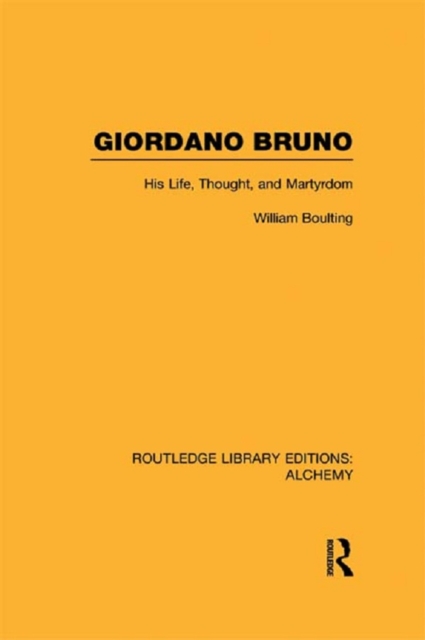
Giordano Bruno
This comprehensive book outlines the life and works of an important revolutionary intellectual of the 16th Century. This book follows Bruno's life and the development of his thought in the order in which he declared it. Giordano Bruno was an Italian Dominican friar, philosopher, mathematician and astronomer. He was burned at the stake after the Roman Inquisition found him guilty of heresy but his modern scientific thought and cosmology became very influential. His writings on science also showed interest in magic and alchemy and those are outlined in this book alongside what he is most remembered for - his place in the history of the relationship between science and faith.
eBook

Asia in the Making of Europe, Volume II: A Century of Wonder. Book 3
Praised for its scope and depth, Asia in the Making of Europe is the first comprehensive study of Asian influences on Western culture. For volumes I and II, the author has sifted through virtually every European reference to Asia published in the sixteenth-century; he surveys a vast array of writings describing Asian life and society, the images of Asia that emerge from those writings, and, in turn, the reflections of those images in European literature and art. This monumental achievement reveals profound and pervasive influences of Asian societies on developing Western culture; in doing so, it provides a perspective necessary for a balanced view of world history.
Volume I: The Century of Discovery brings together \"everything that a European could know of India, Southeast Asia, China, and Japan, from printed books, missionary reports, traders' accounts and maps\" (The New York Review of Books). Volume II: A Century of Wonder examines the influence of that vast new body of information about Asia on the arts, institutions, literatures, and ideas of sixteenth-century Europe.
eBook

Alchemy in Popular Culture: Leonardo Fioravanti and the Search for the Philosopher's Stone
This article examines the alchemical ideas and practices of the sixteenth-century Italian surgeon Leonardo Fioravanti. I argue that Fioravanti's \"search for the philosopher's stone\" was as much an effort at self-fashioning as a search for alchemical gold. Exploit the fashion for alchemical drugs, he framed a \"new theory\" of healing that relied on the use of distilled drugs as a means of purging bodily corruptions. His theory resonated with popular culture, and made him the focus of an alternative medical movement. I conclude that Fioravanti's alchemy was not not Paracelsianism, but relied much more on more immediate sources such as Arnald of Villanova, the pseudo-Lull, and the contemporary Milanese alchemist Ettore Ausonio.
Journal Article

An interesting new species of Alchemilla (Rosaceae) from S Italy
Brullo, S., Scelsi, F. & Spampinato, G.: An interesting new species of Alchemilla (Rosaceae) from S Italy. — Willdenowia 27: 69–72. 1997. — ISSN 0511-9618. Alchemilla austroitalica from the Aspromonte area in S Italy is described as a species new to science and illustrated, and its relationships are discussed. The new species is particularly remarkable as it is the only member of A. sect. Erectae found to the west of the Balkans.
Journal Article


Daughters of Alchemy: Women and Scientific Culture in Early Modern Italy. (I Tatti Studies in Italian Renaissance History)
De Vries reviews Daughters of Alchemy: Women and Scientific Culture in Early Modern Italy by Meredith K. Ray.
Book Review