
Catalogue Search | MBRL


Are you sure you want to remove the book from the shelf?

{{itemTitle}}
1,435
result(s) for
"Algebra Textbooks"
Sort by:

EnVision algebra 1
\"EnVision A G A ©2018 is a brand-new high school mathematics program. It includes Algebra 1, Geometry, and Algebra 2. enVision A G A helps students look at math in new ways, with engaging, relevant, and adaptive content. For teachers, the program offers a flexible choice of options and resources. Customize instruction, practice, and assessments. Re-energize students and help them become more self-directed and independent learners\"--Provided by publisher
Book
Linear algebra
Praise for the Third Edition \"This volume is ground-breaking in terms of mathematical texts in that it does not teach from a detached perspective, but instead, looks to show students that competent mathematicians bring an intuitive understanding to the subject rather than just a master of applications.\"- Electric Review A comprehensive introduction, Linear Algebra: Ideas and Applications, Fourth Edition provides a discussion of the theory and applications of linear algebra that blends abstract and computational concepts. With a focus on the development of mathematical intuition, the book emphasizes the need to understand both the applications of a particular technique and the mathematical ideas underlying the technique. The book introduces each new concept in the context of an explicit numerical example, which allows the abstract concepts to grow organically out of the necessity to solve specific problems. The intuitive discussions are consistently followed by rigorous statements of results and proofs. Linear Algebra: Ideas and Applications, Fourth Edition also features: Two new and independent sections on the rapidly developing subject of wavelets A thoroughly updated section on electrical circuit theory Illuminating applications of linear algebra with self-study questions for additional study End-of-chapter summaries and sections with true-false questions to aid readers with further comprehension of the presented material Numerous computer exercises throughout using MATLAB® code Linear Algebra: Ideas and Applications, Fourth Edition is an excellent undergraduate-level textbook for one or two semester courses for students majoring in mathematics, science, computer science, and engineering. With an emphasis on intuition development, the book is also an ideal self-study reference.
eBook


Topics in Quaternion Linear Algebra
Quaternions are a number system that has become increasingly useful for representing the rotations of objects in three-dimensional space and has important applications in theoretical and applied mathematics, physics, computer science, and engineering. This is the first book to provide a systematic, accessible, and self-contained exposition of quaternion linear algebra. It features previously unpublished research results with complete proofs and many open problems at various levels, as well as more than 200 exercises to facilitate use by students and instructors. Applications presented in the book include numerical ranges, invariant semidefinite subspaces, differential equations with symmetries, and matrix equations.Designed for researchers and students across a variety of disciplines, the book can be read by anyone with a background in linear algebra, rudimentary complex analysis, and some multivariable calculus. Instructors will find it useful as a complementary text for undergraduate linear algebra courses or as a basis for a graduate course in linear algebra. The open problems can serve as research projects for undergraduates, topics for graduate students, or problems to be tackled by professional research mathematicians. The book is also an invaluable reference tool for researchers in fields where techniques based on quaternion analysis are used.
eBook

Introduction to Modern Algebra and its Applications
\"The book provides an introduction to modern abstract algebra and its applications. It covers all major topics of classical theory of numbers, groups, rings, fields and finite dimensional algebras. The book also provides interesting and important modern applications in such subjects as Cryptography, Coding Theory, Computer Science and Physics. In particular, it considers algorithm RSA, secret sharing algorithms, Diffie-Hellman Scheme and ElGamal cryptosystem based on discrete logarithm problem. It also presents Buchbergers algorithm which is one of the important algorithms for constructing Gröbner basis. Key Features: Covers all major topics of classical theory of modern abstract algebra such as groups, rings and fields and their applications. In addition it provides the introduction to the number theory, theory of finite fields, finite dimensional algebras and their applications. Provides interesting and important modern applications in such subjects as Cryptography, Coding Theory, Computer Science and Physics. Presents numerous examples illustrating the theory and applications. It is also filled with a number of exercises of various difficulty.
Describes in detail the construction of the Cayley-Dickson construction for finite dimensional algebras, in particular, algebras of quaternions and octonions and gives their applications in the number theory and computer graphics.\"
eBook
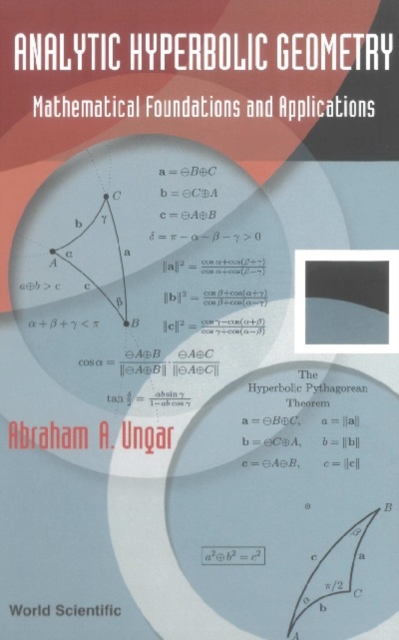
Analytic hyperbolic geometry
This is the first book on analytic hyperbolic geometry, fully analogous to analytic Euclidean geometry. Analytic hyperbolic geometry regulates relativistic mechanics just as analytic Euclidean geometry regulates classical mechanics. The book presents a novel gyrovector space approach to analytic hyperbolic geometry, fully analogous to the well-known vector space approach to Euclidean geometry. A gyrovector is a hyperbolic vector. Gyrovectors are equivalence classes of directed gyrosegments that add according to the gyroparallelogram law just as vectors are equivalence classes of directed segments that add according to the parallelogram law. In the resulting “gyrolanguage” of the book one attaches the prefix “gyro” to a classical term to mean the analogous term in hyperbolic geometry. The prefix stems from Thomas gyration, which is the mathematical abstraction of the relativistic effect known as Thomas precession. Gyrolanguage turns out to be the language one needs to articulate novel analogies that the classical and the modern in this book share.
eBook
Discrete Algebraic Methods
The idea behind this book is to provide the mathematical foundations for assessing modern developments in the Information Age. It deepens and complements the basic concepts, but it also considers instructive and more advanced topics. The treatise starts with a general chapter on algebraic structures; this part provides all the necessary knowledge for the rest of the book. The next chapter gives a concise overview of cryptography. Chapter 3 on number theoretic algorithms is important for developping cryptosystems, Chapter 4 presents the deterministic primality test of Agrawal, Kayal, and Saxena. The account to elliptic curves again focuses on cryptographic applications and algorithms. With combinatorics on words and automata theory, the reader is introduced to two areas of theoretical computer science where semigroups play a fundamental role.The last chapter is devoted to combinatorial group theory and its connections to automata. Contents: Algebraic structures Cryptography Number theoretic algorithms Polynomial time primality test Elliptic curves Combinatorics on words Automata Discrete infinite groups
eBook
Cours d'algèbre et D'algorithmique
Comment savoir si un nombre entier est compose ou premier, et dans le cas ou il est compose, comment obtenir sa factorisation primaire ?Ces questions essentielles de la theorie des nombres sont au centre des preoccupations de tous ceux qui etudient une discipline frontiere entre les mathematiques et l'informatique : la cryptologie.Science des ecritures secretes, elle utilise des protocoles mathematiques necessitant une connaissance approfondie en algebre : groupes, anneaux, corps finis, fractions continues, courbes elliptiques, mais aussi en algorithmique : tests de primalite, algorithmes de factorisation.Puissamment aides par l'ordinateur et la tres grande qualite de leurs travaux, les mathematiciens ont permis a la cryptologie moderne, A moteur de la theorie des nombres A d'acquerir des lettres de noblesse incontestables que cet ouvrage souhaite faire partager au public scientifique le plus large possible : etudiants en Classes Preparatoires, etudiants, candidats au CAPES ou a l'Agregation, ingenieurs, enseignants.
eBook

Differential equations, dynamical systems, and linear algebra
This book is about dynamical aspects of ordinary differential equations and the relations between dynamical systems and certain fields outside pure mathematics. A prominent role is played by the structure theory of linear operators on finite-dimensional vector spaces; the authors have included a self-contained treatment of that subject.
eBook

Learning Modern Algebra
Learning Modern Algebra aligns with the CBMS Mathematical Education of Teachers II recommendations, in both content and practice. It emphasizes rings and fields over groups, and it makes explicit connections between the ideas of abstract algebra and the mathematics used by high school teachers. It provides opportunities for prospective and practicing teachers to experience mathematics for themselves, before the formalities are developed, and it is explicit about the mathematical habits of mind that lie beneath the definitions and theorems.This book is designed for prospective and practicing high school mathematics teachers, but it can serve as a text for standard abstract algebra courses as well. The presentation is organized historically: the Babylonians introduced Pythagorean triples to teach the Pythagorean theorem; these were classified by Diophantus, and eventually this led Fermat to conjecture his Last Theorem. The text shows how much of modern algebra arose in attempts to prove this; it also shows how other important themes in algebra arose from questions related to teaching. Indeed, modern algebra is a very useful tool for teachers, with deep connections to the actual content of high school mathematics, as well as to the mathematics teachers use in their profession that doesn't necessarily \"end up on the blackboard.\"The focus is on number theory, polynomials, and commutative rings. Group theory is introduced near the end of the text to explain why generalizations of the quadratic formula do not exist for polynomials of high degree, allowing the reader to appreciate the more general work of Galois and Abel on roots of polynomials. Results and proofs are motivated with specific examples whenever possible, so that abstractions emerge from concrete experience. Applications range from the theory of repeating decimals to the use of imaginary
quadratic fields to construct problems with rational solutions. While such applications are integrated throughout, each chapter also contains a section giving explicit connections between the content of the chapter and high school teaching.
eBook