
Catalogue Search | MBRL


Are you sure you want to remove the book from the shelf?

{{itemTitle}}
158
result(s) for
"Algeria Biography."
Sort by:


What Fanon Said: A Philosophical Introduction to His Life and Thought
Antiblack racism avows reason is white while emotion, and thus supposedly unreason, is black. Challenging academic adherence to this notion, Lewis R. Gordon offers a portrait of Martinican-turned-Algerian revolutionary psychiatrist and philosopher Frantz Fanon as an exemplar of \"living thought\" against forms of reason marked by colonialism and racism. Working from his own translations of the original French texts, Gordon critically engages everything in Fanon from dialectics, ethics, existentialism, and humanism to philosophical anthropology, phenomenology, and political theory as well as psychiatry and psychoanalysis. Gordon takes into account scholars from across the Global South to address controversies around Fanon's writings on gender and sexuality as well as political violence and the social underclass. In doing so, he confronts the replication of a colonial and racist geography of reason, allowing theorists from the Global South to emerge as interlocutors alongside northern ones in a move that exemplifies what, Gordon argues, Fanon represented in his plea to establish newer and healthier human relationships beyond colonial paradigms.
eBook


Frantz Fanon
A biography of the revolutionary philosopher and psychiatrist. Doctor, militant, essayist, ambassador, teacher, journalist, pan-Africanist, Frantz Fanon sought to decolonize mid-twentieth-century culture as he embodied a new kind of intellectual. Born in colonial Martinique, he fought for France during World War II but later renounced his citizenship and fought in the Algerian War of Independence. This book emphasizes Fanon's gift for self-invention and performance as it follows his short but extraordinary life and explores how his pioneering work in psychiatry influenced his revolutionary philosophy.
eBook

Augustine’s Confessions
In this brief and incisive book, Pulitzer Prize-winning historian Garry Wills tells the story of theConfessions--what motivated Augustine to dictate it, how it asks to be read, and the many ways it has been misread in the one-and-a-half millennia since it was composed. Following Wills's biography of Augustine and his translation of theConfessions, this is an unparalleled introduction to one of the most important books in the Christian and Western traditions.
Understandably fascinated by the story of Augustine's life, modern readers have largely succumbed to the temptation to read theConfessionsas autobiography. But, Wills argues, this is a mistake. The book is not autobiography but rather a long prayer, suffused with the language of Scripture and addressed to God, not man. Augustine tells the story of his life not for its own significance but in order to discern how, as a drama of sin and salvation leading to God, it fits into sacred history. \"We have to read Augustine as we do Dante,\" Wills writes, \"alert to rich layer upon layer of Scriptural and theological symbolism.\" Wills also addresses the long afterlife of the book, from controversy in its own time and relative neglect during the Middle Ages to a renewed prominence beginning in the fourteenth century and persisting to today, when theConfessionshas become an object of interest not just for Christians but also historians, philosophers, psychiatrists, and literary critics.
With unmatched clarity and skill, Wills strips away the centuries of misunderstanding that have accumulated around Augustine's spiritual classic.
eBook
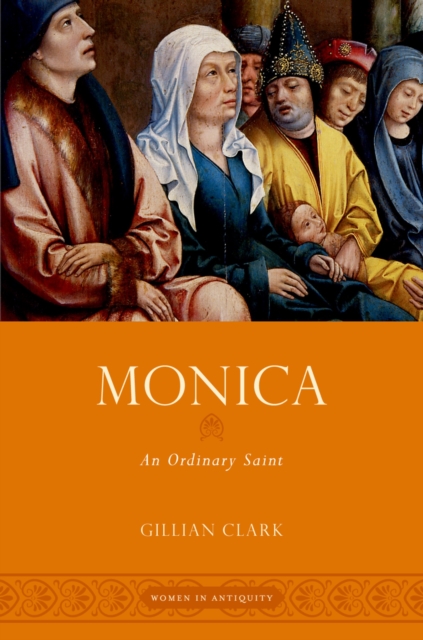
Monica
Rarely did ancient authors write about the lives of women; even more rarely did they write about the lives of ordinary women: not queens or heroines who influenced war or politics, not sensational examples of virtue or vice, not Christian martyrs or ascetics, but women of moderate status, who experienced everyday joys and sorrows and had everyday merits and failings. Such a woman was Monica--now Saint Monica because of her relationship with her son Augustine, who wrote about her in the Confessions and elsewhere. Despite her rather unremarkable life, Saint Monica has inspired a robust controversy in academia, the Church, and the Augustine-reading public alike: some agree with Ambrose, bishop of Milan, who knew Monica, that Augustine was exceptionally blessed in having such a mother, while others think that Monica is a classic example of the manipulative mother who lives through her son, using religion to repress his sexual life and to control him even when he seems to escape. In Monica: An Ordinary Saint, Gillian Clark reconciles these competing images of Monica's life and legacy, arriving at a woman who was shrewd and enterprising, but also meek and gentle. Weighing Augustine's discussion of his mother against other evidence of women's lives in late antiquity, Clark achieves portraits both of Monica individually, and of the many women like her. Augustine did not claim that his mother was a saint, but he did think that the challenges of everyday life required courage and commitment to Christian principle. Monica's ordinary life, as both he and Clark tell it, showed both. Monica: An Ordinary Saint illuminates Monica, wife and mother, in the context of the societal expectations and burdens that shaped her and all ordinary women.
eBook

Augustine's conversion : a guide to the argument of Confessions I-IX
Augustine's Conversion: A Guide to the Argument of Confessions I-IX by Colin Starnes.
eBook