
Catalogue Search | MBRL


Are you sure you want to remove the book from the shelf?

{{itemTitle}}
52
result(s) for
"Ali Shariati"
Sort by:
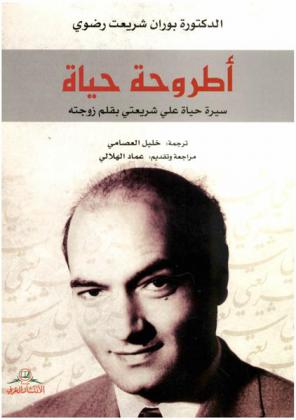
أطروحة حياة : سيرة حياة علي شريعتي بقلم زوجته
يتناول الكتاب سيرة حياة بوران التي كانت حافلة بالنشاط السياسي والثقافي والاجتماعي والأعمال الخيرية التي لم تفارقها ما دامت هي على قيد الحياة، وعندما تلتقي بها تشعر بأنها عاشت حياة مملوءة بالمتاعب وتربية الأطفال والملاحقات السياسية والتنغيصات من قبل هذا وذاك، ولكن مع كل هذه الأمور ظلت بوران صامدة وسائرة نحو الهدف الذي رسمته لنفسها فبقيت منارة وشمعة تضيء إلى الآخرين.
Book

Ali Shariati’s Reading of Ibn Khaldun
Ali Shariati has written extensively on various aspects of social theory and the history of religions, but very few have studied his views on Ibn Khaldun. In other words, my main concern in this article is focused squarely on Shariati's reading of Ibn Khaldun's discourses. My argument is not to be preoccupied by Eastern or WesternKhaldunian studies or even how sociologists and social anthropologists such as Ahmad Ashraf construe him. On the contrary, I attempt to go through the 36 volumes of Ali Shariati's legacy in this article, delving into his reections on Ibn Khaldun. Does he say anything substantial at all on Ibn Khaldun? What does Shariati think of Ibn Khaldun? How does Shariati read Ibn Khaldun? Has anybody else worked upon the typeof Ibn Khaldun thatShariati has construed? As muchas I have studied the literature in the Persian, English, Swedish, Russian, Arabic, and Turkish languages, no references are found regarding Shariatia’s interpretations of Ibn Khaldun. But, as Ali Shariati is one of the most pivotal contemporary non-Eurocentric social theorists in the world and his views on one of the most important classical social thinkers (i.e., Ibn Khaldun) should not go unheeded,this is why I have taken upon this challenge and inquired upon the question that is begged of what Shariati's approach towardIbn Khaldun is.
Journal Article

علي شريعتي : سيرة سياسية
في هذا الكتاب نقترب من حياة شريعتي ونتعرف على المنابع الفكرية التي شكلت فكره في سياق الأوضاع الثقافية والإجتماعية والسياسية المعقدة التي مرت بها إيران. يتناول الكتاب نشأة شريعتي في مدينة مشهد، ومشواره الدراسي والسياسي في باريس أوائل الستينيات، وتطوره إلى مفكر ديني ثوري على خلاف دائم مع النظام البهلوي والمؤسسة الدينية، إلى وفاته في المنفى ولما يبلغ الخامسة والأربعين من عمره. عبر بحث وتنقيب طويل ينجح علي رهنما في كشف الكثير من الغموض المحيط بهذه الشخصية الفريدة، ويقدم فهما جديدا لجرل أدى دورا بالغ الأهمية في الثورة الإيرانية، ويحلل واحدا من التيارات التي أثرت في حركات الإسلام السياسي في الشرق الأوسط.
BOOK

Philosophizing Movement, Mobilizing Philosophers: Rausyan Fikr Institute and the Dissent Narratives of the Shia Islam Community in Indonesia
This article explores the Rausyan Fikr Institute as a distinctive intellectual and philosophical movement within Indonesia’s Shia Muslim community, focusing on its role in mobilizing dissent narratives and fostering intellectual activism. Within the broader historical trajectory of Shi’ism in Indonesia—from its early cultural impact and political mobilization during the Iranian Revolution to its institutional development in the Reformasi era —the Rausyan Fikr Institute represents a unique approach to implementing Shia philosophical thought through grassroots mobilization. Using the framework of ideologically structured action (ISA), this article highlights how Rausyan Fikr articulates its identity through the transmission of philosophical frameworks, critical discourse on current social-political issues, and inclusive educational initiatives. It explores three elements: (i) the dissemination of Shia Islam-inspired thought through translation, publishing, and education, (ii) the development of dissent narratives on capitalism, feminism, and dominant political structure, and (iii) the engagement with wider communities and mobilization strategies for its members, which involve students, women, and families alike in establishing space for intellectual development. The article concludes by reflecting on the Rausyan Fikr Institute’s resilience in sustaining philosophical activism under sectarian pressures, its contribution to Indonesia’s broader intellectual and religious discourse, and the challenges it encounters in preserving both ideological identity and relevance in a contested socio-political landscape.
Journal Article
The Protestant Reformation as an Islamisation of Christianity in the Thought of Ziya Gökalp and Ali Shariati
Following Ziya Gökalp and Ali Shariati’s assertion that Protestantism arose due to the influence of Islam in Europe in the Middle Ages, this study discusses the different discourses elaborated by the Turkish and Iranian authors based on this idea. The controversies surrounding modernity, westernization, colonialism, and Islam were a constant in their writings, despite the different geographical and historical circumstances. This paper discusses the logic of Gökalp and Shariati’s claim that Protestantism was Islamized Christianity. The aim is to provide a detailed perspective on how this claim illuminates their broader thinking about civilization, culture, and religion.
Journal Article

Mapping Post-Secular Islamic Liberation Theology
This article argues that the post-secular turn is the new social analysis that shapes the politics of the impoverized in Islamic liberation theology. In this article, I suggest that, given the essentialism and determinism characterizing much of the contemporary studies of religion and secularism, a direct articulation of a post-secular approach from an Islamic liberation theology perspective is both inevitable and necessary. Such an approach can offer new meaning for both religion and secularism by engaging with the hegemony of secularism in relation to the state and society to envision a politics of the impoverized.
Journal Article

Paradox as Decolonization
This article reevaluates the Iranian polymath Ali Shariati’s most controversial lectures. Scholarly consensus reads 1969’s Ummat va Imāmat as derivative, comprising an imitation of Sukarno’s guided democracy and hence an apology for postcolonial authoritarian rule. Shariati’s rhetorical performance suggests otherwise. The lectures address a postcolonial iteration of Jean-Jacques Rousseau’s paradox of founding—a call for self-determination alongside the external intervention needed to prepare for it in the wake of moral dispositions accrued during colonization. Shariati proposes to resolve the problem of enduring colonial domination by citing a fabricated French professor, a foreigner, as an authoritative source. He practices a noble lie, believable because it draws from colonized sensibilities but laden with hints encouraging audiences to see past it. If audiences develop the requisite ability to decipher the lie, Shariati wagers, they at once develop the autonomy implied by self-determination. On these grounds, Shariati theorizes the paradox of politics as decolonization.
Journal Article
Theology of Revolution: In Ali Shari’ati and Walter Benjamin’s Political Thought
In this paper, I offer a comparative analysis of the political thoughts of twentieth century Iranian revolutionary thinker and sociologist Ali Shari’ati (1933–1977) and German-Jewish philosopher Walter Benjamin (1892–1940). Despite their conspicuously independent historical-theoretical trajectories, both Shari’ati and Benjamin engaged with theology and Marxism to create theological–political conceptions of the revolution of the oppressed. Shari’ati re-interpreted and re-animated Shia history from the angle of contemporary concerns to theorize a revolution against all forms of domination. In comparison, Benjamin fused Marxism with Jewish theology in his call to seize the possibilities of past failed revolutions in the present. Both Shari’ati and Benjamin conceptualized an active messianism led by each generation, eliminating the wait for the return of a messiah. As a result, each present moment takes on a messianic potential; the present plays an essential role to both thinkers. Past was also essential to both, because theology (through remembrance) had made the past sufferings incomplete to them. Both thinkers viewed past sufferings as an integral part of present struggles for justice in the form of remembrance (or yād or zekr for Shari’ati, and Zekher for Benjamin). I explore the ways Shari’ati and Benjamin theorized the role of the past in the present, remembrance, and messianism to create a dialectical relation between theology and Marxism to reciprocally transform and compliment both of them.
Journal Article

THE INFLUENCE OF EUROPEAN INTELLECTUAL IDEAS UPON IRANIAN PROSE AND NON-FICTION IN THE 60S AND 70S
Following the coup d'etat of 1953 and the trauma caused by it gradually in the 60s and 70s in Iran a new subjectivity, a new vision for the Iranian subject of modernity emerged. Iranians were called by their intellectuals to overcome the trauma, which was called \"occidentosis\", a state in which everything that they try to create and produce is \"stilborn\". They were asked to no longer accept predestination and quietism, developing courage instead, becoming militant and finding their own, authentic way of encountering technologies and the West. This paper systematically demonstrates that the new subjectivity, which can be seen in the Iranian prose and non-fiction in the 60s and 70s is heavily influenced by European intellectual ideas.
Journal Article

Shia Phoenix: Is Iran's Islamic Republic a Variety of Political Religion?
This study focuses on post-revolutionary Iran. The Islamic Republic might initially appear to involve a religious cosmology cognate to the term 'politicized religion'–a political use of religion. However, the more complex arrangement of secular and metaphysical politics, as identified in this research, provides context to evaluate the case of the Islamic Republic in the framework of a 'political religion.' In particular, this study explores the Iranian regime's sacralization of politics, its employment of charismatic leadership, and its efforts to create a 'new man.'
Journal Article