
Catalogue Search | MBRL


Are you sure you want to remove the book from the shelf?

{{itemTitle}}
6
result(s) for
"Alien criminals Australia."
Sort by:

Birthplace, migration and crime : the Australian experience
Issues surrounding the migration of human beings are some of the most pressing of our time. Through both historical and contemporary material, this book builds on the author's previous work in the area to explore the landscape of crime and migration in Australia. Focusing primarily upon the Australian experience, but illuminated by studies in other countries and at other times, Professor Francis provides a comprehensive account of crime and migration, linking migration policy with criminality and mental health and arguing that it is birthplace, not race, which impacts upon crimes committed by migrants. Covering a diverse range of issues from the police, courts and prisons to victimology and immigration policy, this book will appeal to scholars across Criminology, Sociology, Law, Migration Studies and Politics.
Book

Australia's Detention Centre and the Erosion of Democracy in Nauru
Since 2013, the Nauru government has undermined democracy by reducing the independence of the judiciary, treating opposition MPs as potential traitors, curbing freedom of speech and restricting visits by variously defined groups of people who include journalists, Australians and New Zealanders. New Zealand responded by suspending its aid to Nauru's justice and border control department. Australia, by contrast, has said little. The Nauru government would not have acted so boldly in curbing civil freedoms and weakening the rule of law if Australia had been less dependent on its goodwill to act as host for Australia's Regional Processing Centre, which houses asylum seekers who have attempted to reach Australia by boat. Australia's reliance on Nauru - driven by urgent domestic political considerations - has fostered an atmosphere where the principles of good governance can be flouted with little fear of significant criticism from Canberra.
Journal Article
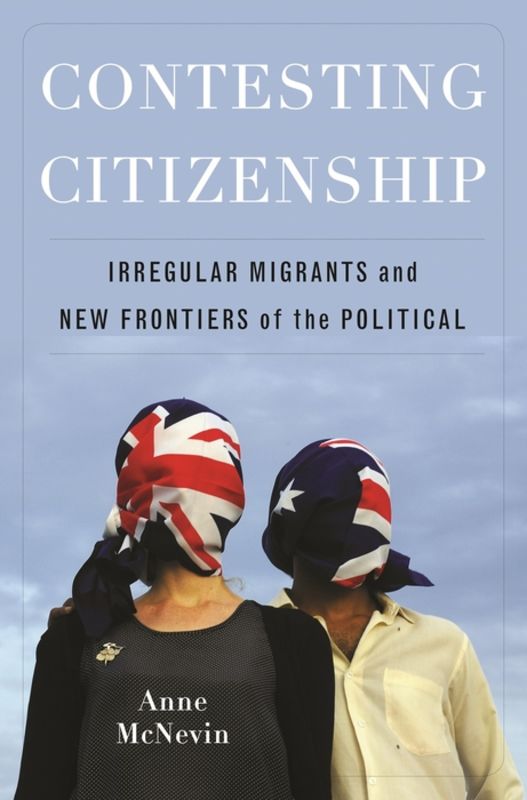
Contesting citizenship
Irregular migrants complicate the boundaries of citizenship and stretch the parameters of political belonging. Comprised of refugees, asylum seekers, \"illegal\" labor migrants, and stateless persons, this group of migrants occupies new sovereign spaces that generate new subjectivities. Investigating the role of irregular migrants in the transformation of citizenship, Anne McNevin argues that irregular status is an immanent (rather than aberrant) condition of global capitalism, formed by the fast-tracked processes of globalization.
McNevin casts irregular migrants as more than mere victims of sovereign power, shuttled from one location to the next. Incorporating examples from the United States, Australia, and France, she shows how migrants reject their position as \"illegal\" outsiders and make claims on the communities in which they live and work. For these migrants, outsider status operates as both a mode of subjectification and as a site of active resistance, forcing observers to rethink the enactment of citizenship. McNevin connects irregular migrant activism to the complex rescaling of the neoliberal state. States increasingly prioritize transnational market relations that disrupt the spatial context for citizenship. At the same time, states police their borders in ways that reinvigorate territorial identities. Mapping the broad dynamics of political belonging in a neoliberal era, McNevin provides invaluable insight into the social and spatial transformation of citizenship, sovereignty, and power.
eBook

SELLING THE PASS: HABEAS CORPUS, DIPLOMATIC RELATIONS AND THE PROTECTION OF LIBERTY AND SECURITY OF PERSONS DETAINED ABROAD
On 31 October 2012 the Supreme Court of England and Wales handed down its judgment in Rahmatullah v Secretary of State for Foreign Affairs and Secretary of State for Defence [2012] UKSC 48. The case concerns an application for habeas corpus brought by a citizen of Pakistan originally detained by the United Kingdom in Iraq before being transferred into the custody of the United States. Rahmatullah addresses important issues concerning the extraterritorial reach of habeas corpus under English law in respect of persons held in the custody of a foreign State, as well as the international rule of law. The case may be considered a legal victory for persons detained without trial by the US in facilities thought to be beyond the reach of the courts. However, in reality any strength in the arm of the law is drained by the priority given to the conduct of foreign affairs, ‘forbidden territory’ for the courts, over the Court's ruling and the UK's obligations under international law. The case is examined in the light of similar jurisprudence from US and Australian courts.
Journal Article
Deportation of Aliens and Immigrants from Australia
When Australia's \"White Australia\" policy was abandoned in favour of multiculturalism, the concepts in the old immigration law in relation to racial equality and human rights were also abandoned. The new standards regarding the deportation of aliens and immigrants have been regarded as in advance of many nations in the humanitarian context. This article examines this transformation of deportation law from openly racist to humanely enlightening. A comparison with the deportation law in the United Kingdom is also made.
Journal Article