
Catalogue Search | MBRL


Are you sure you want to remove the book from the shelf?

{{itemTitle}}
4,401,279
result(s) for
"All, John."
Sort by:

Icefall : adventures at the wild edges of our dangerous, changing planet
\"In May 2014, the mountaineer and scientist John All fell into a crevasse near Everest and took a series of videos as he struggled to climb out 70 feet of ice and snow with fifteen broken bones - including 6 cracked vertebrae, internal bleeding, a severely dislocated shoulder, and his face covered in blood. The videos of him went viral and appeared in newscasts all over the world: CNN, BBC, Australia, Brazil, Israel, South Korea, Saudi Arabia, etc. and every website imaginable - from People Magazine to National Geographic. NPR called him \"a badass for science.\" Yet this story is only the latest of All's adventures. He's also won a footrace for his life with a wild hyena, stepped on a black mamba in the African bush, and scaled Everest - all in pursuit of his true passion: the future of adaptation to our world's changing climate. Icefall is more than a fascinating adventure story-it is a report from the extremes, which hold new lessons about the impact of climate change. It is about the collapsing Andean glaciers, the hidden jungles in Honduras where native people have learned about surviving hurricanes, and the highest points on earth, where more scientific secrets lie. The result is a thrilling adventure memoir with profound lessons for how humans will adjust as our world continues to change beneath our feet\"-- Provided by publisher.
Book

Two Treatises of Government and A Letter Concerning Toleration
Among the most influential writings in the history of Western political thought, John Locke'sTwo Treatises of GovernmentandA Letter Concerning Tolerationremain vital to political debates today, more than three centuries after they were written. The complete texts appear in this volume, accompanied by interpretive essays by three prominent Locke scholars.Ian Shapiro's introduction places Locke's political writings in historical and biographical context. John Dunn explores both the intellectual context in which Locke wrote theTwo Treatises of GovernmentandA Letter Concerning Tolerationand the major interpretive controversies surrounding their meaning. Ruth Grant offers a comprehensive discussion of Locke's views on women and the family, and Shapiro contributes an essay on the democratic elements of Locke's political theory. Taken together, the texts and essays in this volume offer invaluable insights into the history of ideas and the enduring influence of Locke's political thought.
eBook
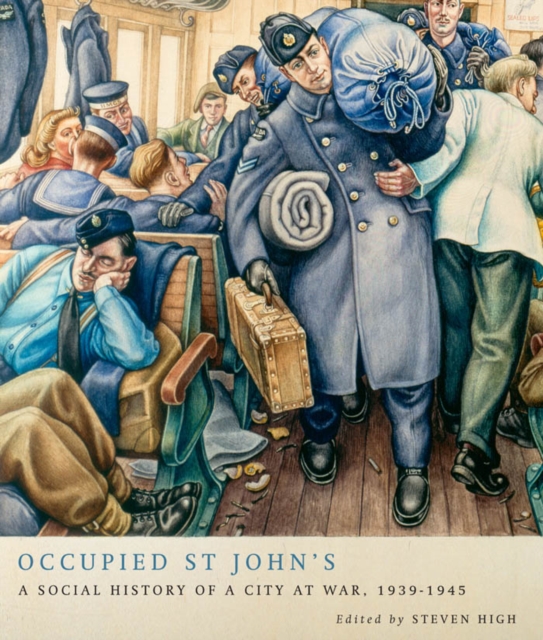
Occupied St John's
In January 1941, the hulking twenty-one thousand ton troopship Edmund B. Alexander docked in St John’s harbor, carrying a thousand American soldiers sent to join the thousands of Canadian troops protecting Newfoundland against attack by Germany. France had fallen, Great Britain was fighting for its survival, and Newfoundland – then a dominion of Britain – was North America’s first line of defence. Although the German invasion never came, St John’s found itself occupied by both Allied Canadian and American forces.
eBook

The making of a Catholic president : Kennedy vs. Nixon 1960
The 1960 presidential election, won ultimately by John F. Kennedy, was one of the closest and most contentious in American history. The country had never elected a Roman Catholic president, and the last time a Catholic had been nominated—New York Governor Al Smith in 1928—he was routed in the general election. From the outset, Kennedy saw the religion issue as the single most important obstacle on his road to the White House. He was acutely aware of, and deeply frustrated by, the possibility that his personal religious beliefs could keep him out of the White House. This book tells the fascinating story of how the Kennedy campaign transformed the “religion question” from a liability into an asset, making him the first (and still only) Catholic president. Drawing on archival research, including many never-before-seen documents, the book travels inside the campaign to show Kennedy's chief advisors—Ted Sorensen, John Kenneth Galbraith, Archibald Cox—grappling with the staunch opposition to the candidate's Catholicism. The book also reveals many of the Nixon campaign's efforts to tap in to anti-Catholic sentiment, with the aid of Billy Graham and the National Association of Evangelicals, among others. The alliance between conservative Protestants and the Nixon campaign, it shows, laid the groundwork for the rise of the Religious Right.
eBook

The American Dreams of John B. Prentis, Slave Trader
As a young man, John B. Prentis (1788-1848) expressed outrage over slavery, but by the end of his life he had transported thousands of enslaved persons from the upper to the lower South. Kari J. Winter's life-and-times portrayal of a slave trader illuminates the clash between two American dreams: one of wealth, the other of equality. Prentis was born into a prominent Virginia family. His grandfather, William Prentis, emigrated from London to Williamsburg in 1715 as an indentured servant and rose to become the major shareholder in colonial Virginia's most successful store. William's son Joseph became a Revolutionary judge and legislator who served alongside Thomas Jefferson, Patrick Henry, and James Madison. Joseph Jr. followed his father's legal career, whereas John was drawn to commerce. To finance his early business ventures, he began trading in slaves. In time he grew besotted with the high-stakes trade, appeasing his conscience with the populist platitudes of Jacksonian democracy, which aggressively promoted white male democracy in conjunction with white male supremacy. Prentis's life illuminates the intertwined politics of labor, race, class, and gender in the young American nation. Participating in a revolution in the ethics of labor that upheld Benjamin Franklin as its icon, he rejected the gentility of his upbringing to embrace solidarity with \"mechanicks,\" white working-class men. His capacity for admirable thoughts and actions complicates images drawn by elite slaveholders, who projected the worst aspects of slavery onto traders while imagining themselves as benign patriarchs. This is an absorbing story of a man who betrayed his innate sense of justice to pursue wealth through the most vicious forms of human exploitation.
eBook

Bold conscience : Luther to Shakespeare to Milton
How the conscience in early modern England emerged as a fulcrum for public action
Bold Conscience chronicles the shifting conception of conscience in early modern England, as it evolved from a faculty of restraint—what Shakespeare labels “coward conscience”—to one of bold and forthright self-assertion. The concept of conscience played an important role in post-Reformation England, from clerical leaders to laymen, not least because of its central place in determining loyalties during the English Civil War and the regicide of King Charles I. Yet the most complex and lasting perspectives on conscience emerged from deliberately literary voices—William Shakespeare, John Donne, and John Milton.
Joshua Held argues that literary texts by these authors transform the idea of conscience as a private, shameful state to one of boldness fit for navigating both royal power and common dissent in the public realm. Held tracks the increasing political power of conscience from Shakespeare’s Hamlet and Henry VIII to Donne’s court sermons and Milton’s Areopagitica , showing finally that in Paradise Lost , Milton roots boldness in the inner paradise of a pure, common conscience.
Applying a fine-grain analysis to literary England from about 1601 to 1667, this study also looks back to the 1520s, to Luther’s theological foundations of the concept, and forward to 1689, to Locke’s transformation of the idea alongside the term “consciousness.” Ultimately, Held’s study shows how conscience emerges at once as a bulwark against absolute sovereignty and as a stronghold of personal certainty.
eBook

The pull of politics : Steinbeck, Wright, Hemingway, and the left in the late 1930s
In the late 1930s, John Steinbeck, Richard Wright, and Ernest Hemingway wrote novels that won critical acclaim and popular success: The Grapes of Wrath, Native Son, and For Whom the Bell Tolls. All three writers were involved with the Left at the time, and that commitment informed their fiction. Milton Cohen examines their motives for involvement with the Left; their novels' political themes; and why they separated from the Left after the novels were published. These writers were deeply conflicted about their political commitments, and Cohen explores the tensions that arose between politics and art, resulting in the abandonment of a political attachment.
eBook

John Brown's Spy
John Brown's Spytells the nearly unknown story of John E. Cook, the person John Brown trusted most with the details of his plans to capture the Harper's Ferry armory in 1859. Cook was a poet, a marksman, a boaster, a dandy, a fighter, and a womanizer-as well as a spy. In a life of only thirty years, he studied law in Connecticut, fought border ruffians in Kansas, served as an abolitionist mole in Virginia, took white hostages during the Harper's Ferry raid, and almost escaped to freedom. For ten days after the infamous raid, he was the most hunted man in America with a staggering $1,000 bounty on his head.
Tracking down the unexplored circumstances of John Cook's life and disastrous end, Steven Lubet is the first to uncover the full extent of Cook's contributions to Brown's scheme. Without Cook's participation, the author contends, Brown might never have been able to launch the insurrection that sparked the Civil War. Had Cook remained true to the cause, history would have remembered him as a hero. Instead, when Cook was captured and brought to trial, he betrayed John Brown and named fellow abolitionists in a full confession that earned him a place in history's tragic pantheon of disgraced turncoats.
eBook

Historical Milton
John Milton's Commonplace Book is the only known political notebook of a radical polemicist writing during the English civil war, and the most extensive manuscript record of reading we have from any major English poet from this period. In this rethinking of a surprisingly neglected body of evidence, Thomas Fulton explores Milton's reading practices and the ways he used this reading in his writing. Fulton's close study of the Commonplace Book suggests that this reading record is far from the haphazard collection of notes that it first appears but is instead a program of research which had its own ideology that responded to the reading habits and practices of Milton's contemporaries. Created mostly in the late 1630s and during the overthrow of the Stuart government in the 1640s, Milton's reading notes yield a number of surprises, the most fundamental being a highly structured commitment to political history. Fulton explores the relationship between the manuscript author and his polemical persona, placing the Commonplace Book, the manuscript \"Digression\" to the History of Britain, and some wartime poems in revealing contrast to the printed political texts of this period.
eBook