
Catalogue Search | MBRL


Are you sure you want to remove the book from the shelf?

{{itemTitle}}
202
result(s) for
"All Popular Science Titles"
Sort by:
The Road to Scientific Success
The book is unique in its emphasis on the road to scientific success rather than the science itself. Scientists communicate much on their science through research publications, but they tend to talk much less, if at all, on the challenges encountered on the road to success. Information on the road to scientific success is helpful to people that are considering embarking on the journey on this road or are in the middle of the journey on this road. These people need inspiration and encouragement. Unless the information is recorded, it would be lost.
The objectives of this book series are to:
eBook
Beating the odds
E A Milne was one of the giants of 20th century astrophysics and cosmology. His bold ideas, underpinned by his Christianity, sparked controversy — he believed two time scales operate in the universe. Struggling against poverty, Milne won five scholarships to Cambridge, but he never finished his degree. In World War I he was invited to develop Horace Darwin's device for anti-aircraft gunnery and after the Armistice his prowess in ballistics took him straight to a Fellowship at Trinity College, Cambridge. By the age of thirty he was a Manchester professor and a Fellow of the Royal Society. At Oxford he battled to improve the university's attitude towards science, and established a world-centre of astrophysics. He suffered from Parkinsonism in his forties, the consequence of his having had encephalitis lethargica as a young man. However, buoyed by his Christian faith, he did not slacken his pace. When he died, twice widowed, the author — Milne's daughter — was a teenager. This book is born out of curiosity. The author's aim is to show the human face of science, how the course of her father's life was shaped by circumstance and by the influence of illustrious friends and colleagues such as Einstein, Eddington, G H Hardy, J B S Haldane, Hubble, F A Lindemann and Rutherford. Against all odds, Milne emerged as a scientific powerhouse — and a rebellious one at that.
eBook
An introduction to systems science
This is the first book that renders a thorough discussion of systems science. It draws on material from an extensive collection of external sources, including several other books and a special library collection complete with videotape empirical evidence of applicability of the theory to a wide variety of circumstances. This is essential because systems science must be responsive to diverse human situations of the widest difficulty, and it must fill the void that the specific sciences cannot fill, because these sciences are insensitive to the necessities of reconciling disparate views of multiple observers, and incorporating local conditions in hypotheses that precede inductive explorations.
eBook

Chemistry
This book uses history to introduce central issues in the philosophy of chemistry. Mobilizing the theme of impurity, it explores the tradition of chemistry's negative image. It then argues for the positive philosophical value of chemistry, reflecting its characteristic practical engagement with the material world.
eBook

Facts and mysteries in elementary particle physics
This book provides a comprehensive overview of modern particle physics accessible to anyone with a true passion for wanting to know how the universe works. We are introduced to the known particles of the world we live in. An elegant explanation of quantum mechanics and relativity paves the way for an understanding of the laws that govern particle physics. These laws are put into action in the world of accelerators, colliders and detectors found at institutions such as CERN and Fermilab that are in the forefront of technical innovation. Real world and theory meet using Feynman diagrams to solve the problems of infinities and deduce the need for the Higgs boson. Facts and Mysteries in Elementary Particle Physics offers an incredible insight from an eyewitness and participant in some of the greatest discoveries in 20th century science. From Einstein's theory of relativity to the elusive Higgs particle, this book will fascinate and educate anyone interested in the world of quarks, leptons and gauge theories. This book also contains many thumbnail sketches of particle physics personalities, including contemporaries as seen through the eyes of the author. Illustrated with pictures, these candid sketches present rare, perceptive views of the characters that populate the field. The Chapter on Particle Theory, in a pre-publication, was termed “superbly lucid” by David Miller in Nature (Vol. 396, 17 Dec. 1998, p. 642).
eBook
Publishing and the advancement of science
Popular science books, selling in their thousands — even millions — help us appreciate breakthroughs in understanding the natural world, while highlighting the cultural importance of scientific knowledge. Textbooks bring these same advances to students; the scientists of tomorrow. But how do these books come about? And why are some of them so spectacularly successful? This is the first ever insider's account of science publishing, written by an editor intimately involved in the publication of some of the most famous bestsellers in the field. Michael Rodgers reveals the stories behind these extraordinary books, providing a behind-the-scenes view of the world of books, authors and ideas. These vivid and engaging narratives illuminate not only the challenges of writing about science, but also how publishing itself works and the creative collaboration between authors and editors that lies at its heart.
eBook
Intelligible design
This book provides realistic answers to hotly debated scientific topics: Science is about quantitative aspects of natural realities (physical, chemical, biological) but it is the result of human intellectual inquiry and therefore not \"per se\" materialistic.
This book, with contributions from experts in physics, cosmology, mathematics, engineering, biology and genetics, covers timely and relevant topics such as the origin of the universe, the origin of life on Earth, the origin of man (intelligent life) and the origin of science.
eBook

Chemistry in theatre
This book examines the questions “What can science do for the theatre?” and “What can the theatre do for science?” which raise challenges for both theatre professionals and scientists. Unusually, this book deals with plays first and foremost as reading material — as texts to be read alone or in dramatic readings — rather than emphasizing performances on the stage. Concrete examples are given to demonstrate the potential pedagogic value of using the dialogic style and plot structure of plays in science, with a special focus on chemistry.
eBook

Let there be light
This book is the first of its kind devoted to the key role played by light and electromagnetic radiation in the universe. Readers are introduced to philosophical hypotheses such as the economy, symmetry and the universality of natural laws, and are then guided to practical consequences such as the rules of geometrical optics and even Einstein's well-known but mysterious relationship, E = mc2. Most chapters feature a pen picture of the life and character of a relevant scientific figure. These ‘Historical Interludes’ include, among others, Galileo's conflicts with the Inquisition, Fourier's taunting of the guillotine, Neils Bohr and World War II, and the unique character of Richard Feynman.
eBook
Crackle and fizz
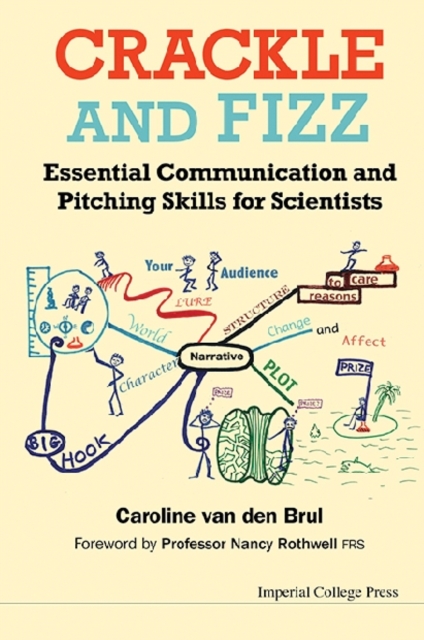
This is a book for scientists and other experts who need to explain the significance and potential of their work to colleagues, committees, funding bodies or the general public. It details how to harness story-telling principles to make complex or technical content easier to communicate and fulfilling for audiences.
Eight narrative ingredients, Audience, Change and Affect, Lure, World, Character, Big Hook, Plot and Structure, are illustrated with examples and exercises to demonstrate how to build a presentation, how to pitch for funds or resources, how to make a persuasive argument, or simply how to explain ideas so they CRACKLE and FIZZ for the Audience.
eBook