
Catalogue Search | MBRL


Are you sure you want to remove the book from the shelf?

{{itemTitle}}
137
result(s) for
"Allied Control Council"
Sort by:

Ballots and Bullets
There is a widespread belief, among both political scientists and government policymakers, that \"democracies don't fight each other.\" Here Joanne Gowa challenges that belief. In a thorough, systematic critique, she shows that, while democracies were less likely than other states to engage each other in armed conflicts between 1945 and 1980, they were just as likely to do so as were other states before 1914. Thus, no reason exists to believe that a democratic peace will survive the end of the Cold War. Since U.S. foreign policy is currently directed toward promoting democracy abroad, Gowa's findings are especially timely and worrisome.
Those who assert that a democratic peace exists typically examine the 1815-1980 period as a whole. In doing so, they conflate two very different historical periods: the pre-World War I and post-World War II years. Examining these periods separately, Gowa shows that a democratic peace prevailed only during the later period. Given the collapse of the Cold War world, her research calls into question both the conclusions of previous researchers and the wisdom of present U.S. foreign policy initiatives.
By re-examining the arguments and data that have been used to support beliefs about a democratic peace, Joanne Gowa has produced a thought-provoking book that is sure to be controversial.
eBook

The Imperfect Union
In the mid-summer of 1989 the German Democratic Republic-- known as the GDR or East Germany--was an autocratic state led by an entrenched Communist Party. A loyal member of the Warsaw Pact, it was a counterpart of the Federal Republic of Germany (West Germany), which it confronted with a mixture of hostility and grudging accommodation across the divide created by the Cold War. Over the following year and a half, dramatic changes occurred in the political system of East Germany and culminated in the GDR's \"accession\" to the Federal Republic itself. Yet the end of Germany's division evoked its own new and very bitter constitutional problems.The Imperfect Uniondiscusses these issues and shows that they are at the core of a great event of political, economic, and social history.
Part I analyzes the constitutional history of eastern Germany from 1945 through the constitutional changes of 1989-1990 and beyond to the constitutions of the re-created east German states. Part II analyzes the Unification Treaty and the numerous problems arising from it: the fate of expropriated property on unification; the unification of the disparate eastern and western abortion regimes; the transformation of East German institutions, such as the civil service, the universities, and the judiciary; prosecution of former GDR leaders and officials; the \"rehabilitation\" and compensation of GDR victims; and the issues raised by the fateful legacy of the files of the East German secret police. Part III examines the external aspects of unification.
eBook

Religion as an Element of Identity of the German Minority. in the Third Republic of Poland / Religia jako element tożsamości mniejszości niemieckiej w Rzeczpospolitej Polskiej
Poland is an example of a national and ethnic structure which is inextricably linked with religion. Religion ought to be perceived as a multi-faceted phenomenon for it permeates all structures of the society. It exerts a profound influence on the functioning of families, local communities, the system of education, as well as on professional and other types of associations. Poland and its history constitute an excellent point of reference in that matter, for it has undergone a long and complex process of transformation from the country of multiculturalism to that of homogeneity. National and religious homogeneity was a rather short -lived experience because it was the outcome of the change of the country borders and expulsions of World War II. In the People’s Republic of Poland any manifestation of identity or difference was received with hostility. Depending on the area of social life, various degrees of repressive policies were implemented, and national and religious minorities became one of the targets of such politics. It can be argued that it exerted a particularly strong influence on the German minority, no longer able to cultivate its cultural and ethnic identity. The situation did not change until the socio -political transformation of 1989. It was then that a service in the German language was celebrated for the first time since the end of war. The place of celebration was no less significant - it was the Annaberg, a place which both Poles and Germans hold sacred.
Journal Article
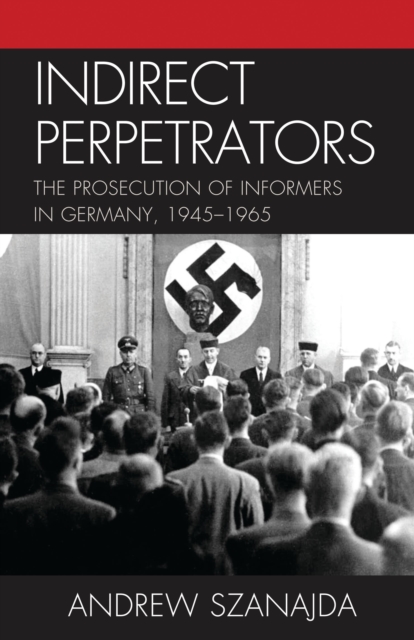
Indirect perpetrators
In Indirect Perpetrators Andrew Szanajda examines the administration of correctional and transitional justice in postwar Germany from 1945 to 1955. He is specifically concerned with the prosecution of those who had denounced others to the authorities during the National Socialist era. The first part of this work looks at the reasons behind the decision to prosecute informers with perpetrating a crime against humanity and the philosophical, legal, and practical problems associated with the administration of justice retroactively in the German courts through legislation specifically enacted for this purpose under the auspices of the Allied occupation powers and subsequent legislation enacted by the German authorities. The second part of the book examines the implementation of this law and the prosecution of informers in the American, French, and British occupation zones and then later in the Federal Republic of Germany, drawing on court proceedings and the judgments that were handed down in these cases. Szanajda discusses the problems associated with the implementation of this law in the respective zones and in the Federal Republic of Germany and the lessons to be drawn from this historically significant attempt to call individuals to account for their crimes against humanity after they had occurred through the use of retroactive legislation.
eBook
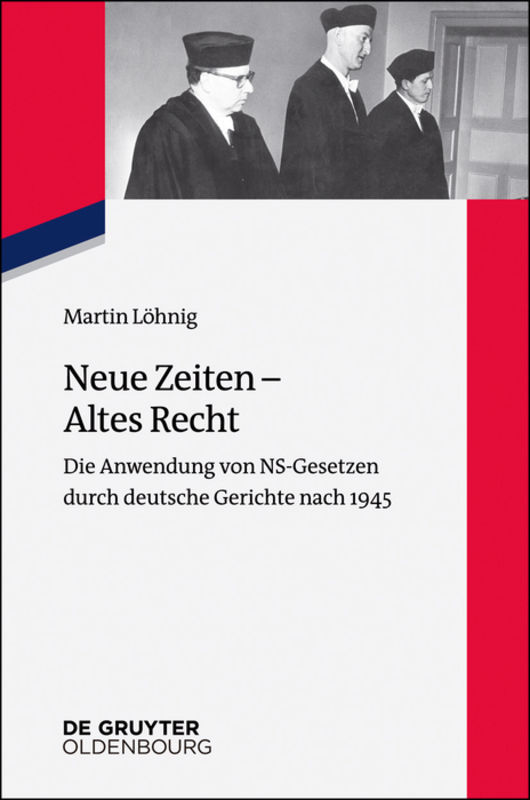
Neue Zeiten, altes Recht : die Anwendung von NS-Gesetzen durch deutsche Gerichte nach 1945
Der Alliierte Kontrollrat hat zahlreiche deutsche Gesetze aus der NS-Zeit zwischen 1933 und 1945 wegen nationalsozialistischer Inhalte aufgehoben. Die Mehrzahl dieser Gesetze blieb jedoch in Kraft. Die deutschen Gerichte standen nach dem Ende des Zweiten Weltkriegs vor der Aufgabe, diese Normen unter grundlegend veränderten Bedingungen anzuwenden. Wie sie mit dieser Herausforderung umgingen, zeigt Martin Löhnig am Beispiel des Familien- und Arbeitsrechts. Der Jurist und Rechtshistoriker wirft damit ein neues Schlaglicht auf ein wichtiges, aber oft vergessenes Kapitel deutscher Rechtsgeschichte am Übergang von der Diktatur zur Demokratie.
eBook


Evaluation of a support worker role, within a nurse delegation and supervision model, for provision of medicines support for older people living at home: the Workforce Innovation for Safe and Effective (WISE) Medicines Care study
Background
Support with managing medicines at home is a common reason for older people to receive community nursing services. With population ageing and projected nurse shortages, reliance on nurses may not be sustainable. We developed and tested a new workforce model: ‘Workforce Innovation for Safe and Effective (WISE) Medicines Care’, which enabled nurses to delegate medicines support home visits for low-risk clients to support workers (known as community care aides [CCAs]). Primary study aims were to assess whether the model increased the number of medicines support home visits conducted by CCAs, explore nurses’, CCAs’ and consumers’ experiences with the CCAs’ expanded role, and identify enablers and barriers to delegation of medicines support.
Methods
A prospective before-after mixed-methods study was conducted within a community nursing service that employed a small number of CCAs. The CCAs’ main role prior to the WISE Medicines Care model was personal care, with a very limited role in medicines support. CCAs received training in medicines support, and nurses received training in assessment, delegation and supervision. Home visit data over two three-month periods were compared. Focus groups and interviews were conducted with purposive samples of nurses (
n
= 27), CCAs (
n
= 7) and consumers (
n
= 28).
Results
Medicines support visits by CCAs increased from 43/16,863 (0.25 %) to 714/21,552 (3.3 %) (
p
< 0.001). Nurses reported mostly positive experiences, and high levels of trust and confidence in CCAs. They reported that delegating to CCAs sometimes eliminated the need for duplicate nurse and CCA visits (for people requiring personal care plus medicines support) and enabled them to visit people with more complex needs. CCAs enjoyed their expanded role and were accepted by clients and/or carers. Nurses and CCAs reported effective communication when medicine-related problems occurred. No medication incidents involving CCAs were reported. Barriers to implementation included the limited number of CCAs employed in the organisation and reluctance from some nurses to delegate medicines support to CCAs. Enablers included training and support, existing relationships between CCAs and nurses, and positive staff attitudes.
Conclusions
Appropriately trained and supervised support workers can be used to support community nurses with providing medicines management for older people in the home care setting, particularly for those who are at low risk of adverse medication events or errors. The model was acceptable to nurses, clients and carers, and may offer a sustainable and safe and effective future workforce solution to provision of medicines support for older people in the home care setting.
Journal Article

Mandatory reporting of healthcare associated infections
Purpose - This editorial aims to summarize major points from and explains the rationale of a symposium convened in Canada to explore whether American experience with mandatory public reporting of healthcare associated infection (HAI) information can usefully inform Canadian policy.Design methodology approach - The symposium brought together members of the Universities Council, an interdisciplinary consortium of Canadian and American researchers organized by the Healthcare Associated Infections Program of the Washington State Health Department. Its members are interested in patient safety generally, and a comprehensive strategy to evaluate HAI public reporting specifically.Findings - American health department experts shared insights from their experience with mandatory reporting; Canadian experts, primarily from the British Columbia Centre for Disease Control, described the current reporting policies of Canadian public health authorities. Presentations were discussed by an audience that included members of the public, allied health professionals, academic researchers, patient safety advocates, the British Columbia Ministry of Health as well as the Canadian Institute for Health Information. The American papers presented are published in this theme issue. Participants found the symposium to be a useful discussion of important issues that identified knowledge gaps underlying the role and value of public reporting in HAI prevention. Discussion of key research agenda issues was informed by the presentations and ensuing discussions.Practical implications - The Universities Council research agenda was confirmed and further informed through the presentations and discussions, affording its members and others a better understanding of current needs and opportunities. Historical and state of the art descriptions of public reporting afforded comparisons of cultures, approaches and early results that can inform any policy makers contemplating relative merits of such programs.Originality value - Despite much start-up activity in response to demands for more transparency, indications of consumer interest, and some early claims of success, there remain fundamental knowledge gaps and coordination problems hampering achievement of best approaches and value in public reporting. The group brought together in this symposium offers one of the most comprehensive perspectives available on current theory and practice.
Journal Article