
Catalogue Search | MBRL


Are you sure you want to remove the book from the shelf?

{{itemTitle}}
4
result(s) for
"Almshouses Fiction"
Sort by:

Spinning Thistledown at Midnight
[...]shameful was it to have had an impoverished family member confined in the workhouse that rebels torched many of the remaining records during the Irish War of Independence. 3 MY first up-close glimpse of childhood poverty came when I was seven. \"According to the KJth annual report of the commissioners, Wexford County fed KJM paupers more in a year than New Ross did but it cost New Ross NLO more than Wexford... Jeremiah's departure is one more gap in our family narrative, alongside our aunt's hushed-up suicide attempts, our mother's first marriage to a doomed air force pilot, and several unexplained family estrangements. 15 IN Powers of the Weak, Elizabeth Janeway reminds us that for the weak to rule their own lives requires \"a wise mistrust of the powerful and a willingness to exercise dissent.\" ANNE MCGOURAN's non-fiction has appeared in the Smart Set, the Coachella Review, the Journal of Wild Culture, GreenPrints, and TRANSITION magazine and is forthcoming in Northern Terminus: The African-Canadian History Journal.
Journal Article

Pauper Fiction in Economic Science: \Paupers in Almshouses\ and the Odd Fit of Oliver Twist
The almshouse dominated the thinking about poverty and the poor during America's period of industrialization and its greatest economic downturns. Yet economists had surprisingly little to say about the facts of almshouse demography, and what they have written has been a rather bad fiction when seen in contrast with American novels. The main object of the paper is to delineate typical characters and characteristics of almshouses in America, and to examine the plausibility of various literary characterizations in light of the facts. The data certainly suggest new stories about paupers in American history: economists, and even the new social historians, have gotten it wrong. Between the Civil War and the Great Depression, the typical pauper living in an almshouse was not Oliver Twist (as many believe). He was not the Shiftless Man of the classical imagination (as Malthusians and Benthamites believe). The typical pauper of an American almshouse was plural. Instructive examples in American literature include Lennie, of Steinbeck's Of Mice and Men ; Denver, of Toni Morrison's Beloved ; Mrs. Thomson, of Edward Eggleston's The Hoosier School-Master ; and Forrest Gump, of Winston Groom's Forrest Gump .
Journal Article

The Cant of Reform
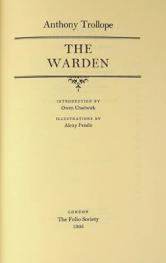
THE WARDEN (1855) deserves special recognition as the only Victorian novel to parody a Dickens novel that Dickens never actually wrote. Trollope pretends to be answering an imaginary broadside entitledThe Almshouse. Chapter 15 ofThe Wardenis often celebrated for its dismissal of Dickens as “Mr. Popular Sentiment,”¹ author of the broadside, but a dislike for Boz’s latest polemic colors the entire novel. The anti-Sentiment section forms part of a comprehensive reconsideration of Dickens as realist and social critic, especially his use of Juvenalian satire to promote a radical politics and encourage reform.
Trollope’s book finds Dickens’s outbursts unacceptable
Book Chapter