
Catalogue Search | MBRL


Are you sure you want to remove the book from the shelf?

{{itemTitle}}
847,535
result(s) for
"Alternative energy sources"
Sort by:

Sustainable energy landscapes : designing, planning, and development
\"With experts from different related fields discussing their approaches to energy-conscious planning and design, this comprehensive book presents state-of-the-art research, education, and design practice with respect to sustainable energy landscapes. It also addresses how to quantify the impact of energy transition both on landscape quality and energy economy, issues of growing importance. Focusing on the municipal and regional scale, where energy-conscious interventions are effective and stakeholders can participate actively in the transition process, the text illustrates practical applications of emerging methods using case studies from across the globe\"-- Provided by publisher.
Book
Formation of the model of sustainable economic development of renewable energy
The article considers the use of sustainable energy as a potentially effective alternative energy source capable of replacing traditional natural fuels. The aim of the research is to develop a complex model of sustainable economic development able to promote introducing and expanding sustainable power engineering as potential alternative energy source, providing sustainable economic development, energy efficiency and reducing damages to the environment. The hypothesis lies in introduction of a model for sustainable economic development due to expansion of renewable energy which will result in economic growth, rise in energy efficacy and reducing hazards to the environment. A comparative analysis of costs and revenues of various types for using energy sources was carried out to estimate the economic efficiency and feasibility of renewable energy. The data analysis toolkit uses MS Power BI software, in which the data model was created. The conducted regression analysis provided valuable numerical and practical results on formation of the model of sustainable economic development of renewable power engineering. The research is based on the analysis of the impact “share of energy” on the level of electric energy import and CO₂ emissions. It is recommended to intensify efforts to develop renewable energy as a key direction for sustainable economic development to ensure energy security, reduce negative environmental impact and achieve global sustainable development goals.
Journal Article

IoT, Machine Learning and Blockchain Technologies for Renewable Energy and Modern Hybrid Power Systems
This edited book comprises chapters that describe the IoT, machine learning, and blockchain technologies for renewable energy and modern hybrid power systems with simulation examples and case studies.
After reading this book, users will understand recent technologies such as IoT, machine learning techniques, and blockchain technologies and the application of these technologies to renewable energy resources and modern hybrid power systems through simulation examples and case studies.
This edited book comprises chapters that describe the IoT, machine learning, and blockchain technologies for renewable energy and modern hybrid power systems with simulation examples and case studies.
eBook

Energy mix, technological change, and the environment
This paper studies the relationship between the energy mix and the environment using a theoretical framework in which two alternative energy sources are considered: fossil fuels (dirty energy) and renewable energy (clean energy). We find that a positive aggregate productivity shock increases energy consumption and emissions but reduces energy intensity and emissions per unit of output as renewable energy consumption increases, that is, carbon emissions are procyclical but emissions per unit of output are countercyclical. Second, an energy efficiency improvement provokes a “rebound effect” above 100% (the backfire effect), resulting in a rise of pollutant emissions by increasing energy use. Third, a technological improvement in emissions leads to a reduction in emissions per unit of fossil fuel, but also implies a slow-down in the adoption of renewable energy sources. Finally, we consider the case of a decentralized economy in which the government chooses an optimal specific tax on fossil fuel to maximize social welfare. We show that the “second-best” policy is highly effective in correcting the negative effects of the environmental externality and able to almost achive the centralized economy outcome.
Journal Article

The Dynamic Impact of Renewable Energy Consumption on Economic Growth in Zimbabwe: An ARDL Approach
Motivated by the study country’s active involvement in the reduction of global greenhouse gas emissions and the positive strides it has made domestically in increasing renewable energy in its energy mix, on the one hand, and the need to find out whether renewable energy consumption can also assist in reviving the economy, on the other hand, this study empirically examines the dynamic impact of renewable energy consumption on economic growth in Zimbabwe. Using annual time-series data from 1990 to 2019, and the autoregressive distributed lag approach, the results of the study show that in Zimbabwe, renewable energy consumption has apositive impact on economic growth, both in the short and long run. Increasing the usage of renewable energy increases the growth of the economy in the country of study. These results imply that Zimbabwe can achieve two goals using one strategy – increasing renewable energy consumption to decrease the negative impact climate change and greenhouse gas emission have on the environment and the economy, and increasing economic growth. Policy makers in Zimbabwe are, therefore, recommended to supportincreased use of renewable energy over alternative energy sources, as this would have positive implications on the economy, both in the short and long term.
Journal Article

Impact of Electricity Pricing Policies on Renewable Energy Investments and Carbon Emissions
We investigate the impact of pricing policies (i.e., flat pricing versus peak pricing) on the investment levels of a utility firm in two competing energy sources (renewable and conventional), with a focus on the renewable investment level. We consider generation patterns and intermittency of solar and wind energy in relation to the electricity demand throughout a day. Industry experts generally promote peak pricing policy as it smoothens the demand and reduces inefficiencies in the supply system. We find that the same pricing policy may lead to distinct outcomes for different renewable energy sources due to their generation patterns. Specifically, flat pricing leads to a higher investment level for solar energy, and it can lead to still more investments in wind energy if a considerable amount of wind energy is generated throughout the day. We validate these results by using electricity generation and demand data of the state of Texas. We also show that flat pricing can lead to substantially lower carbon emissions and a higher consumer surplus. Finally, we explore the effect of direct (e.g., tax credit) and indirect (e.g., carbon tax) subsidies on investment levels and carbon emissions. We show that both types of subsidies generally lead to a lower emission level but that indirect subsidies may result in lower renewable energy investments. Our study suggests that reducing carbon emissions through increasing renewable energy investments requires careful attention to the pricing policy and the market characteristics of each region.
This paper was accepted by Serguei Netessine, operations management
.
Journal Article

Intermittency and the Value of Renewable Energy
A key problem with solar energy is intermittency: solar generators produce only when the sun is shining, adding to social costs and requiring electricity system operators to reoptimize key decisions. We develop a method to quantify the economic value of large-scale renewable energy. We estimate the model for southeastern Arizona. Not accounting for offset carbon dioxide, we find social costs of $138.40 per megawatt hour for 20 percent solar generation, of which unforecastable intermittency accounts for $6.10 and intermittency overall for $46.00. With solar installation costs of $1.52 per watt and carbon dioxide social costs of $39.00 per ton, 20 percent solar would be welfare neutral.
Journal Article

Renewable energy and security for Ukraine: challenge or smart way?
Nowadays, as most of the countries in the world pledged to the low-carbon future, global energy problems become more acute. One of the most promising ways to address the growing problems of energy supply widely considered by the interna- tional community is use of alternative energy source such as the renewable or „clean” energy. Renewable energy is highly praised for its wide availability and environmental friendliness and its decisive advantage over traditional energy is that it is not subjected to depletion like the fossil fuel resources and that it does not lead to the increasing pol- lution. The paper examines how renewable energy sources can be made useful in the case of Ukraine. Our analysis run along two dimensions: the EU and world’s global tendencies as well as the internal current situation. Our main focus is on whether the investing in renewable energy sources can be regarded as a country’s “smart” power policy and what the outcomes of turning to the renewable resources might be like over some time period in the future. On the base of statistical approach we came to the con- clusions for Ukraine: 1) renewable energy sources (RES) production has a potential to replace oil, gas and coal sources, however the same could not be said about nuclear power; 2) the “green tariff” indeed makes renewable energy projects more attractive for investments; 3) RES production opens new projects in industry thus the employment rate in industry can grow, but not such could be said about agriculture; 4) in analyzed years RES production had very low level of impact on the economic performance; 5) RES have positive effect on the environment in Ukraine in analyzed period; 5) RES consumption has a potential to boost positive effects of alternative energy resources,more than even its production. That evokes the idea of necessity to implement policy and some actions to motivate namely private consumers and industry to increase the consumption of RES. Then it could obviously drive the increase of RES production.
Journal Article
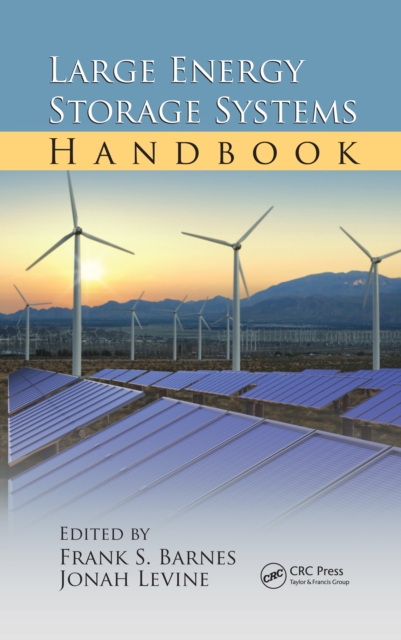
Large Energy Storage Systems Handbook
Reviewing several ways in which large amounts of energy can be stored so that it may be deployable by utilities, this handbook covers major topics including pumped hydroelectric systems, compressed air, and batteries. By considering the perspective of developers, planners, and legislators as well as engineers tasked with assessing and developing real energy storage systems, readers will find the information they need to make economic and practical decisions concerning renewable energy. Chapters on modeling for integration of wind and solar energy into the grid, hydrogen generation and storage, and thermal energy storage are included.
eBook

Do renewable energy and health expenditures improve load capacity factor in the USA and Japan? A new approach to environmental issues
This study performs the augmented autoregressive distributed lag (ARDL) approach to investigate the impact of renewable energy and health expenditures on the load capacity factor in Japan and the United States of America (USA) over the period 1982-2016. The load capacity factor is obtained by dividing the biocapacity into the ecological footprint and provides a general picture of environmental quality. Thus, the study departs from the current literature by approaching environmental problems from a broader perspective. The results of this study confirm the existence of cointegration in the USA and Japan. The long-run estimates demonstrate that renewable energy and health expenditures improve environmental quality in the USA, while renewable energy has a positive but insignificant impact on load capacity factor in Japan. It has also been determined economic growth causes significant environmental degradation, which cannot be compensated by renewables and health expenditures in both countries. According to these findings, Japanese and American governments should promote green growth, support the increase in health expenditures, and diversify renewable energy sources to reduce environmental pressure.
Journal Article