
Catalogue Search | MBRL


Are you sure you want to remove the book from the shelf?

{{itemTitle}}
4,240
result(s) for
"Alto"
Sort by:

Palo Alto : a history of California, capitalism, and the world
\"In Palo Alto, the first comprehensive, global history of Silicon Valley, Malcolm Harris examines how and why Northern California evolved in the particular, consequential way it did, tracing the ideologies, technologies, and policies that have been engineered there over the course of 150 years of Anglo settler colonialism, from IQ tests to the \"tragedy of the commons,\" racial genetics, and \"broken windows\" theory. The Internet and computers, too. It's a story about how a small American suburb became a powerful engine for economic growth and war, and how it came to lead the world into a surprisingly disastrous 21st century\"-- Provided by publisher.
Book

The Archaeological Excavations in the Castel Corno Caves (Isera, Trento, Italy)
The Archaeological Excavations in the Castel Corno Caves
presents the results of two different excavation campaigns in a
prehistoric archaeological site in a deep cave in Trentino Alto
Adige (Castel Corno, Isera, Trento, Italy). The excavations
uncovered a number of tombs deep in the cave and, outside, the
remains of a settlement. The site is significant for the excellent
preservation of the artefacts and of the animal and human bones, a
result of the depth of the cave. Despite damage caused by grave
robbers, a considerable quantity of data was recovered enabling the
partial reconstruction of human activity in this area. In the tombs
the remains of seven individuals were excavated. Radiocarbon dating
indicates that the tombs can be dated between the end of the Copper
Age and the beginning of the Early Bronze Age (25th-21st centuries
BC), but the occupation of the site, for ritual and settlement
purposes, continued at least until the end of the Early Bronze Age
(18th-17th centuries BC).
eBook


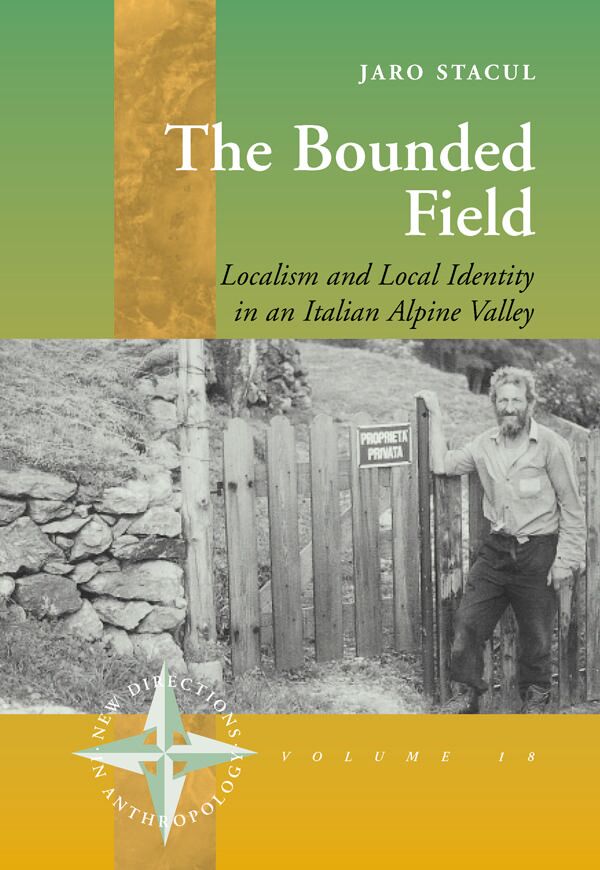
The Bounded Field
Regionalism is one of the most debated issues in contemporary western Europe. Yet why the region, rather than the nation state, can have such a strong appeal for the construction of social and political identity remains largely unexplored. Drawing on data collected in the mountainous Trentino region of northern Italy, the author investigates how ideas about village boundaries and private property form the background against which regionalist ideologies are understood. In suggesting that ideas about regionalism largely reflect views about private property, he provides an alternative to theories of nationalism that overlook the articulation between official ideologies and discourses at the local level.
eBook

El Alto, rebel city : self and citizenship in Andean Bolivia
Combining anthropological methods and theories with political philosophy, Sian Lazar analyzes everyday practices and experiences of citizenship in a satellite city to the Bolivian capital of La Paz: El Alto, where more than three-quarters of the population identify as indigenous Aymara. For several years, El Alto has been at the heart of resistance to neoliberal market reforms, such as the export of natural resources and the privatization of public water systems. In October 2003, protests centered in El Alto forced the Bolivian president to resign; in December 2005, the country's first indigenous president, Evo Morales, was elected. The growth of a strong social justice movement in Bolivia has caught the imagination of scholars and political activists worldwide. El Alto remains crucial to this ongoing process. In El Alto, Rebel City Lazar examines the values, practices, and conflicts behind the astonishing political power exercised by El Alto citizens in the twenty-first century.
Drawing on ethnographic fieldwork conducted between 1997 and 2004, Lazar contends that in El Alto, citizenship is a set of practices defined by one's participation in a range of associations, many of them collectivist in nature. Her argument challenges Western liberal notions of the citizen by suggesting that citizenship is not only individual and national but in many ways communitarian and distinctly local, constituted through different kinds of affiliations. Since in El Alto these affiliations most often emerge through people's place of residence and their occupational ties, Lazar offers in-depth analyses of neighborhood associations and trade unions. In so doing, she describes how the city's various collectivities mediate between the state and the individual. Collective organization in El Alto and the concept of citizenship underlying it are worthy of attention; they are the basis of the city's formidable power to mobilize popular protest.
eBook
Migration and Autonomous Territories
Migration and Autonomous Territories discusses complex migration issues in sub-national autonomous territories inhabited by historical communities and minorities, in particular the cases of South Tyrol and Catalonia, by analyzing challenges associated with reconciling diversity and unity.
eBook

Teoría general de las decisiones
Starting from Simon's (1976) opposition between procedural and substantive rationality, the paper addresses the question whether it is possible to characterize the former in general terms, and discusses the problem of overcoming the aforementioned opposition. It tries to show, by means of the concept of a general decision structure, that even though it is not possible to characterize procedural rationality in an exhaustive and fully general way, at least it is possible to introduce a scheme within which it is possible to pose problems of procedural rationality, or even to postulate sorne axiomatic restrictions for the same, It is not hard to see that substantive rationality is a particular case of this scheme, namely, the case in which it is possible to measure certain theoretical parameters and adopt as rules of decision certain classical principIes grounded upon the concept of expected utility. The paper does not provide, however, the details that show how the special theory is obtained out of the more general one. [A. G. S.]
Journal Article
The bounded field
Regionalism is one of the most debated issues in contemporary western Europe. Yet why the region, rather than the nation state, can have such a strong appeal for the construction of social and political identity remains largely unexplored. Drawing on data collected in the mountainous Trentino region of northern Italy, the author investigates how ideas about village boundaries and private property form the background against which regionalist ideologies are understood. In suggesting that ideas about regionalism largely reflect views about private property, he provides an alternative to theories of nationalism that overlook the articulation between official ideologies and discourses at the local level.
eBook