
Catalogue Search | MBRL


Are you sure you want to remove the book from the shelf?

{{itemTitle}}
76
result(s) for
"Amazon.com Inc."
Sort by:
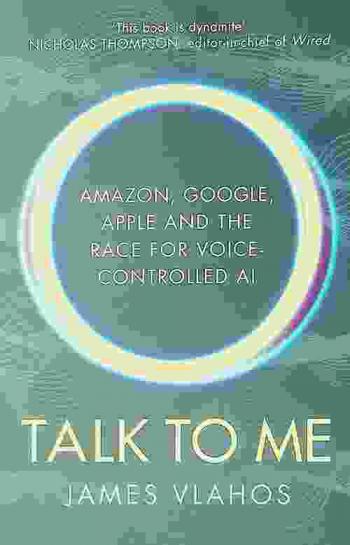
Talk to me : Amazon, Google, Apple and the race for voice-controlled AI
The next great technological disruption is coming. The titans of Silicon Valley are racing to build the last, best computer that the world will ever need. They know that whoever successfully creates it will revolutionise our relationship with technology and make billions of dollars in the process. They call it conversational AI. Computers that can speak and think like humans do may seem like the stuff of science fiction, but they are rapidly moving towards reality. In Talk to Me, veteran tech journalist James Vlahos meets the researchers at Google, Amazon and Apple who are leading the way to a voice computing revolution. He explores how voice tech will transform every sector of society handing untold new powers to businesses, upending traditional notions of privacy, revolutionising access to information, and fundamentally altering the way we understand human consciousness. And he even tries to understand the significance of the revolution firsthand - by building a chatbot version of his terminally ill father. Vlahos's research leads him to one fundamental question: What happens when our computers become as articulate, compassionate, and creative as we are?

Digitization and Pre-Purchase Information
Digitization has led to many new creative products, straining the capacity of professional critics and consumers. Yet, the digitization of retailing has also delivered new crowd-based sources of pre-purchase information. We compare the relative impacts of professional critics and crowd-based Amazon star ratings on consumer welfare in book publishing. Using various fixed effects and discontinuity-based empirical strategies, we estimate their causal impacts on sales. We use these causal estimates to calibrate a structural demand model. The aggregate effect of star ratings on consumer surplus is, in our baseline estimates, more than ten times the effect of traditional review outlets.
Journal Article


Firm Strategies in the \Mid Tail\ of Platform-Based Retailing
While millions of products are sold on its retail platform, Amazon.com itself stocks and sells only a very small fraction of them. Most of these products are sold by third-party sellers who pay Amazon a fee for each unit sold. Empirical evidence clearly suggests that Amazon tends to sell high-demand products and leave long-tail products for independent sellers to offer. We investigate how a platform owner such as Amazon, facing ex ante demand uncertainty, may strategically learn from these sellers' early sales which of the \"mid-tail\" products are worthwhile for its direct selling and which are best left for others to sell. The platform owner's \"cherry-picking\" of the successful products, however, gives an independent seller the incentive to mask any high demand by lowering his sales with a reduced service level (unobserved by the platform owner).
We analyze this strategic interaction between a platform owner and an independent seller using a game-theoretic model with two types of sellers-one with high demand and one with low demand. We show that it may not always be optimal for the platform owner to identify the seller's demand. Interestingly, the platform owner may be
worse off
by retaining its option to sell the independent seller's product, whereas both types of sellers may
benefit
from the platform owner's threat of entry. The platform owner's entry option may reduce consumer surplus in the early period, although it increases consumer surplus in the later period. We also investigate how consumer reviews influence the market outcome.
Journal Article


Online Social Interactions: A Natural Experiment on Word of Mouth Versus Observational Learning
Consumers' purchase decisions can be influenced by others' opinions, or word of mouth (WOM), and/or others' actions, or observational learning (OL). Although information technologies are creating increasing opportunities for firms to facilitate and manage these two types of social interaction, to date, researchers have encountered difficulty in disentangling their competing effects and have provided limited insights into how these two social influences might differ from and interact with each other. Using a unique natural experimental setting resulting from information policy shifts at the online seller Amazon.com, the authors design three longitudinal, quasi-experimental field studies to examine three issues regarding the two types of social interaction: (1) their differential impact on product sales, (2) their lifetime effects, and (3) their interaction effects. An intriguing finding is that while negative WOM is more influential than positive WOM, positive OL information significantly increases sales, but negative OL information has no effect. This suggests that reporting consumer purchase statistics can help mass-market products without hurting niche products. The results also reveal that the sales impact of OL increases with WOM volume.
Journal Article

One click : Jeff Bezos and the rise of Amazon.com
\"An insightful look at how Amazon really works and how its founder and CEO makes it happen. Amazon's business model is deceptively simple: make online shopping so easy and convenient that customers won't think twice. It can almost be summed up by the button on every page: Buy now with one click. Why has Amazon been so successful? Much of it has to do with Jeff Bezos, the CEO and founder, whose unique combination of character traits and business strategy have driven Amazon to the top of the online retail world. Originally a computer nerd rather than a businessman, he had the vision to capitalize on the untapped online marketplace for bookselling and continues to discover new market opportunities, from groceries to auto parts. He's a calculating machine, high energy, passionate, highly aggressive, and out to radically transform retail. Through numerous interviews with Amazon employees, competitors, and observers, Richard Brandt has deciphered how Bezos thinks, what drives his actions, and how he makes decisions. Anyone in business can learn a lot from the example of Amazon's ongoing evolution.\"-- Provided by publisher.
Book

The impact of external word-of-mouth sources on retailer sales of high-involvement products
Online word-of-mouth (WOM) such as consumer opinions, user experiences, and product reviews has become a major information source in consumer purchase decisions. Prior research on online WOM effect has focused mostly on low-involvement products such as books or CDs. For these products, retailer-hosted (internal) WOM is shown to influence sales overwhelmingly. Numerous surveys, however, suggest consumers often conduct pre-purchase searches for high-involvement products (e.g., digital cameras) and visit external WOM Web sites during the search process. In this study, the authors analyze the relative impact of external and internal WOMs on retailer sales for high-involvement products using a panel of sales and WOM data for 148 digital cameras from Amazon.com and three external WOM Web sites (Cnet, DpReview, and Epinions) over a four-month period. The results suggest that a retailer's internal WOM has a limited influence on its sales of high-involvement products, while external WOM sources have a significant impact on the retailer's sales.
Journal Article

The Effect of Online Consumer Reviews on New Product Sales
This study examines the effect of online reviews on new product sales for consumer electronics and video games. Analyses of panel data of 332 new products from Amazon.com over nine months reveal that the valence of reviews and the volume of page views have a stronger effect on search products, whereas the volume of reviews is more important for experience products. The results also show that the volume of reviews has a significant effect on new product sales in the early period and such effect decreases over time. Moreover, the percentage of negative reviews has a greater effect than that of positive reviews, confirming the negativity bias. Thus, marketers need to consider the distinctive influences of various aspects of online reviews when launching new products and devising e-marketing strategies.
Journal Article

The Visible Hand? Demand Effects of Recommendation Networks in Electronic Markets
Online commercial interactions have increased dramatically over the last decade, leading to the emergence of networks that link the electronic commerce landing pages of related products to one another. Our paper conjectures that the explicit visibility of such \"product networks\"can alter demand spillovers across their constituent items. We test this conjecture empirically using data about the copurchase networks and demand levels associated with more than 250,000 interconnected books offered on Amazon.com over the period of one year while controlling for alternative explanations of demand correlation using a variety of approaches. Our findings suggest that on average the explicit visibility of a copurchase relationship can lead to up to an average threefold amplification of the influence that complementary products have on each others' demand levels. We also find that newer and more popular products \"use\" the attention they garner from their network position more efficiently and that diversity in the sources of spillover further amplifies the demand effects of the recommendation network. Our paper presents new evidence quantifying the role of network position in electronic markets and highlights the power of basing (virtual) shelf position on consumer preferences that are explicitly revealed through shared purchasing patterns.
This paper was accepted by Pradeep Chintagunta, marketing.
Journal Article