
Catalogue Search | MBRL


Are you sure you want to remove the book from the shelf?

{{itemTitle}}
1,154
result(s) for
"America -- Antiquities"
Sort by:

Bioarchaeology of Pre-Columbian Mesoamerica : an interdisciplinary approach
This edited volume presents work from both Mesoamerican-based and U.S.-based researchers who use a combination of cultural ethnohistorical, (bio)archaeological, dental, and chemical data in an interdisciplinary approach to research population history in pre-Columbian Mesoamerica. The goals for such a project are threefold: 1) to encourage more cross-fertilization of work between fields and subfields, in order to more appropriately address large regional questions of population history; 2) to explicitly address the theoretical and methodological challenges and rewards of interdisciplinary work; and 3) to introduce a larger audience to the state of interdisciplinary work in Mesoamerica.
Book

Archaeological Theory and the Politics of Cultural Heritage
This controversial book is a survey of how relationships between indigenous peoples and the archaeological establishment have got into difficulty, and a crucial pointer to how to move forward from this point.
With lucid appraisals of key debates such as NAGPRA, Kennewick and the repatriation of Tasmanian artefacts, Laurajane Smith dissects the nature and consequences of this clash of cultures.
Smith explores how indigenous communities in the USA and Australia have confronted the pre-eminence of archaeological theory and discourse in the way the material remains of their past are cared for and controlled, and how this has challenged traditional archaeological thought and practice.
Essential reading for all those concerned with developing a just and equal dialogue between the two parties, and the role of archaeology in the research and management of their heritage.
1. Introduction 2 . The Cultural Politics of Identity: Defining the Problem 3. Archaeological Theory and the 'Politics' of the Past 4. Archaeology and the Context of Governance: Expertise and the State 5. Archaeological Stewardship: The Rise of Cultural Resource Management and the 'Scientific Professional' arcHaeologist 6. Significance Concepts and the Embedding of Processual Discourse in Cultural Resource Management 7. The Role of Legislation in the Governance of Material Culture in America and Australia 8. NAGPRA and Kennewick: Contesting Archaeological Govrnance in America 9. The 'Death of Archaeology': Contesting Archaeological Covernance in Australia 10. Conclusion
Laurajane Smith is Lecturer in cultural heritage studies and archaeology at the University of York, UK. She previously taught Indigenous Studies at the University of New South Wales, Sydney and worked as a cultural heritage consultant for many years. Her research interests include heritage and the construction and negotiation of cultural and social identities, and public policy and heritage management, archaeological theory and politics, feminist archaeology.
'Essential reading ... Well-written [and] easy to follow ... a useful companion volume.' - Rodney Harrison, The Australian National University
'Laurajane Smith has produced a significant work that will hopefully stimulate archaeological departments in South African universities to pay more attention to educating future CRM practitioners. This book is compulsory reading for CRM practitioners, archaeology students and their professors alike.' – South African Archaeological Bulletin
eBook


First peoples in a new world
More than 12,000 years ago, in one of the greatest triumphs of prehistory, humans colonized North America, a continent that was then truly a new world. Just when and how they did so has been one of the most perplexing and controversial questions in archaeology. This dazzling, cutting-edge synthesis, written for a wide audience by an archaeologist who has long been at the center of these debates, tells the scientific story of the first Americans: where they came from, when they arrived, and how they met the challenges of moving across the vast, unknown landscapes of Ice Age North America. David J. Meltzer pulls together the latest ideas from archaeology, geology, linguistics, skeletal biology, genetics, and other fields to trace the breakthroughs that have revolutionized our understanding in recent years. Among many other topics, he explores disputes over the hemisphere's oldest and most controversial sites and considers how the first Americans coped with changing global climates. He also confronts some radical claims: that the Americas were colonized from Europe or that a crashing comet obliterated the Pleistocene megafauna. Full of entertaining descriptions of on-site encounters, personalities, and controversies, this is a compelling behind-the-scenes account of how science is illuminating our past.
eBook


Exploring Ontologies of the Precontact Americas
Applying social theory and incorporating non-Western
perspectives in the interpretation of bioarchaeological
research
This volume demonstrates how researchers in bioarchaeology and
mortuary archaeology can work to better understand concepts of life
and death in past societies of the Indigenous Americas. Through
case studies that apply the \"ontological turn\" to human funerary
and skeletal remains, contributors set aside Western views of
reality, nature, and personhood to explore how people of various
cultures understood existence and the human body.
Contributors examine mortuary records from Inuit groups in
Labrador and Greenland, Hopewell culture in the Lower Illinois
River Valley, and Weeden Island and Puebloan traditions in the
United States Southeast and Southwest. They look at the Paquimé
community in Mexico, iconography of the Maya civilization, the
demographics of Inka populations, and an ancient village on the
Amazon River in Brazil. With attention to the viewpoints of these
cultures, these essays deconstruct the boundaries between human
remains and other interred artifacts, the living and the dead, and
other binaries rooted deeply in Western science.
Exploring Ontologies of the Precontact Americas reminds
readers that their own ontological perspectives affect how they
interpret the past. By considering diverse, non-Western worldviews
and engaging with novel social theories of the body, this volume
inspires new understandings of precontact societies.
Contributors: Gordon F. M. Rakita | Pamela
Geller | Jason L. King | Sarah Jackson | Jane Buikstra | Robert
Pickering | Peter Whitridge | John Krigbaum | Neill J. Wallis |
Adrianne Offenbecker | Avelino Gambim Júnior | Bethany L. Turner |
Mari Kleist | María Cecilia Lozada | Debra L. Martin | Kyle Waller
| James L. Fitzsimmons | J. Christina Freiberger
eBook

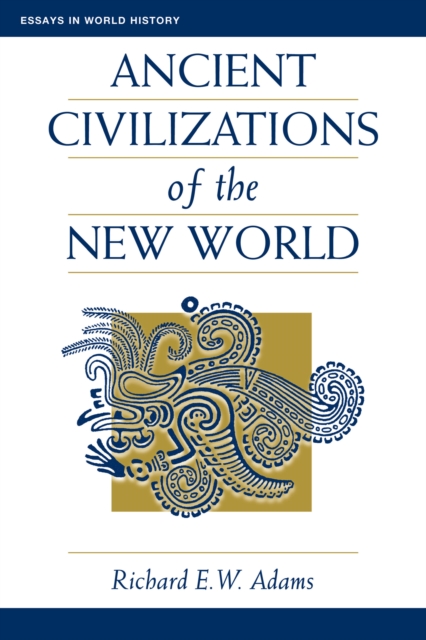
Ancient Civilizations Of The New World
In this concise, yet sweeping look at the origins and development of ancient new world civiliozations, Richard adams provides a superb introductory overview of these unique and fascinating cultures. Incorporating the latest breakthroughs in the study of the cultures of Mesoamerica and the Andes, Adams examines the development of the Olmec, Maya, Aztec, and Inca peoples, among others, from simple agricultural societies to urban civilizations with complex transportation networks, distinct social hierarchies, rich artistic and religious traditions, and writing systems that have defied anthropological investigation until recently.
Richard Ew Adams
List of tables and Illustrations -- Acknowledgments -- 1 Introduction: Complex cultures, cities, and a rapid survey of the earliest old world civilizations -- 2 Mesoamerica: Origins and early civilizations -- 3 Mesoamerica: Transformations and the late civilazations -- 4 The central andes of south America: origins and Early civilizations -- 5 The central Andes of south america: late civilizations and the Inca -- Epilogue -- References -- About the Book and Author -- Index.
eBook

Strangers in a new land : what archaeology reveals about the first Americans
\"The history of North America, from Christopher Columbus to the present day, is a chaotic struggle for ownership of the land. This text will address questions such as the history of native communities that were displaced or conquered, and even further back to how Native North, Central and South Americans came to these continents in the first place. Historical facts are mainly supported through archaeological findings.\"--Provided by the publisher.
Book

Community-based archaeology
Archaeology impacts the lives of indigenous, local, or descendant communities. Yet often these groups have little input to archaeological research, and its results remain inaccessible. As archaeologists consider the consequences and benefits of research, the skills, methodologies, and practices required of them will differ dramatically from those of past decades. As an archaeologist and a Native American, Sonya Atalay has investigated the rewards and complex challenges of conducting research in partnership with indigenous and local communities. In Community-Based Archaeology, she outlines the principles of community-based participatory research and demonstrates how CBPR can be effectively applied to archaeology. Drawing on her own experiences with research projects in North America and the Near East, Atalay provides theoretical discussions along with practical examples of establishing and developing collaborative relationships and sharing results. This book will contribute to building an archaeology that is engaged, ethical, relevant, and sustainable.
eBook