
Catalogue Search | MBRL


Are you sure you want to remove the book from the shelf?

{{itemTitle}}
970
result(s) for
"America -- Discovery and exploration"
Sort by:

Ancient ocean crossings : reconsidering the case for contacts with the pre-Columbian Americas
In Ancient Ocean Crossings: Reconsidering the Case for Contacts with the Pre-Columbian Americas, Stephen Jett encourages readers to reevaluate the common belief that there was no significant interchange between the chiefdoms and civilizations of Eurasia and Africa and peoples who occupied the alleged terra incognita beyond the great oceans. More than a hundred centuries separate the time that Ice Age hunters are conventionally thought to have crossed a land bridge from Asia into North America and the arrival of Columbus in the Bahamas in 1492. Traditional belief has long held that earth's two hemispheres were essentially cut off from one another as a result of the post-Pleistocene meltwater-fed rising oceans that covered that bridge. The oceans, along with arctic climates and daunting terrestrial distances, formed impermeable barriers to interhemispheric communication. This viewpoint implies that the cultures of the Old World and those of the Americas developed independently. Drawing on abundant and concrete evidence to support his theory for significant pre-Columbian contacts, Jett suggests that many ancient peoples had both the seafaring capabilities and the motives to cross the oceans and, in fact, did so repeatedly and with great impact. His deep and broad work synthesizes information and ideas from archaeology, geography, linguistics, climatology, oceanography, ethnobotany, genetics, medicine, and the history of navigation and seafaring, making an innovative and persuasive multidisciplinary case for a new understanding of human societies and their diffuse but interconnected development.
Book

Fernández de Oviedo's chronicle of America : a new history for a New World
No detailed description available for \"Fernández de Oviedo's Chronicle of America\".
eBook

Nature in the New World
InNature in the New World(translated 1985), Antonello Gerbi examines the fascinating reports of the first Europeans to see the Americas. These accounts provided the basis for the images of strange and new flora, fauna, and human creatures that filled European imaginations.Initial chapters are devoted to the writings of Columbus, Vespucci, Cortés, Verrazzano, and others. The second portion of the book concerns theHistoria general y natural de las Indiasof Gonzalo Fernández de Oviedo, a work commissioned by Charles V of Spain in 1532 but not published in its entirety until the 1850s. Antonello Gerbi contends that Oviedo, a Spanish administrator who lived in Santo Domingo, has been unjustly neglected as a historian. Gerbi shows that Oviedo was a major authority on the culture, history, and conquest of the New World.
eBook

The Elusive West and the Contest for Empire, 1713-1763
A truly continental history in both its geographic and political
scope, The Elusive West and the Contest for Empire,
1713-1763 investigates eighteenth-century diplomacy involving
North America and links geographic ignorance about the American
West to Europeans' grand geopolitical designs. Breaking from
scholars' traditional focus on the Atlantic world, Paul W. Mapp
demonstrates the centrality of hitherto understudied western
regions to early American history and shows that a Pacific focus is
crucial to understanding the causes, course, and consequences of
the Seven Years' War.
eBook
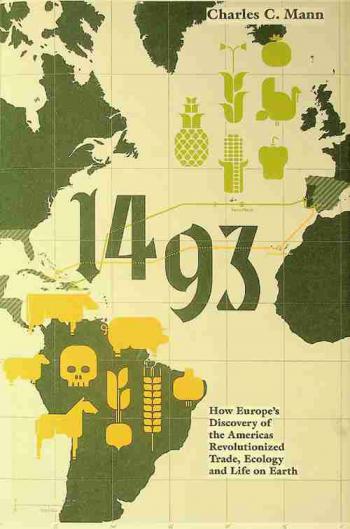
1493 : how Europe's discovery of the Americas revolutionized trade, ecology and life on Earth
\"From the author of 1491--the best-selling study of the pre-Columbian Americas--a deeply engaging new history that explores the most momentous biological event since the death of the dinosaurs. More than 200 million years ago, geological forces split apart the continents. Isolated from each other, the two halves of the world developed totally different suites of plants and animals. Columbus's voyages brought them back together--and marked the beginning of an extraordinary exchange of flora and fauna between Eurasia and the Americas. As Charles Mann shows, this global ecological tumult--the \"Columbian Exchange\"--Underlies much of subsequent human history. Presenting the latest generation of research by scientists, Mann shows how the creation of this worldwide network of exchange fostered the rise of Europe, devastated imperial China, convulsed Africa, and for two centuries made Manila and Mexico City-- where Asia, Europe, and the new frontier of the Americas dynamically interacted--the center of the world. In 1493, Charles Mann gives us an eye-opening scientific interpretation of our past, unequaled in its authority and fascination\"-
Book

Nature and culture in the early modern Atlantic
In the sixteenth-century Atlantic world, nature and culture swirled in people's minds to produce fantastic images. In the South of France, a cloister's painted wooden panels greeted parishioners with vivid depictions of unicorns, dragons, and centaurs, while Mayans in the Yucatan created openings to buildings that resembled a fierce animal's jaws, known to archaeologists as serpent-column portals.In Nature and Culture in the Early Modern Atlantic, historian Peter C. Mancall reveals how Europeans and Native Americans thought about a natural world undergoing rapid change in the century following the historic voyages of Christopher Columbus. Through innovative use of oral history and folklore maintained for centuries by Native Americans, as well as original use of spectacular manuscript atlases, paintings that depict on-the-spot European representations of nature, and texts that circulated imperfectly across the ocean, he reveals how the encounter between the old world and the new changed the fate of millions of individuals.This inspired work of Atlantic, European, and American history begins with medieval concepts of nature and ends in an age when the printed book became the primary avenue for the dissemination of scientific information. Throughout the sixteenth century, the borders between the natural world and the supernatural were more porous than modern readers might realize. Native Americans and Europeans alike thought about monsters, spirits, and insects in considerable depth. In Mancall's vivid narrative, the modern world emerged as a result of the myriad encounters between peoples who inhabited the Atlantic basin in this period. The centuries that followed can be comprehended only by exploring how culture in its many forms—stories, paintings, books—shaped human understanding of the natural world.
eBook

The exploration of North America
Young readers learn about the history of North American discovery and exploration, detailing all of the successes, hardships, dangers, and accomplishments of key figures in exploration history. From the mighty Mississippi to the Rockies, up to Canada and down to Mexico, readers will learn about Columbus, Lewis and Clark, Smith, and many more.
Book

Ancient Ocean Crossings
Paints a compelling picture of impressive pre-Columbian
cultures and Old World civilizations that, contrary to many
prevailing notions, were not isolated from one another
In
Ancient Ocean Crossings: Reconsidering the Case for Contacts
with the Pre-Columbian Americas , Stephen Jett encourages
readers to reevaluate the common belief that there was no
significant interchange between the chiefdoms and civilizations
of Eurasia and Africa and peoples who occupied the alleged
terra incognita beyond the great oceans. More than a
hundred centuries separate the time that Ice Age hunters are
conventionally thought to have crossed a land bridge from Asia
into North America and the arrival of Columbus in the Bahamas in
1492. Traditional belief has long held that earth’s two
hemispheres were essentially cut off from one another as a result
of the post-Pleistocene meltwater-fed rising oceans that covered
that bridge. The oceans, along with arctic climates and daunting
terrestrial distances, formed impermeable barriers to
interhemispheric communication. This viewpoint implies that the
cultures of the Old World and those of the Americas developed
independently. Drawing on abundant and concrete evidence to
support his theory for significant pre-Columbian contacts, Jett
suggests that many ancient peoples had both the seafaring
capabilities and the motives to cross the oceans and, in fact,
did so repeatedly and with great impact. His deep and broad work
synthesizes information and ideas from archaeology, geography,
linguistics, climatology, oceanography, ethnobotany, genetics,
medicine, and the history of navigation and seafaring, making an
innovative and persuasive multidisciplinary case for a new
understanding of human societies and their diffuse but
interconnected development.
eBook