
Catalogue Search | MBRL


Are you sure you want to remove the book from the shelf?

{{itemTitle}}
379
result(s) for
"American Revolution (United States : 1775-1783)"
Sort by:

A short history of the American Revolutionary War
\"Ideologically defined by the colonists' formal Declaration of Independence in 1776, the struggle has taken on something of a mythic character. From the Boston Tea Party to Paul Revere's ride to raise the countryside of New England against the march of the Redcoats; and from the American travails of Bunker Hill (1775) to the final humiliation of the British at Yorktown (1781), the entire contest is now emblematic of American national identity. Stephen Conway shows that, beyond mythology, this was more than just a local conflict: rather a titanic struggle between France and Britain. The Thirteen Colonies were merely one frontline of an extended theatre of operations, with each superpower aiming to deliver the knockout blow. This bold new history recognizes the war as the Revolution but situates it on the wider, global canvas of European warfare.\"--Publisher's website.
BOOK

Sentiments of a British-American Woman
At the time of her death in 1780, British-born Esther DeBerdt Reed—a name few know today—was one of the most politically important women in Revolutionary America. Her treatise \"The Sentiments of an American Woman\" articulated the aspirations of female patriots, and the Ladies Association of Philadelphia, which she founded, taught generations of women how to translate their political responsibilities into action. DeBerdt Reed's social connections and political sophistication helped transform her husband, Joseph Reed, from a military leader into the president of the Supreme Executive Council of Pennsylvania, a position analogous to the modern office of governor. DeBerdt Reed's life yields remarkable insight into the scope of women's political influence in an age ruled by the strict social norms structured by religion and motherhood. The story of her courtship, marriage, and political career sheds light both on the private and political lives of women during the Revolution and on how society, religion, and gender interacted as a new nation struggled to build its own identity. Engaging, comprehensive, and built on primary source material that allows DeBerdt Reed's own voice to shine, Owen Ireland's expertly researched biography rightly places her in a prominent position in the pantheon of our founders, both female and male.
eBook


Revolutionary Backlash
The Seneca Falls Convention is typically seen as the beginning of the first women's rights movement in the United States. Revolutionary Backlash argues otherwise. According to Rosemarie Zagarri, the debate over women's rights began not in the decades prior to 1848 but during the American Revolution itself. Integrating the approaches of women's historians and political historians, this book explores changes in women's status that occurred from the time of the American Revolution until the election of Andrew Jackson.Although the period after the Revolution produced no collective movement for women's rights, women built on precedents established during the Revolution and gained an informal foothold in party politics and male electoral activities. Federalists and Jeffersonians vied for women's allegiance and sought their support in times of national crisis. Women, in turn, attended rallies, organized political activities, and voiced their opinions on the issues of the day. After the publication of Mary Wollstonecraft's A Vindication of the Rights of Woman, a widespread debate about the nature of women's rights ensued. The state of New Jersey attempted a bold experiment: for a brief time, women there voted on the same terms as men.Yet as Rosemarie Zagarri argues in Revolutionary Backlash, this opening for women soon closed. By 1828, women's politicization was seen more as a liability than as a strength, contributing to a divisive political climate that repeatedly brought the country to the brink of civil war. The increasing sophistication of party organizations and triumph of universal suffrage for white males marginalized those who could not vote, especially women. Yet all was not lost. Women had already begun to participate in charitable movements, benevolent societies, and social reform organizations. Through these organizations, women found another way to practice politics.
eBook

Killing England : the brutal struggle for American independence
Told through the eyes of George Washington, Benjamin Franklin, Thomas Jefferson, and Great Britain's King George III, Killing England chronicles the path to independence in gripping detail, taking the reader from the battlefields of America to the royal courts of Europe. What started as protest and unrest in the colonies soon escalated to a world war with devastating casualties. O'Reilly and Dugard re-create the war's landmark battles, including Bunker Hill, Long Island, Saratoga, and Yorktown, revealing the savagery of hand-to-hand combat and the often brutal conditions under which these brave American soldiers lived and fought. Also here are the reckless treachery of Benedict Arnold and the daring guerrilla tactics of the \"Swamp Fox\" Francis Marion.
Book
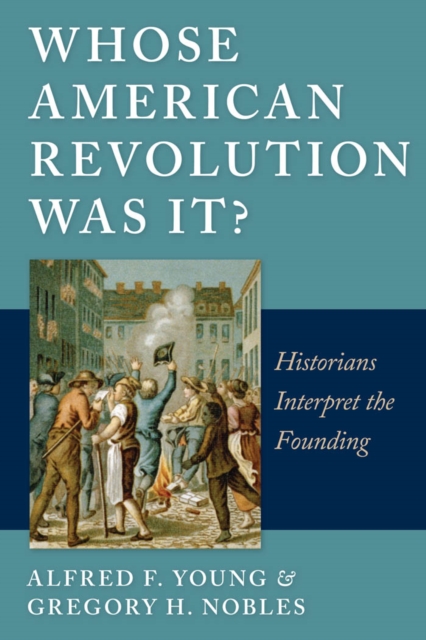
Whose American Revolution Was It?
The meaning of the American Revolution has always been a much-contested question, and asking it is particularly important today: the standard, easily digested narrative puts the Founding Fathers at the head of a unified movement, failing to acknowledge the deep divisions in Revolutionary-era society and the many different historical interpretations that have followed. Whose American Revolution Was It? speaks both to the ways diverse groups of Americans who lived through the Revolution might have answered that question and to the different ways historians through the decades have interpreted the Revolution for our own time. As the only volume to offer an accessible and sweeping discussion of the period's historiography and its historians, Whose American Revolution Was It? is an essential reference for anyone studying early American history. The first section, by Alfred F. Young, begins in 1925 with historian J. Franklin Jameson and takes the reader through the successive schools of interpretation up to the 1990s. The second section, by Gregory H. Nobles, focuses primarily on the ways present-day historians have expanded our understanding of the broader social history of the Revolution, bringing onto the stage farmers and artisans, who made up the majority of white men, as well as African Americans, Native Americans, and women of all social classes.
eBook


America's Founding and the Struggle over Economic Inequality
If, as many allege, attacking the gap between rich and poor is a form of class warfare, then the struggle against income inequality is the longest running war in American history. To defenders of the status quo, who argue that the accumulation of wealth free of government intervention is an essential feature of the American way, this book offers a forceful answer. While many of those who oppose addressing economic inequality through public policy today do so in the name of freedom, Clement Fatovic demonstrates that concerns about freedom informed the Founding Fathers' arguments for public policy that tackled economic disparities. Where contemporary arguments against such government efforts conceptualize freedom in economic terms, however, those supporting public policies conducive to greater economic equality invoked a more participatory, republican, conception of freedom. As many of the Founders understood it, economic independence, which requires a wide if imperfect distribution of property, is a precondition of the political independence they so profoundly valued.Fatovic reveals a deep concern among the Founders - including Thomas Jefferson, Thomas Paine, and Noah Webster - about the impact of economic inequality on political freedom.America's Founding and the Struggle over Economic Inequalitytraces this concern through many important political debates in Congress and the broader polity that shaped the early Republic - debates over tax policies, public works, public welfare, and the debt from the Revolution. We see how Alexander Hamilton, so often characterized as a cold-hearted apologist for plutocrats, actually favored a more progressive system of taxation, along with various policies aimed at easing the economic hardship of specific groups. In Thomas Paine, frequently portrayed as an advocate of laissez-faire government, we find a champion of a comprehensive welfare state that would provide old-age pensions, public housing, and a host of other benefits as a matter of \"right, not charity.\" Contrary to the picture drawn by so many of today's pundits and politicians, this book shows us how, for the first American statesmen, preventing or minimizing economic disparities was essential to the preservation of the new nation's freedom and practice of self-government.
eBook

American Indians and African Americans of the American Revolution--through primary sources
\"Examines the lives and roles of African Americans and American Indians during the American Revolution, including the difficulty of choosing sides in the war and fighting for the Americans and the British\"--Provided by publisher.
Book
After Yorktown
After the Humiliating Defeat at Yorktown in 1781, George III Vowed to Keep Fighting the Rebels and Their Allies Around the World, Holding a New Nation in the Balance Although most people think the American Revolution ended with the British surrender at Yorktown, Virginia, on October 19, 1781, it did not.
eBook